
TEDCO-Backed Companies Generate More Than $9.9 Billion in Economic Output, Independent Study Finds
Source: PR Newswire
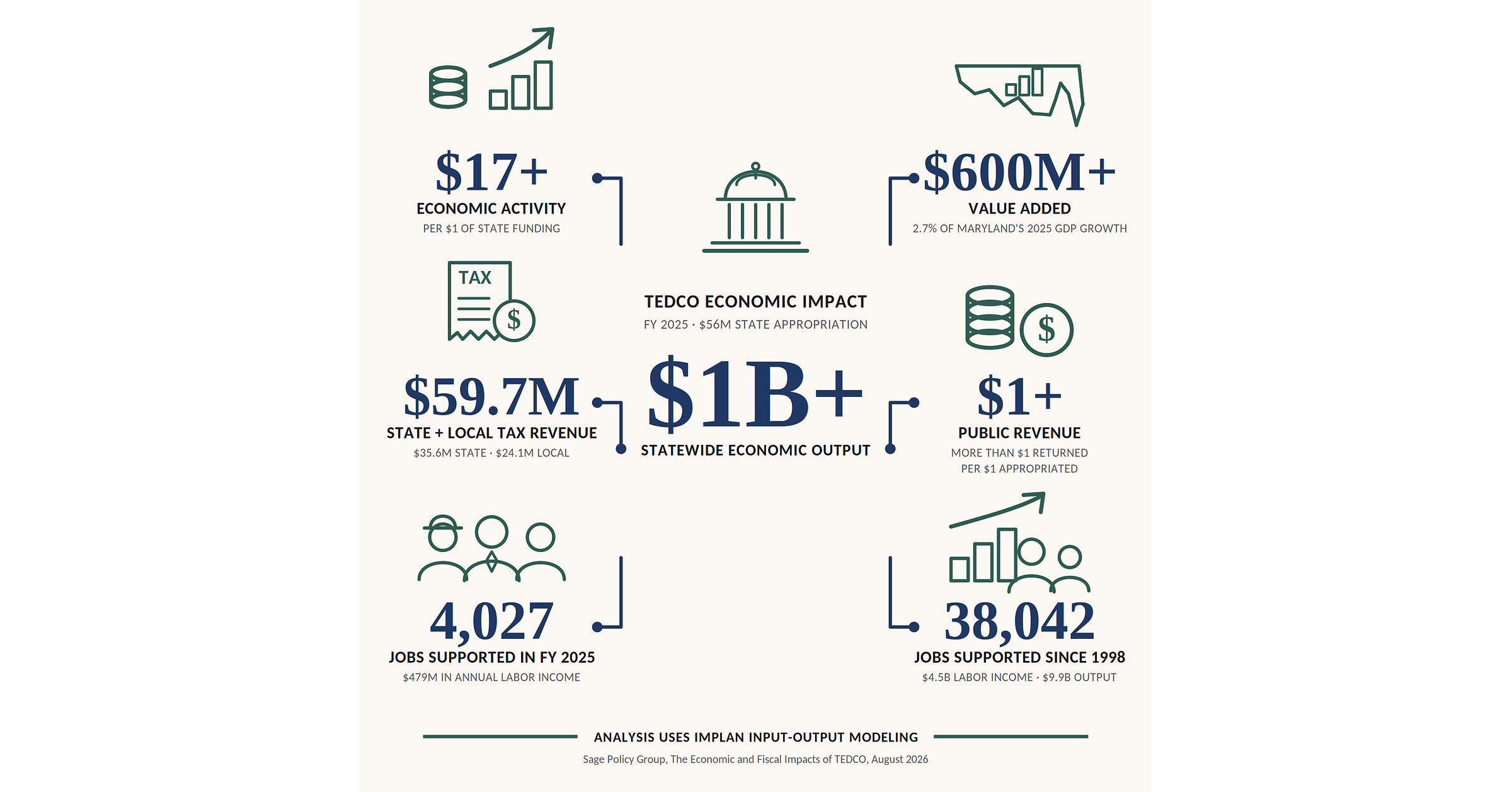
TEDCO's FY2025 economic-impact study found that each $1 of Maryland state funding generated more than $17 in statewide economic activity, supporting over $1 billion of output, 4,027 jobs and $479 million in labor income. TEDCO-supported activity generated nearly $60 million in state and local tax revenue, including $24.1 million for counties and municipalities. The results strengthen the case for continued public innovation funding as Maryland faces more than 46,000 job losses since December 2024 and a projected structural budget gap exceeding $6 billion by 2030.
Analysis
This is not a direct public-equity earnings catalyst; it is principally a state-budget allocation signal and a company-sponsored economic-impact claim. The relevant market mechanism is whether Maryland preserves early-stage commercialization funding while federal employment and procurement exposure weaken: sustained capital could modestly improve the formation and financing environment for private biotech, cybersecurity and defense-technology companies clustered around Baltimore and the I-270 corridor.
The near-term read-through for listed securities is limited. Over 1-3 months, Maryland fiscal negotiations matter more than modeled economic-output multipliers: a broad spending squeeze could reduce co-investment and grant availability, disproportionately pressuring pre-revenue private companies and lengthening their financing cycles. Conversely, protected innovation appropriations could create a small but favorable pipeline effect for regional venture-backed assets, not a material revenue step-up for large-cap public companies.
The non-obvious risk is that fiscal stress shifts policy toward demonstrable near-term tax receipts, favoring later-stage companies and defense-adjacent commercialization over long-duration life-science platforms. That would improve capital access for firms with federal customers but worsen the financing backdrop for early clinical-stage biotech. Treat the report as advocacy rather than independent investable evidence until the underlying methodology, funding base and incremental private-capital mobilization are verified.
Contrarian view: the headline may raise expectations for continued funding precisely when budget arithmetic makes protection difficult. The key falsifier is the enacted Maryland FY27 budget and any change in innovation-program appropriations; absent a measurable increase in program capital or follow-on financings, there is no basis for a public-market rerating.
AllMind Terminal
AI-powered research, real-time alerts, and portfolio analytics for institutional investors.
Request TrialMarket Sentiment
Overall Sentiment
moderately positive
Sentiment Score
0.45
Key Decisions for Investors
- No standalone directional public-equity trade on this release; expected earnings sensitivity for broad technology and biotech benchmarks is immaterial over days to weeks.
- Monitor Maryland FY27 budget negotiations over the next 1-3 months for innovation-program appropriations versus baseline. A material cut would be a negative financing-sentiment signal for regional private biotech and cyber holdings; a protected or expanded allocation is only a watch-list positive until portfolio-company financing data confirm it.
- For private-market exposure, prioritize Maryland-area defense/cyber companies with contracted federal or enterprise revenue over preclinical life-science companies dependent on successive grant rounds; the former should be more resilient if public capital becomes more selective over 6-18 months.
- Use XBI only as a macro liquidity hedge, not as an expression of this development: initiate no position unless evidence emerges of a broader state-led life-science funding expansion or a material deterioration in regional biotech financing.
More News
- Here’s the ‘core economic flaw’ in the AI bull case as stock and bond trades unravel, according to a top economist
- France’s latest debt warning describes a country where governance is breaking down — and even doing too little, too late is barely possible
- Biotech stocks are surging. How investors can play the new drug innovation boom
- Braskem creditors, shareholders near deal on $11bn debt restructuring
- Instacart reportedly discussed selling itself with DoorDash and Uber
- Sudan’s soaring fuel prices make getting by harder for workers