
Looking beyond raw numbers: Farmers Insurance® reveals where animal collisions make up the biggest share of comprehensive losses
Source: PR Newswire
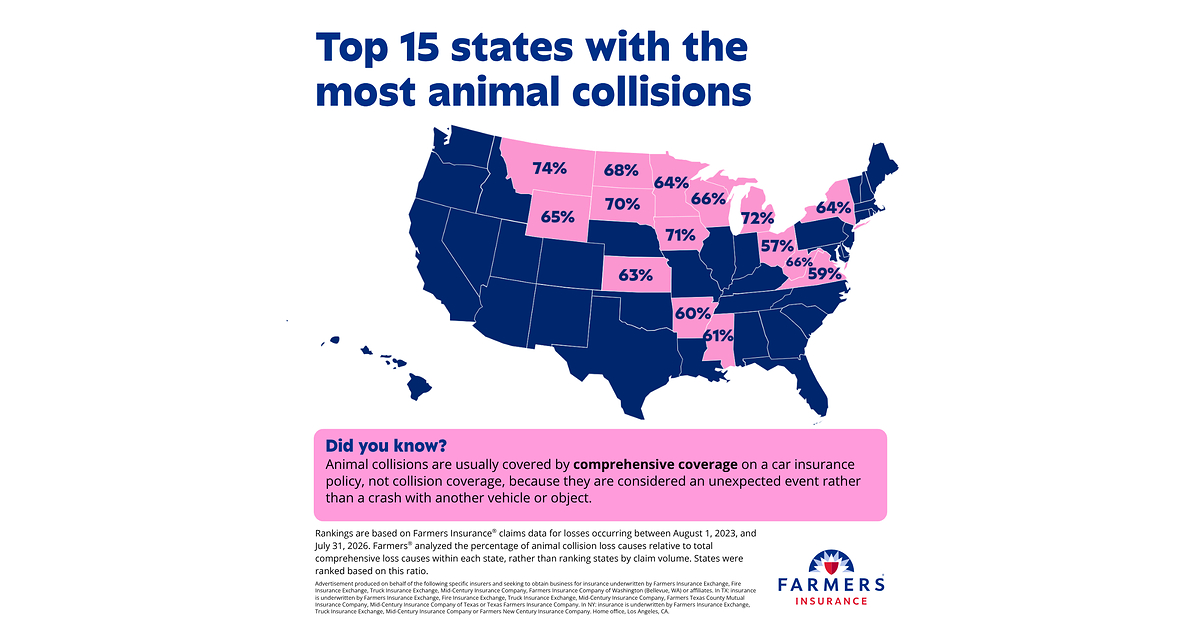
Farmers Insurance analysis of claims from August 2023 through July 2026 found animal collisions represented 74% of comprehensive loss causes in Montana, 72% in Michigan and 71% in Iowa. Collisions occur most frequently from October through December, with rural Upper Midwest and Northern Plains states showing the highest relative wildlife-loss exposure. The release is primarily consumer safety and insurance-coverage guidance, with no material financial disclosures or outlook changes.
Analysis
This is a low-signal, seasonal underwriting datapoint rather than a material earnings catalyst for listed insurers. The relevant exposure is concentrated in personal-auto writers with meaningful Midwest, Plains and rural-state policy density—PGR, ALL, TRV, HIG and KMPR—but comprehensive losses are generally a smaller and more predictable component of total auto loss costs than collision and bodily injury. The principal near-term effect is potential fourth-quarter loss-ratio noise, particularly if deer activity overlaps with early snow/ice events that increase repair severity and towing costs.
The more investable second-order read is for auto-body repair and replacement-parts inflation. Animal strikes disproportionately damage hoods, grilles, headlights, radiators, sensors and ADAS calibration systems; newer vehicle penetration raises average repair severity even if incident frequency is stable. That modestly supports repair consolidators and parts distributors such as CRASH, LKQ and ORLY over 6-18 months, while creating another reason insurers will seek rate increases or tighten underwriting in rural geographies.
Do not extrapolate Farmers' loss-cause percentages into industrywide claim-frequency growth: the metric is a mix effect against other comprehensive causes, not evidence of higher total loss dollars. A tradable insurance signal requires independently reported October-November frequency/severity data, state-level rate filings, or reserve commentary; absent those, any sector move on this release should be faded rather than chased. Thesis is falsified if carrier disclosures show flat comprehensive severity and no incremental rural pricing actions through 4Q results.
AllMind Terminal
AI-powered research, real-time alerts, and portfolio analytics for institutional investors.
Request TrialMarket Sentiment
Overall Sentiment
neutral
Sentiment Score
0.00
Key Decisions for Investors
- No directional trade solely on this release; treat it as a watch item ahead of October-November carrier frequency updates and 4Q earnings.
- Monitor PGR and ALL for adverse-development language or a 100bp+ sequential deterioration in comprehensive/physical-damage loss ratios during 4Q reporting; that would support a 1-3 month underweight versus CB (less personal-auto sensitivity).
- For a 6-18 month quality tilt, prefer long LKQ or ORLY versus short KMX only if used-car repair-cost inflation and insurer repair-severity commentary accelerate; target a 10-15% relative move, with exit if parts pricing and repair-severity growth decelerate for two consecutive quarters.
- Set a weather trigger rather than an animal-collision trigger: a broad early-season snow/ice event across the Upper Midwest alongside elevated repair-shop labor rates would increase the probability of a 4Q auto-loss surprise for PGR/ALL/TRV.
More News
- What next for France as riots rattle markets? Three questions facing investors ahead of more protests
- Looters hit 3,000 French businesses. Within hours, the haul was trending on Vinted under the riot’s date
- As winter nears, heating oil emerges as hurdle for Republicans in US Senate races
- Volvo CEO Says China Market Gone, Luxury Weakness Remains
- ‘There’s nothing temporary about a temporary store’: How Spirit Halloween’s CEO took it from 130 stores to 1,550—and swallowed your mall’s Hot Topic
- Instacart explores potential sale, holds talks with Uber and DoorDash: report