
Denied and Weather-Related Renters Claims Can Avoid Premium Surcharges, Ingram Insurance Group Analysis Finds
Source: PR Newswire
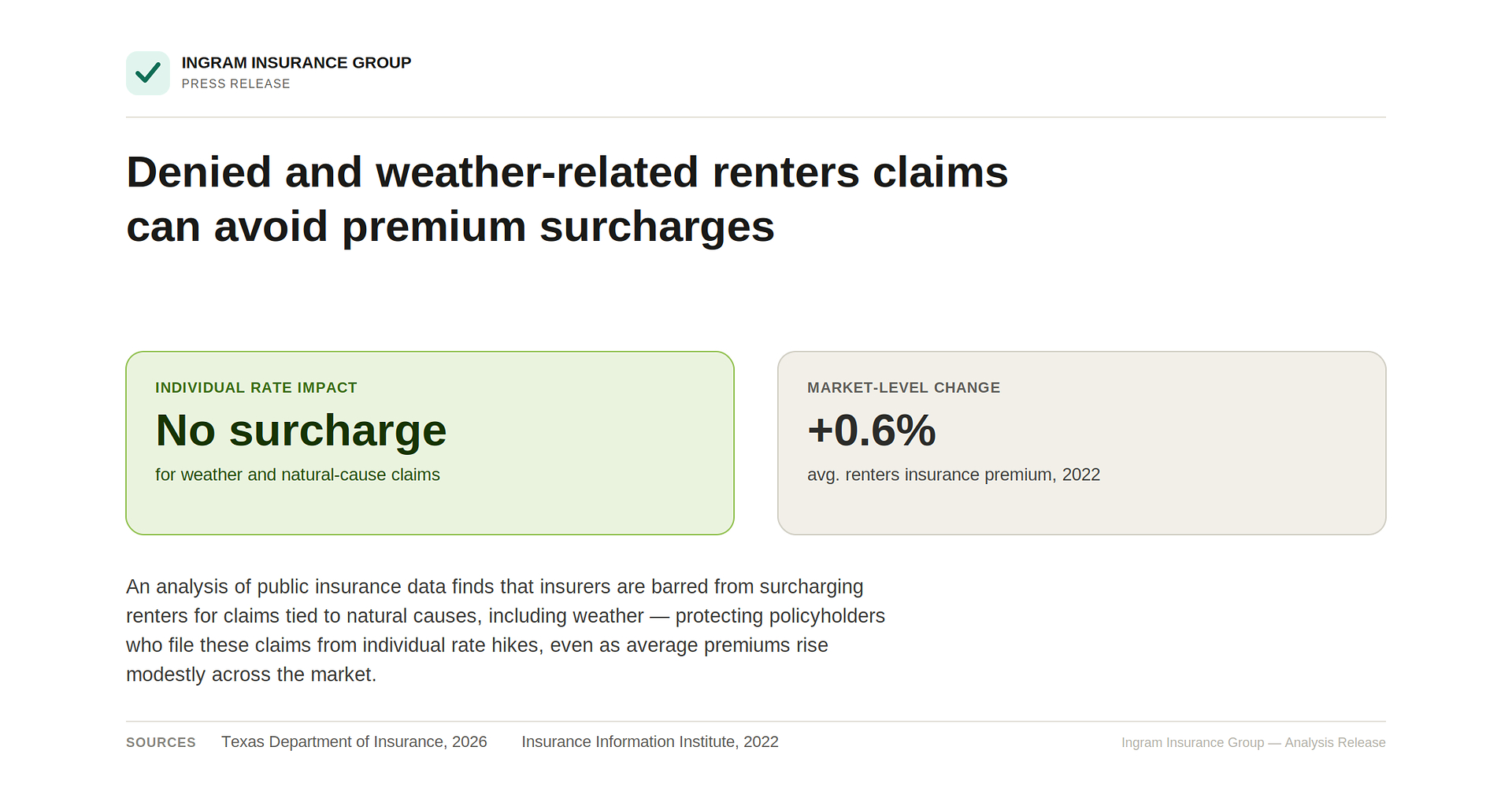
Ingram Insurance Group says renters cannot be individually surcharged for denied claims or weather-related losses under cited Texas insurance rules, although average renters insurance costs rose 0.6% at the market level. Average annual renters premiums were $170 in 2021 and $211 in 2023, substantially less volatile than homeowners premiums, which rose 7.6% to $1,411 in 2021. Separately, Federal Reserve research cited in the analysis estimates higher property-insurance costs can add $7-$12 per month to apartment rents, increasing pressure on renters despite claim-specific surcharge protections.
Analysis
This is not a renters-insurance earnings catalyst; the more investable read-through is that catastrophe-driven property-insurance inflation remains a recurring operating-cost issue for multifamily owners. Landlords can recover part of that expense through rent, but the pass-through is likely weakest in lower-income and supply-heavy Sun Belt rental markets, where affordability constraints limit pricing power. That creates modest margin risk for apartment REITs with meaningful exposure to catastrophe-prone states, including MAA and CPT, versus coastal, supply-constrained peers such as AVB and EQR.
The cited surcharge protections are jurisdiction-specific and should not be extrapolated nationally; moreover, protection from renewal surcharges does not prevent carriers from tightening underwriting, increasing deductibles, reducing coverage limits, or repricing new business. The second-order effect is therefore less about renters-policy premium growth and more about insurer willingness to retain personal-lines exposure after weather losses. Public insurers with meaningful homeowners exposure—ALL, PGR, TRV and CB—remain more sensitive to catastrophe frequency, reinsurance pricing and state-rate approvals than to renters policies.
Over the next 1-3 months, this is primarily a monitoring signal for third-quarter catastrophe losses and 2027 property-insurance renewal expectations, not a standalone trade. Over 6-18 months, repeated severe-weather loss years could widen the operating-cost and rent-growth dispersion between multifamily portfolios in high-risk geographies and portfolios concentrated in supply-constrained urban markets. The thesis is falsified if reinsurance renewal pricing moderates materially, state regulators approve adequate rate increases quickly, or apartment owners demonstrate sustained rent growth sufficient to offset insurance and repair-cost inflation.
AllMind Terminal
AI-powered research, real-time alerts, and portfolio analytics for institutional investors.
Request TrialMarket Sentiment
Overall Sentiment
neutral
Sentiment Score
0.05
Key Decisions for Investors
- No directional trade on renters insurers from this item; the reported market effect is too small and the source is a broker press release relying partly on dated public data.
- Maintain a relative-risk watch: favor AVB/EQR over MAA/CPT for 6-18 months where portfolio review confirms lower catastrophe-insurance cost exposure and stronger ability to pass through operating costs. Reassess following 2027 insurance renewals or if same-store NOI guidance shows insurance expense decelerating.
- For property-and-casualty exposure, monitor ALL, PGR, TRV and CB after major U.S. weather events and at January reinsurance renewals. A long-quality-insurer / short-catastrophe-exposed multifamily pair should only be considered if disclosed catastrophe losses or insurance-expense guidance produce a material valuation divergence.
- Set alerts for apartment REIT quarterly disclosures: insurance-expense growth above rent growth for two consecutive quarters, or reductions in same-store NOI guidance attributable to insurance, would strengthen the MAA/CPT relative underperformance case.
More News
- Instacart reportedly discussed selling itself with DoorDash and Uber
- Sudan’s soaring fuel prices make getting by harder for workers
- Ukraine says Starlink and Starshield high speed restrictions have been lifted
- French police use tear gas and water cannons after some protests turn violent as shopkeepers board up storefronts across Paris
- France Faces New Protests After Week of Violence
- Violence flares in Paris after massive, largely peaceful protests across France