
Bolster AI Exposes Dark Web Counterfeit Currency Operation
Source: PR Newswire
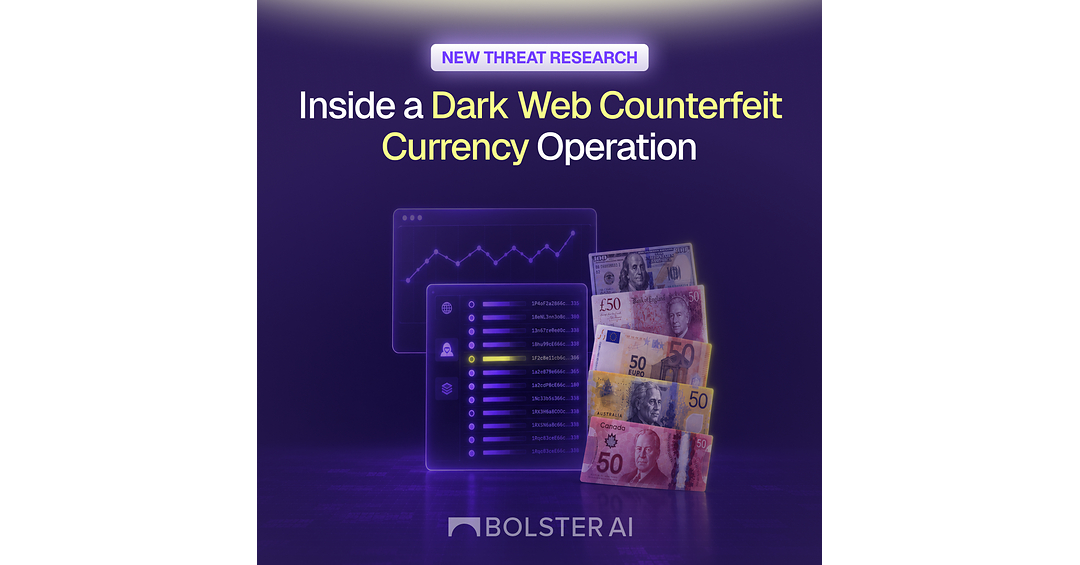
Bolster AI reports a dark-web counterfeit currency operation on the Tor marketplace “ShadowMarket” displaying 57,803 advertised orders, while its payment infrastructure generated fewer than 2,400 orders. It also found the claimed “Multisig Escrow System” lacked multisig/PGP functionality, buyer-seller messaging lacked end-to-end encryption, and payment routing reused ~600 Bitcoin addresses. The research highlights counterfeiters “counterfeiting trust” amid rising counterfeit banknote detections (Bank of England: ~200,000 notes removed in 2025, up from the prior year).
Analysis
This is a signal for the fraud-prevention stack, not a broad cyber-beta catalyst. The economically relevant takeaway is that criminals are industrializing the conversion funnel: manufactured trust, fake escrow, and weak comms are exactly the kind of friction points that create budget urgency for digital risk protection, identity monitoring, and brand-abuse takedown tools. The listed beneficiaries are likely the picks-and-shovels vendors around threat intel and scam disruption rather than endpoint or network security names.
Near term, I would not expect a meaningful earnings revision from this alone; procurement teams usually react only after a visible consumer-loss spike, regulatory inquiry, or a named-brand impersonation event. The more interesting 1-3 month effect is that law-enforcement disruption of these networks can push adversaries toward faster-moving channels and more disposable infrastructure, which increases the value of continuous monitoring and entity-resolution capabilities. That favors vendors whose products ingest external-web, marketplace, and payment-rail signals, especially if they can prove takedown efficacy.
Contrarian view: the market often overprices headline cyber-fraud stories as if they translate directly into SaaS demand. In reality, this is mostly a validation of an already-known problem, and the spend uplift may be lumpy and delayed. The thesis breaks if the next few quarters show no change in fraud-related budget commentary or if buyers keep treating this as a legal/compliance issue rather than a security line item.
AllMind Terminal
AI-powered research, real-time alerts, and portfolio analytics for institutional investors.
Request TrialMarket Sentiment
Overall Sentiment
moderately negative
Sentiment Score
-0.35
Key Decisions for Investors
- No immediate broad trade on the headline; treat this as a watch item for cyber names with fraud/brand-protection exposure (e.g., GEN, CRWD) into the next earnings cycle. I would only get constructive if management explicitly cites higher attach rates or faster pipeline conversion tied to external-threat monitoring.
- If you want expression now, consider a small relative-value long HACK / short XLK pair for 1-3 months. The thesis is that fraud and threat-intel spend is more insulated from IT budget pauses than general software, but keep sizing modest because the read-through is indirect.
- Set alerts on GEN and CRWD for any commentary on identity-theft, scam, or external-web threat modules. Upside requires actual commercial traction; absent that, this remains a sentiment item with limited P&L impact.
- Falsifier for the bullish fraud-security read-through: if the next two major cyber earnings calls do not mention elevated customer demand tied to scams, impersonation, or takedown services, fade the theme and rotate back toward higher-quality secular software.
More News
- Iran’s military says US preparing to resume strikes
- Iran vows 'painful' retaliation as Trump piles on pressure ahead of UN General Assembly meeting
- Chinese biopharma stocks jump as U.S. weighs keeping door open to drug deals
- Oil falls as crude flows remain 'surprisingly strong'
- Bessent proposes U.S.-China AI safety system in talks with China
- US Diesel Tops $6.50 a Gallon as Wars Worsen Global Fuels Crunch
From AllMind Research
- Anthropic IPO Preview: Valuation, Timing, and What to Watch
- Shein After the IPO: Venue, Valuation, and What Must Be Proved
- What AI Research Tools Should a Small Hedge Fund Buy First?
- Document Search Enhancements, AI Enhancements, AI Actions, & Chat Export
- AI Vendor Landscape for Institutional Investment Teams