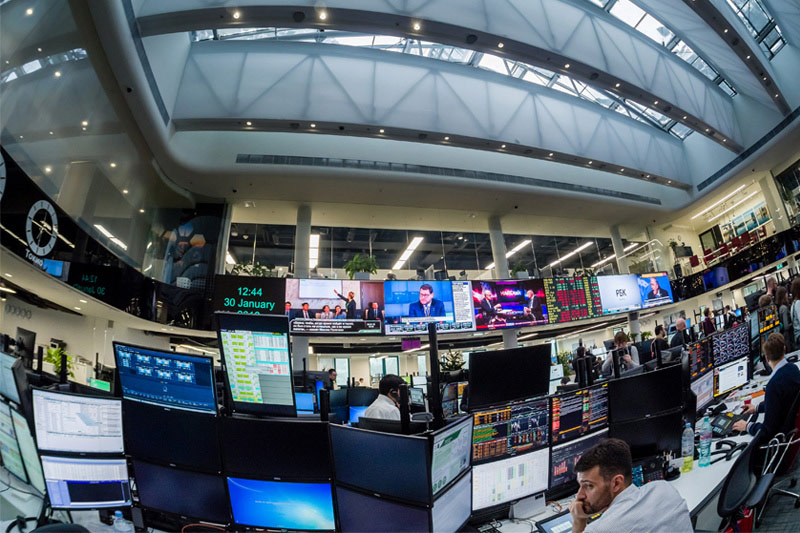
Moscow stocks bounced after the close, with the MOEX Russia Index up 3.46% led by Mining, Power, and Oil & Gas. Polyus jumped 13.44% and ALROSA rose 11.43%, while Volatility Index RVI fell 3.84% to 51.06—suggesting reduced risk premia. Oil rose (Sep WTI +2.50% to $84.54/bbl; Brent essentially flat at $91.52/bbl) alongside steady USD/RUB around 78.56.
The tape is being driven more by factor rotation than by any clean improvement in Russian fundamentals. A lower volatility regime plus firmer commodities tends to reward hard-asset earners first, while domestic growth names lag because they do not get the same immediate earnings translation from oil/gold strength. The key tell is that the currency is not participating: without a weaker RUB, the exporter bid is mostly a multiple/flow event, not yet a durable EPS revision cycle.
For OZON, the move is structurally awkward. Higher oil can pressure logistics, packaging, and consumer purchasing power before it helps top-line GMV, so any broad “risk-on” interpretation is likely overstating the benefit to domestic e-commerce. That makes OZON vulnerable to a reversal if the rally was driven by short-covering and not by actual acceleration in household demand or margin improvement over the next 1-3 months.
The contrarian read is that commodity strength here may be a geopolitical risk premium, not a signal of improving macro confidence. If Brent fails to hold the low-90s or if the RVI bounces back above 60, the current leadership set should fade quickly. The more durable 6-18 month winner remains whichever Russian names can convert hard-currency exposure into free cash flow without depending on local consumer spending; OZON is not in that bucket.
AI-powered research, real-time alerts, and portfolio analytics for institutional investors.
Overall Sentiment
mildly positive
Sentiment Score
0.20
Ticker Sentiment
