
ASUS Ready to Ship NVIDIA HGX Rubin NVL8 Systems
Source: PR Newswire
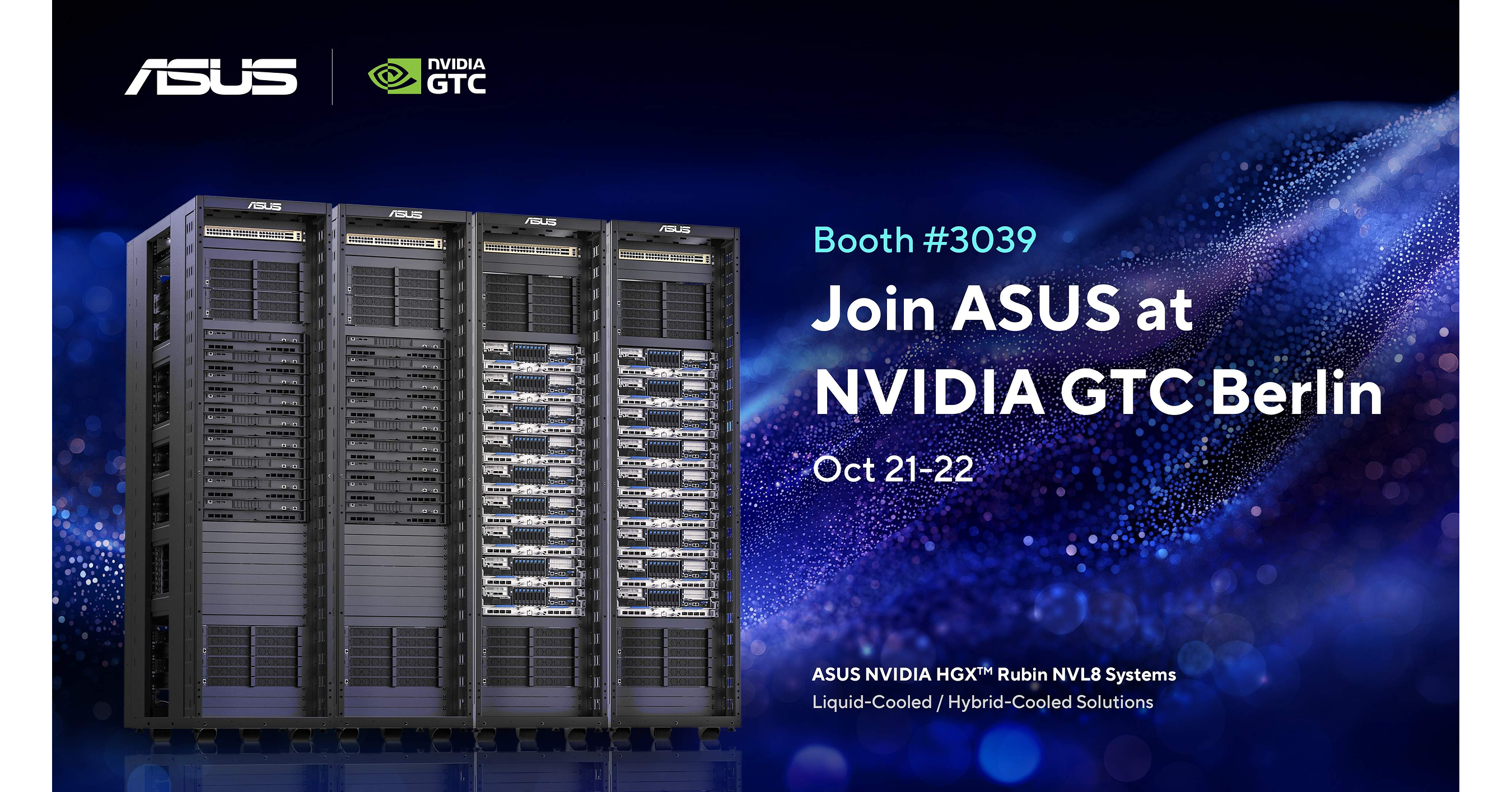
ASUS said its NVIDIA HGX Rubin NVL8 systems are ready to launch in Q4 2026, with partial- and full-rack configurations, including 3U hybrid-cooled and 2U fully liquid-cooled models. At NVIDIA GTC Berlin, it also demonstrated AI factory design and simulation using NVIDIA DSX Sim and presented AI systems spanning data-center infrastructure, development, and edge computing. The announcement highlights product availability plans but provides no pricing or financial targets.
Analysis
The commercial signal is ecosystem validation, not demonstrated demand: a second systems vendor preparing Rubin configurations can broaden deployment choices and reinforce NVIDIA’s platform position, but “ready to launch” plus undisclosed pricing, customer orders, and shipment volumes does not establish incremental GPU revenue. ASUS’s digital-twin pitch addresses a real adoption bottleneck—power, cooling, and facility integration—so successful pre-deployment simulation could pull forward projects; conversely, it cannot remove physical grid and construction constraints. ASUS may gain differentiation against Dell Technologies, Super Micro Computer, and Hewlett Packard Enterprise if validation translates into faster deployments, though no share wins are disclosed.
For NVIDIA (NVDA), the read-through is mildly positive but likely small relative to supply allocation and actual Rubin ramp execution. Intel (INTC) appears only in the air-cooled configuration’s CPU sled; this is a limited attach signal, not evidence of a meaningful recovery in server CPU demand. IBM’s participation in the digital-twin ecosystem is not evidence of a contract or material revenue contribution. No company-specific financial impact is established for ATI.
Near term, treat this as product marketing rather than an earnings catalyst. Over 1–3 months, verify Q4 availability, customer deployments, and whether ASUS publishes orders or design wins. Over 6–18 months, facility power availability and liquid-cooling readiness—not server announcements alone—will govern realized capacity. The contrarian risk is that investors overread another Rubin launch as proof of broad, near-term monetization; the upside case is that more validated suppliers reduce integration friction and widen the addressable buyer pool.
AllMind Terminal
AI-powered research, real-time alerts, and portfolio analytics for institutional investors.
Request TrialMarket Sentiment
Overall Sentiment
mildly positive
Sentiment Score
0.25
Ticker Sentiment
Key Decisions for Investors
- No standalone trade on this announcement. Keep NVDA exposure tied to evidence of Rubin shipments, customer commitments, and supply ramp rather than vendor launch claims.
- Set an alert for ASUS confirmation of Q4 shipment timing, named deployments, and pricing; absent these, classify the announcement as ecosystem validation rather than incremental revenue evidence.
- Monitor data-center power availability, liquid-cooling deployment lead times, and customer capex commentary over the next 1–3 months. Worsening constraints would falsify the near-term deployment thesis even if server supply is ready.
- Treat the INTC read-through as immaterial unless subsequent disclosures show meaningful CPU content or volume in ASUS systems; do not infer a broader server CPU demand inflection from this configuration.
More News
- The U.S. market has never been more focused on one single bet—but AI’s payoff will likely take decades
- CoreWeave’s market confidence erodes as bond yields spike and stock sinks
- SpaceX gives the AI trade a shot in the arm. What it means for our stocks
- To help world gorge on GPUs, Nvidia brings cash bucket to fatten wafer-thin supply chain
- Apple's iPhone Duo in short supply — plus, the 2 stocks fueling an AI rebound
- IBM beats on top and bottom lines as CEO Krishna touts 'Super Intelligence' traction