
Chungnam National University Researchers Develop Model for Predicting Growth Hormone Therapy Responses in Children With Short Stature
Source: PR Newswire
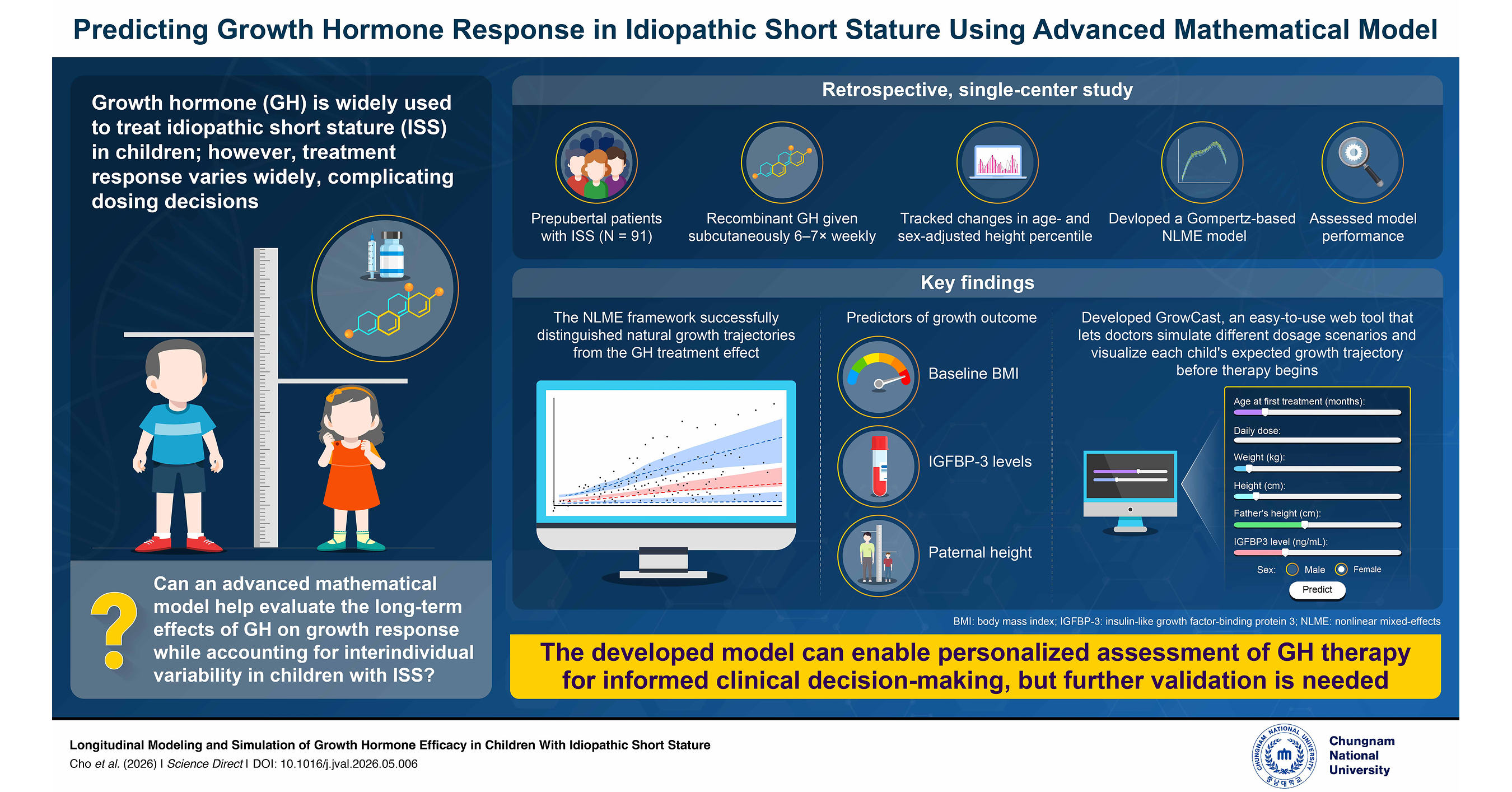
A retrospective study of 91 prepubertal Korean children with idiopathic short stature found mean height percentile rose from 1.26 at baseline to 9.16 over a mean 619 ± 307 days of growth hormone treatment. Its model estimated a growth-response parameter of about 17.2 percentile points, with two-year simulated median outcomes ranging from 4.0% to 31.0% across patient profiles and treatment exposure. Researchers developed GrowCast to model individual growth trajectories, but say it is not a validated dosing tool and requires larger prospective, multicenter studies before routine use.
Analysis
Commercial signal is weak: this is a clinical decision-support hypothesis, not evidence that any somatropin product works better or that treatment volumes will rise. If externally validated, patient-level response estimates could shift competition among GH suppliers toward evidence generation, adherence support, and clinician tools. Better targeting could increase treatment uptake among likely responders, but also discourage treatment in predicted low responders; the net volume effect is ambiguous, while payer scrutiny of cost per meaningful outcome could increase. Near term, no defensible listed-equity read-through is evident. Over 1–3 months, the relevant catalyst is independent validation or a prospective multicenter study, not the model launch itself. Over 6–18 months, routine use would require calibration across populations and evidence that predictions change decisions or outcomes. Key model risks are single-center Korean data, only 91 children, retrospective dose adjustments that can confound dose-response, and simulations that are not proof of treatment benefit. The BMI association should not be interpreted as a causal treatment lever. A contrarian risk is that personalization may narrow the eligible pool and strengthen payer barriers rather than expand the market. Falsification of the adoption thesis: prospective validation fails to reproduce calibration or clinicians do not change treatment choices; confirmation requires independent validation plus demonstrated clinical utility and reimbursement acceptance.
AllMind Terminal
AI-powered research, real-time alerts, and portfolio analytics for institutional investors.
Request TrialMarket Sentiment
Overall Sentiment
mildly positive
Sentiment Score
0.20
Key Decisions for Investors
- No trade on this announcement alone. The study identifies no commercial beneficiary, and it does not establish product-level differentiation or a near-term revenue catalyst.
- Place the story on a 6–18 month watchlist for somatropin suppliers, including Pfizer, Novo Nordisk, and Merck; reassess only if independent validation and clinician adoption emerge. Do not infer ticker exposure from this research item.
- Monitor whether validated response stratification changes treatment initiation, persistence, or payer coverage. Rising uptake among predicted responders could help demand, while exclusion of low responders or tighter cost-effectiveness review could offset it.
- Treat any future claim that higher BMI should guide dosing as a red flag unless prospective evidence establishes causality and safety; the reported association is predictive, not a dosing recommendation.
More News
- Samsung, SK Hynix shares drop as Q3 earnings loom
- DeepSeek set to raise at least $12 bln in Tencent, CATL-led round- Bloomberg
- Security researcher claims to they found KVM guest-host escape flaw
- Brazil Election: Bolsonaro Pushes Lula to Brink as Markets Set to Rally
- SpaceX stock climbs to highest since June, returning Musk to trillionaire status
- Security researcher claims they found KVM guest-host escape flaw