
Miter, the AI Platform for Construction, Raises $40 Million for the Built World
Source: PR Newswire
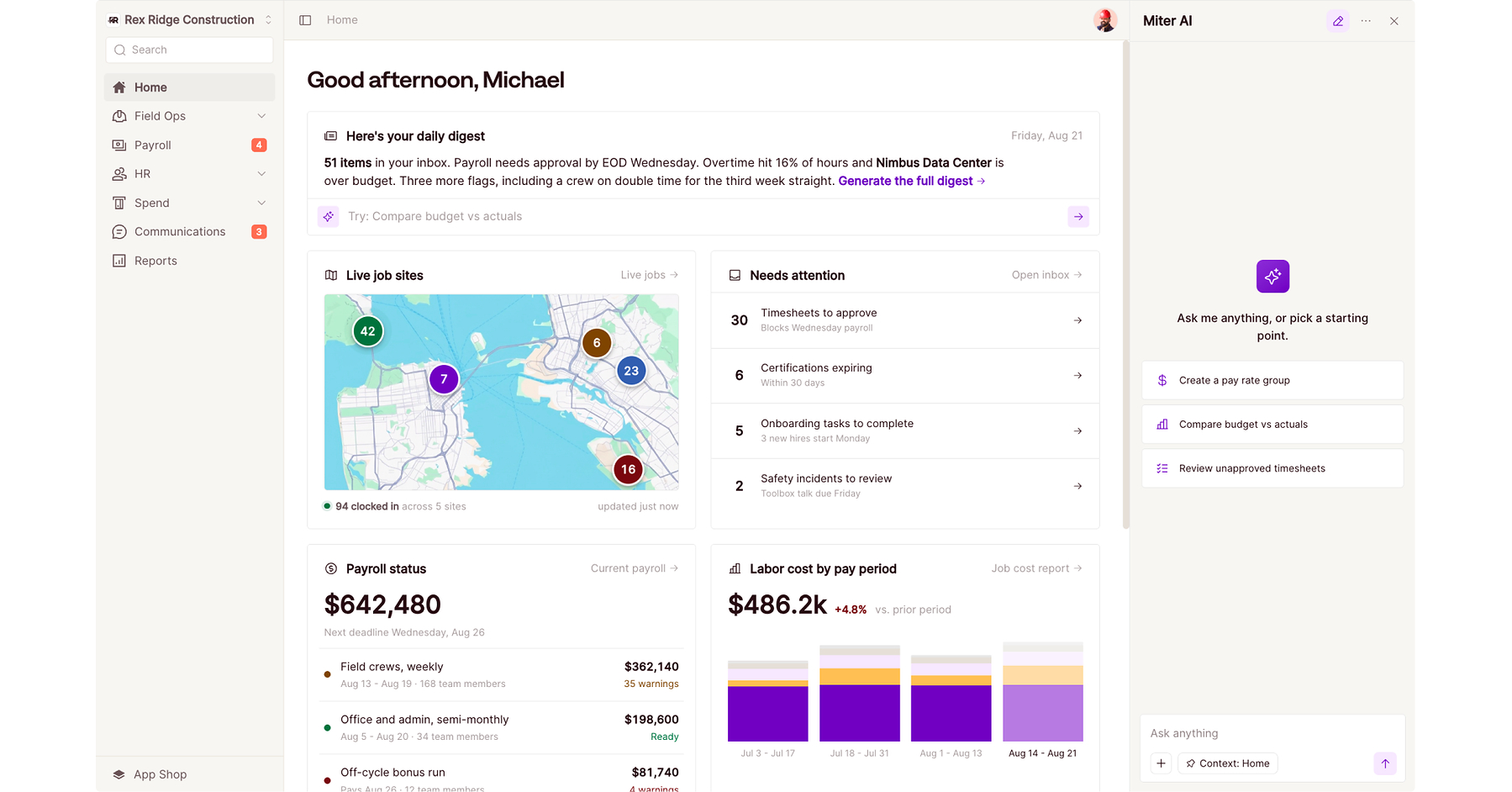
Construction-workforce software provider Miter raised a $40 million Series B led by Battery Ventures, bringing total funding to $78 million. The company, whose platform processes payroll for roughly 2% of U.S. construction workers, has tripled its customer count since its May 2025 Series A and now serves more than 2,000 contractors. Miter will invest the proceeds in AI-driven back-office and jobsite products and expand engineering and U.S. go-to-market teams amid infrastructure, housing, energy and AI data-center construction demand.
Analysis
This is incrementally negative for PCOR, not because a private entrant changes near-term revenue, but because it validates that payroll, compliance, AP and field workflows are converging into a higher-value construction operating-system category. PCOR's valuation durability depends on retaining a premium as the system of record for large contractors; Miter's wedge into labor-cost data creates a credible route to displace point solutions and eventually pressure PCOR's net retention and sales efficiency in specialty trades. The more immediate read-through is favorable for private-market construction software valuations and for TTAN, whose horizontal field-service playbook benefits from investors underwriting vertical SaaS platforms that own payments, payroll and workflow data.
The important second-order issue is data ownership: labor and job-cost records are the earliest indicators of project margin deterioration, change-order exposure and workforce utilization. A vendor that controls those records can attach payments, lending, procurement and insurance products, potentially shifting the profit pool away from pure project-management software. Over 6-18 months, AI features will matter only if they lower administrative headcount or reduce payroll/compliance leakage; generic document summarization is unlikely to sustain pricing. The competitive risk to PCOR becomes material if enterprise contractors begin consolidating payroll and job-cost systems around Miter rather than integrating them into PCOR.
Consensus should avoid treating a venture financing as proof of near-term public-company disruption. Customer-count growth is not evidence of enterprise ACV, retention, implementation success, or positive gross-margin economics, and construction software adoption can be slowed by union, prevailing-wage and multi-state compliance requirements. The actionable catalyst is Miter winning a top-tier contractor deployment or showing payment/financial-services attachment; absent that evidence, this is a watch item rather than a reason to chase a PCOR short.
AllMind Terminal
AI-powered research, real-time alerts, and portfolio analytics for institutional investors.
Request TrialMarket Sentiment
Overall Sentiment
moderately positive
Sentiment Score
0.68
Ticker Sentiment
Key Decisions for Investors
- Maintain PCOR as a 1-3 month underweight/watch short only against a vertical-SaaS basket; do not establish a standalone position from this announcement. Escalate if PCOR reports weaker net retention, longer enterprise implementation cycles, or a reduction in payroll/job-cost integration demand at its next earnings.
- Consider a 6-12 month pair trade long TTAN / short PCOR if the relative valuation spread is near historical median or tighter. TTAN has greater embedded optionality from owning recurring operating workflows and monetizable field-service transactions, while PCOR faces more direct construction-software platform fragmentation; exit if PCOR demonstrates accelerating enterprise retention or material financial-workflow attach.
- Add Miter to diligence alerts rather than treating SHOP or TOST as direct beneficiaries. Required datapoints before any public-market read-through: disclosed ARR, enterprise versus SMB mix, gross retention, implementation duration, and payments/AP penetration.
- Monitor construction labor-cost inflation and publicly funded infrastructure activity over the next 6-18 months. A downturn in nonresidential starts or contractor bankruptcies would reduce software seat growth and make workflow consolidation a cost-cutting catalyst, increasing near-term competitive pressure on PCOR.
More News
- UK Prime Minister Burnham says Iran 'played a part' in British air base incident
- South Korea’s exports hit record high on AI boom
- Asian stocks dip, bonds in focus after torrid September
- RAM supply set to worsen, says Micron, as CEO celebrates ‘much higher’ prices
- Tencent leases 100,000 chips from Oracle for $7 bln- FT
- Greer urges G20 to back Trump tariff agenda, takes aim at China