
Physicians for Informed Consent Files Amicus Brief with U.S. Supreme Court to Protect Religious Freedom for Virtual Public School Students
Source: Newswire
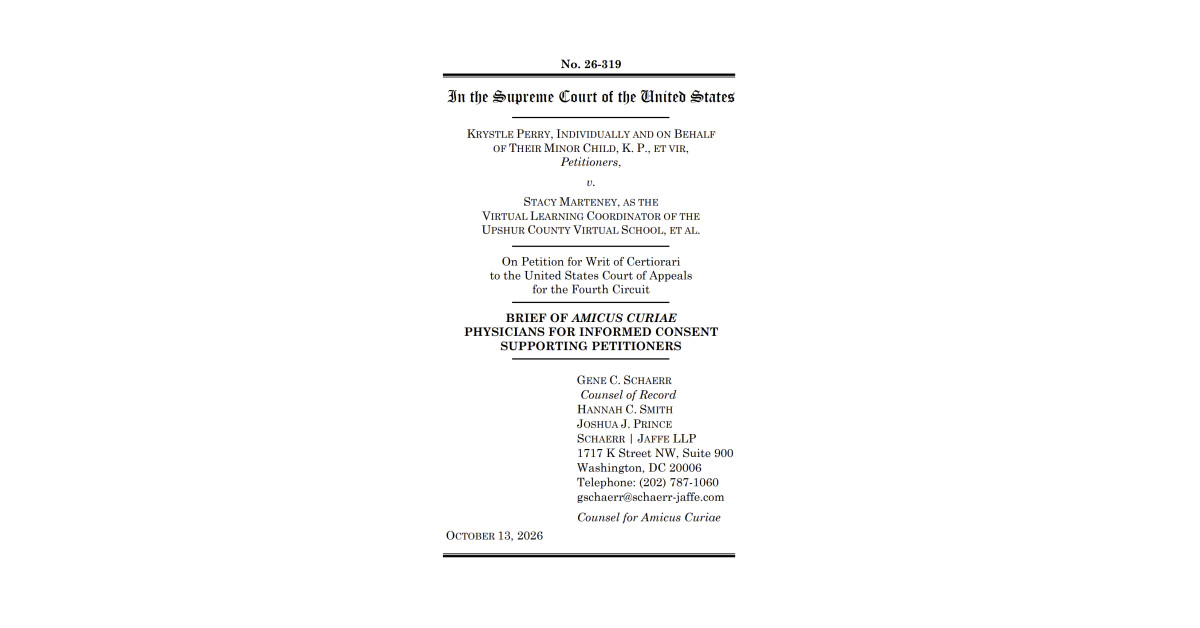
Physicians for Informed Consent filed an amicus brief asking the U.S. Supreme Court to review Perry v. Marteney, a case challenging West Virginia’s vaccination requirement for virtual public school attendance when religious exemptions are unavailable. The family’s daughter is missing one MMR dose and one varicella dose; PIC argues that the state’s different treatment of secular educational arrangements and religious objections raises constitutional questions. The case could have implications in the five states identified as not permitting religious exemptions, but the Court’s review and the case’s outcome remain unresolved.
Analysis
Investment signal is low until the Supreme Court acts: an amicus filing is advocacy, not evidence that the Court will grant review or that the family will prevail. The market mechanism is state policy, not near-term clinical demand. If review is granted and a ruling requires religious exemptions where secular alternatives exist, some states could face pressure to alter school-entry rules. That may marginally reduce demand tied to school mandates for MMR and varicella vaccines, with Merck the most directly relevant commercial name; the actual revenue sensitivity is unverified and should not be inferred to be material at the consolidated-company level. A ruling against the family, or denial of review, would limit the immediate policy catalyst but would not resolve similar disputes elsewhere.
Timing: days to weeks, watch for Supreme Court action on the petition; over 1–3 months, assess any grant and subsequent briefing; over 6–18 months, state-level policy changes matter only if the case produces a broad rule or prompts legislative responses. The contrarian point is that even a plaintiff-friendly decision may be narrower than the advocacy framing suggests: the dispute turns on the state’s treatment of comparable secular and religious educational arrangements, not a general ruling against vaccination requirements. PIC’s vaccine-risk assertions are advocacy claims and do not establish a change in medical guidance or purchasing behavior. Without evidence of mandate changes or meaningful product-level exposure, no directional equity trade is justified.
AllMind Terminal
AI-powered research, real-time alerts, and portfolio analytics for institutional investors.
Request TrialMarket Sentiment
Overall Sentiment
neutral
Sentiment Score
0.00
Key Decisions for Investors
- No trade on the filing alone. Treat this as a low-probability legal-policy watch item, not a near-term vaccine-demand signal.
- Monitor the Supreme Court docket for a certiorari decision and any opinion defining whether virtual public-school attendance is treated differently from homeschooling or other secular alternatives.
- If review is granted, map state exposure and school-mandate policy changes before considering a relative-value position involving Merck; first verify product-level revenue sensitivity and whether any proposed changes extend beyond this fact pattern.
- Falsification/watch points: denial of review or a narrow ruling would weaken the national-policy catalyst; broader state exemption changes or a clear ruling requiring religious accommodation would strengthen it. Reassess only if these developments produce observable mandate or sales effects.
More News
- Bank of America Has 'Accountability' in Face of Fines, Says Moynihan
- US Stocks Tumble as Chip Rout Deepens
- UBS considers leaving Switzerland over capital rule plans, WSJ reports
- Travis Kelce joined an activist group pushing Six Flags to consider a sale. The ‘Final Destination’-style death of a patron poured gas on the fire
- OpenAI bugging suspect allegedly booked one-way trip to Saudi Arabia
- Merck CEO tells CNBC he expects breakthrough cancer vaccine will become faster to make