
Supermicro lanceert samen met IBM en NVIDIA een KV-cacheoplossing die aanzienlijke prestatievoordelen bij AI-inferentie oplevert
Source: PR Newswire
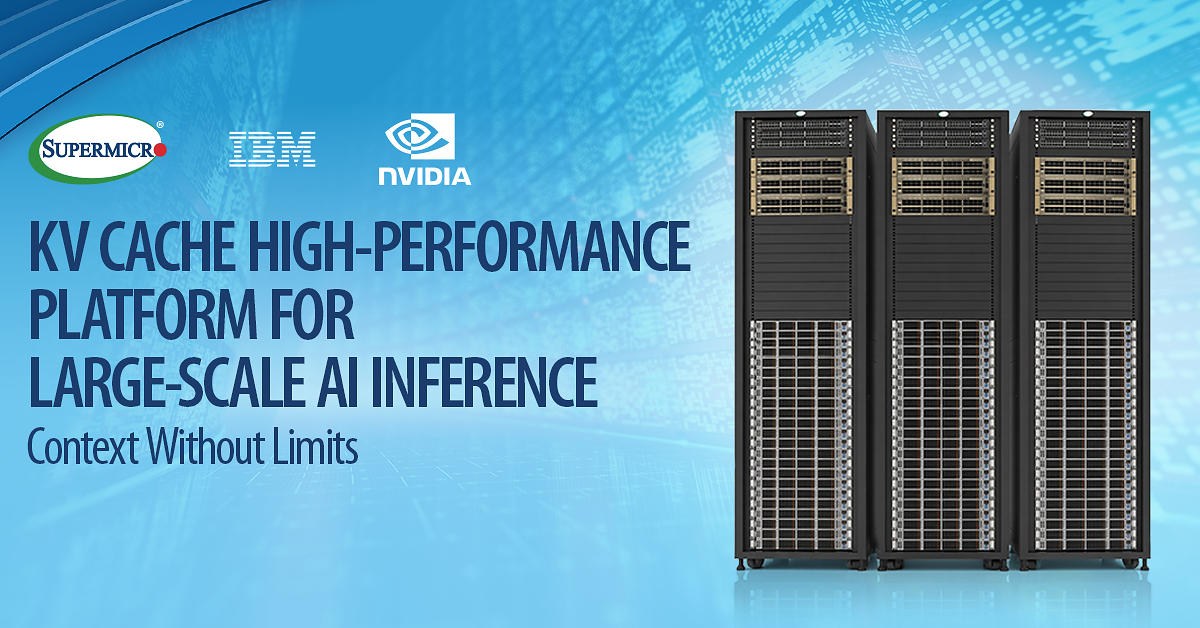
Supermicro, IBM and NVIDIA announced a jointly developed persistent KV-cache storage solution for AI inference; their tests with a 120-billion-parameter LLM showed up to 56× shorter time to first token for 130,000-token prompts. As input length rose from 30,000 to 130,000 tokens, TTFT increased by 0.377 seconds with KV caching versus 29.55 seconds without it. The companies say the integrated system can improve GPU utilization, throughput and scalability; Supermicro says its factory rack integration and deployment services can reduce deployment time from weeks to days.
Analysis
The strategic value is less the headline TTFT result than a shift in the inference bottleneck: externalizing reusable context can improve GPU scheduling, but makes performance more dependent on storage/network latency, contention and cache-hit rates. The quoted benchmark is a vendor-collaboration result, not proof of lower cost per useful response at production scale; workload mix and total system cost remain unverified.
NVIDIA is best positioned to capture ecosystem value: Dynamo and Spectrum-X extend its influence from GPU allocation into the data path, reinforcing platform lock-in. Yet better utilization cuts both ways—if customers serve the same workload with fewer GPUs, near-term GPU demand per deployment could fall. The offset is lower inference cost potentially expanding usage and making long-context agents commercially viable; net GPU demand is a 6–18 month adoption question, not established by this announcement.
SMCI may gain rack-level system pull-through, but the hardware is more replicable than the software/network integration, leaving execution and pricing—not announcement reach—as the earnings test. IBM could benefit from Storage Scale adoption, though the release provides no deployment or revenue evidence. Storage/network vendors such as Dell, HPE, NetApp and Pure Storage face both an expanded addressable workload and stronger NVIDIA-led platform competition.
Over days, treat this as a product/positioning catalyst, not a quantified earnings revision. Over 1–3 months, verify customer deployments, independently reproducible TTFT and throughput under contention, and cost per token including storage/network. The thesis weakens if cache misses or noisy-neighbor effects erase gains, or if customers use utilization gains to defer GPU purchases without enough workload expansion.
AllMind Terminal
AI-powered research, real-time alerts, and portfolio analytics for institutional investors.
Request TrialMarket Sentiment
Overall Sentiment
moderately positive
Sentiment Score
0.55
Ticker Sentiment
Key Decisions for Investors
- Do not chase SMCI on the release alone. Track subsequent orders, storage-server attach rates and gross-margin commentary; absent evidence of scaled customer deployments, treat incremental revenue as unproven.
- Prefer NVDA over a broad AI-infrastructure basket only as a medium-term platform-positioning view, not a near-term earnings call: the thesis is stronger orchestration/network lock-in, tempered by possible lower GPUs required per workload. Reassess if customer deployments show GPU demand displacement without corresponding inference-volume growth.
- Set a 1–3 month verification alert for independently reproduced benchmarks and production economics: TTFT, sustained throughput, cache-hit rate, tail latency under contention, and total cost per token. Failure to preserve gains under realistic workloads falsifies the efficiency thesis.
- Monitor IBM Storage Scale and competing storage/network vendors for named deployments. Without customer counts, recurring software contribution or order disclosure, there is no defensible basis to price a material IBM earnings catalyst or recommend a direct competitor short.
More News
- Magnificent 7 loses $1 trillion. The most eye-popping stats from Thursday's tech stock plunge
- Tech stocks are suffering their biggest selloff since Covid, as investors see premature end to AI datacenter boom
- Wall Street’s best post-midterm rally in 44 years lasted just one day—then $3 trillion vanished as chip stocks plunged over AI fears
- AI stocks plunge after election, driving down US markets
- U.S. stock futures rise after AI rout batters Wall St; payrolls data in focus
- Top Democrats call to rein in AI buildout after midterms sweep: 'National data center moratorium now'