
SEOULTECH Researchers Reveal New Multi-Scale Monitoring Framework for Detecting Hidden Structural Weaknesses in Urban Metro Corridors
Source: PR Newswire
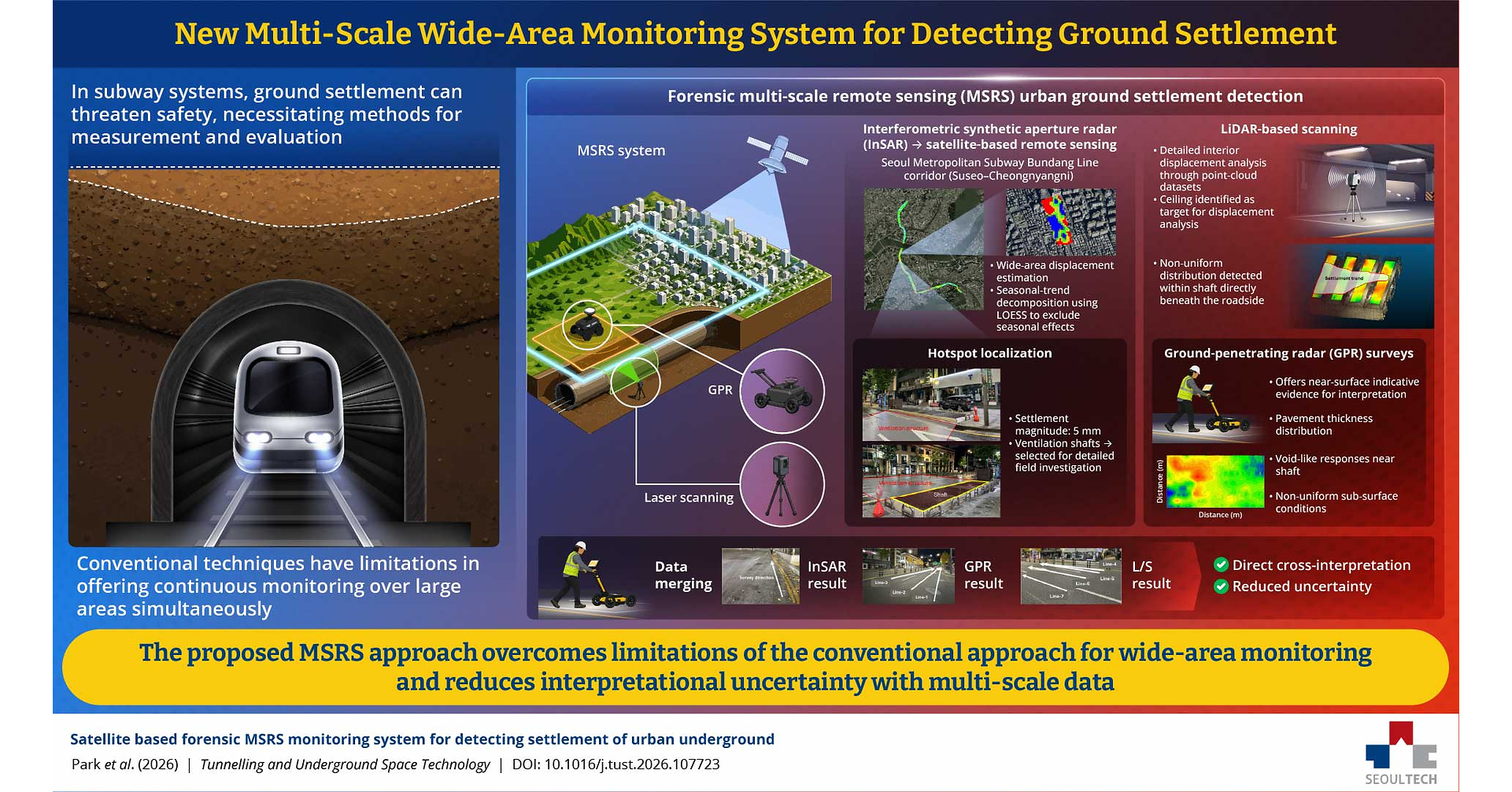
SEOULTECH researchers unveiled a continuous multi-scale remote sensing (MSRS) framework to detect hidden ground settlement in metro corridors, combining satellite InSAR time-series, laser scanning, and GPR. The system was tested on the Seoul Metropolitan Subway Bundang Line over 16km (Suseo to Cheongnyangni), identifying a ventilation shaft with progressive settlement that was validated across all three modalities—reducing interpretational uncertainty. While aimed at proactive prevention of sinkholes and infrastructure failure, the article is a research release with limited direct near-term financial market impact.
Analysis
This is more important as a budgeting signal than as a stock-specific event: continuous, multi-layer monitoring shifts infrastructure spending from episodic repair toward recurring diagnostics and data services. That structurally favors geospatial, surveying, and sensor vendors such as TRMB, PL, and select inspection-tech names, while pure construction/remediation contractors are at risk of margin dilution if they get pulled into lower-priced preventative work before they can scale it.
The second-order effect is on capital allocation inside transit agencies and municipal owners. If this workflow is adopted, the winner is not the contractor that fixes the defect, but the firms that can prove earlier detection, lower false positives, and faster routing to maintenance spend; that can widen the moat for integrated engineering/asset-management platforms like J and ACM. It also nudges insurers and muni-bond investors toward more granular disclosure, which could eventually reward better-maintained operators and punish deferred-maintenance systems through higher funding costs.
The contrarian view is that academia often outruns procurement by 12-24 months, and the hard part is integration, not detection. The adoption curve will likely be slow unless regulators or insurers mandate it; absent that, this remains a pilot-driven niche with limited near-term revenue impact. Falsifiers are straightforward: no follow-on municipal contracts, no evidence of budget conversion, or continued reliance on cheaper periodic inspections rather than continuous monitoring.
AllMind Terminal
AI-powered research, real-time alerts, and portfolio analytics for institutional investors.
Request TrialMarket Sentiment
Overall Sentiment
mildly positive
Sentiment Score
0.12
Key Decisions for Investors
- Long TRMB on a 3-6 month horizon as the cleanest listed proxy for survey/monitoring workflow adoption; enter on any broad industrial pullback. Risk/reward is moderate: limited headline sensitivity, but meaningful upside if procurement converts from pilots to repeatable programs.
- Small long PL / short XLI pair for 6-12 months as an asymmetric basket on recurring satellite-analytics adoption. Thesis fails if PL does not show ARR reacceleration or if public-sector demand remains purely experimental.
- Add J and ACM to a watchlist for maintenance/asset-management contract wins over the next 1-2 quarters; buy only on confirmed backlog conversion, not on the research headline. This is a lower-beta way to express the remediation spend shift.
- Do not short transit operators or civil contractors on this article alone; wait for a regulatory or budgeting catalyst. If municipal capex guidance or inspection mandates do not change within 1-3 quarters, the trade is likely dead money.
More News
- Why is T-Mobile stock tumbling today?
- Why is Verizon stock sliding today?
- SpaceX wants to become a 'major mobile carrier' with low-band spectrum acquisition
- OpenAI projected to bring in $20bn less in revenue than expected
- Soitec climbs 7% as BofA turns bullish on silicon photonics demand
- Schott Pharma drops after Deutsche Bank downgrades on demanding valuation