
Berkshire Hathaway: Warren Buffett Steps Down As Chairman While Higher Rates Turn The Cash Pile Into A Bigger Asset
Source: seekingalpha.com
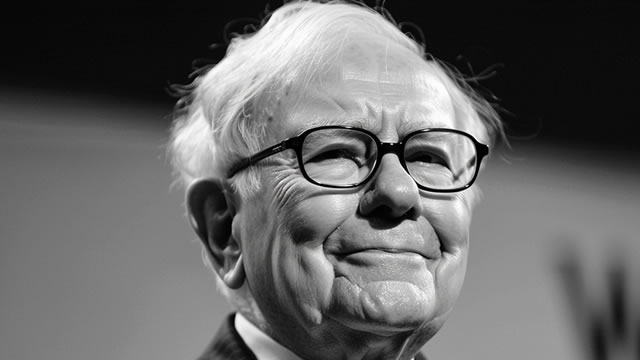
Berkshire Hathaway is positioned to benefit from higher interest rates through $324.9B of Treasury bills repricing upward, supported by a $177.5B insurance float. The article argues succession risk is overstated, citing Greg Abel's 16–18% year-over-year operating-earnings growth, resumed buybacks, and Berkshire's shift to net equity purchases. Berkshire Hathaway Energy, with $148.3B in assets and 11,000 MW of contracted data-center demand, is highlighted as an underappreciated reinvestment-led growth driver.
Analysis
The market is likely already capitalizing a meaningful portion of Berkshire's cash yield, so the nearer-term question is not whether rates help but whether short-end yields remain elevated while deployable opportunities emerge. A 100 bp decline in T-bill yields would create a roughly $3.2B annual pre-tax headwind on the cash portfolio, making the equity sensitive to a faster-than-expected Fed easing cycle unless buybacks or acquisitions offset the earnings drag. This creates a useful distinction: BRK.A can outperform as a quality compounder over 6-18 months, while its relative performance versus financials may soften in the first 1-3 months if front-end rates fall rapidly.
BHE's data-center pipeline is strategically more valuable than a conventional utility growth narrative because contracted load can support multi-year transmission and generation investment, expanding rate base and reducing reinvestment uncertainty. The bottleneck is execution: interconnection, permitting, grid reliability requirements and regulator-approved returns determine whether incremental capex earns utility-like returns or becomes a low-return subsidy to hyperscalers. Public power-equipment suppliers with direct grid exposure—ETN, HUBB and PWR—may capture the earlier and more visible earnings upside from data-center electrification, while BHE's value remains embedded inside BRK.A.
The contrarian issue is capital allocation rather than succession. A rising repurchase cadence would signal management sees intrinsic value above the opportunity cost of cash, but it also implies a thin acquisition pipeline; conversely, a large acquisition can be strategically accretive yet initially dilute Berkshire's per-share cash-yield advantage. Watch quarterly operating earnings excluding investment marks, share count, BHE capex/rate-base guidance, and cash balances rather than treating management-transition commentary as a standalone catalyst.
AllMind Terminal
AI-powered research, real-time alerts, and portfolio analytics for institutional investors.
Request TrialMarket Sentiment
Overall Sentiment
moderately positive
Sentiment Score
0.58
Ticker Sentiment
Key Decisions for Investors
- Accumulate BRK.A on broad-market or rate-cut-driven weakness over a 6-18 month horizon; size as a lower-beta compounder rather than a pure rates trade. Thesis is impaired if operating earnings ex-investment gains decline for two consecutive quarters without offsetting per-share buybacks or clearly accretive deployment.
- Pair trade for the next 3-6 months: long BRK.A / short KRE if recession risk rises and the Fed begins cutting aggressively. Berkshire's diversified underwriting, liquidity and non-bank earnings base should be more resilient than regional-bank net-interest-income and credit exposure; exit if the 2-year Treasury yield stabilizes or rises materially.
- Express the more immediate AI-power-grid capex transmission through long ETN or PWR rather than adding BRK.A solely for data-center exposure. Reassess after quarterly backlog and margin updates; a sustained deterioration in utility order growth or project conversion would falsify the grid-spend thesis.
- Set an alert around a 75-100 bp fall in 3-month Treasury yields: reassess BRK.A earnings sensitivity and avoid adding solely on cash-income assumptions if management has not increased repurchases or announced a credible deployment path.
More News
- Greg Abel Recently Plowed $4.2 Billion Into Warren Buffett's Favorite Stock, and It Wasn't Apple
- Wall Street Week Ahead
- Bloom Energy’s "Time-to-Power" Moat
- Berkshire Hathaway: The World Isn't Ready For Warren Buffett's Successor
- Warren Buffett Steps Down as Chairman of Berkshire Hathaway. 3 Predictions for What Comes Next Under CEO Greg Abel.
- Berkshire Hathaway's Favorite Artificial Intelligence (AI) Stock Looks Like a Genius Buy Now
From AllMind Research
- Anthropic IPO Preview: Valuation, Timing, and What to Watch
- Shein After the IPO: Venue, Valuation, and What Must Be Proved
- What AI Research Tools Should a Small Hedge Fund Buy First?
- AI Research Systems for Hedge Funds: A Pilot Design
- Weekly Update: New Reporting Features, UI Improvements, and Chat Optimizations