
Waystar Launches New Agentic Solutions Transforming AI Into Action Across the Revenue Cycle
Source: PR Newswire
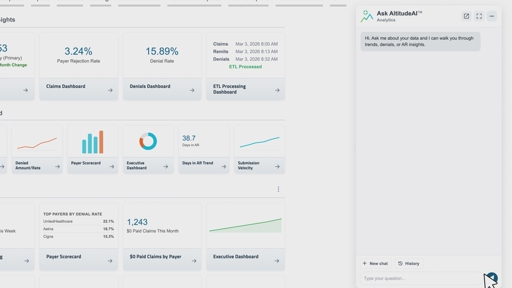
Waystar unveiled new Waystar AltitudeAI agentic capabilities aimed at an autonomous healthcare revenue cycle, including autonomous claim resubmission and AI-driven conversational analytics. The company cites potential operational improvements of up to a 75% reduction in time spent on data analysis, ~25% reduction in clinical documentation review time, and faster progression of eligible denied/rejected claims with minimal human intervention. Overall, this is a product/innovation update with potential medium-term efficiency and reimbursement benefits rather than immediate financial guidance.
Analysis
This is more of a proof-of-capability event than a near-term earnings inflection. The market should focus on whether the AI layer actually converts into fewer touches per claim, lower days sales outstanding, and higher net retention; if those metrics do not show up in customer cohorts, the announcement stays in the “nice demo” bucket and gets little multiple support. The first-order upside is modest, but the second-order value is in embedding Waystar deeper into provider workflows, which can raise switching costs and make future upsells harder for competitors to dislodge.
The competitive read-through is mixed: true autonomous resolution is harder to replicate than generic chatbot features because it depends on payer-specific rules, historical transaction data, and workflow integration. That said, if this works, payers will likely tighten denial logic and standardize exceptions, which can blunt the long-run monetization of the feature and push more of the economic gain back to providers rather than the vendor. In other words, the moat is data and distribution, not the model itself.
Catalyst path is mostly 1-3 months: conference demos, pipeline commentary, and next-quarter adoption metrics. The key falsifier is a lack of measurable lift in claim resolution/collections or any evidence that the AI feature increases implementation burden, compliance risk, or customer support costs. Over 6-18 months, the story only matters if it improves Rule of 40 dynamics; otherwise the market will treat it as incremental product noise.
Contrarian view: consensus may be overestimating how much of the efficiency gain accrues to Waystar versus providers. If adoption is real but pricing power remains weak, the company can win usage without meaningfully expanding margins, which caps upside to the stock. INSO looks like a no-read-through unless it has direct exposure to healthcare workflow automation; otherwise this is primarily a WAY-specific execution test.
AllMind Terminal
AI-powered research, real-time alerts, and portfolio analytics for institutional investors.
Request TrialMarket Sentiment
Overall Sentiment
mildly positive
Sentiment Score
0.25
Ticker Sentiment
Key Decisions for Investors
- Small tactical long WAY on a 3-5% post-event pullback; 1-3 month horizon, with the thesis invalidated if next quarter shows no improvement in adoption, AR days, or net revenue retention.
- Pair trade: long WAY / short EXLS over the next 1-3 months to express the view that deeper workflow automation should win share from service-heavy healthcare ops platforms; cover the short if EXLS proves it can bundle AI without margin leakage.
- Do not chase the headline move with calls; wait for the next earnings print to see whether management can quantify ROI rather than showcase product features.
- Set an alert on payer response language and denial/rework metrics: if resubmission success rates plateau or payers change rules to reduce auto-rework, take profits on WAY into strength.
More News
- Nvidia GPUs are everywhere. Here are the ways companies are accessing them
- Bank of America is bullish on these top stocks ahead of earnings
- As companies pour billions into Earth-based AI infrastructure, Google is taking the data center race off-planet
- AI's Supercharging a Scam Economy Bigger Than the Cocaine Trade
- How U.S. know-how is fracking Australia into a gas boom, from Texas oilmen to Trump’s energy secretary
- The world needs Ukraine’s grain. Its farmers are running out of reasons to plant
From AllMind Research
- Anthropic IPO Preview: Valuation, Timing, and What to Watch
- Shein After the IPO: Venue, Valuation, and What Must Be Proved
- What AI Research Tools Should a Small Hedge Fund Buy First?
- Capital Intensity as Gravity: The AI Trade Enters Its Industrial Era (Looking at Q3 2025 Earnings in Tech)
- AI Portfolio Monitoring: Build an Alert Policy Analysts Can Audit