
SDMC presenta servicios de IA para el hogar implementables en IBC 2026
Source: PR Newswire
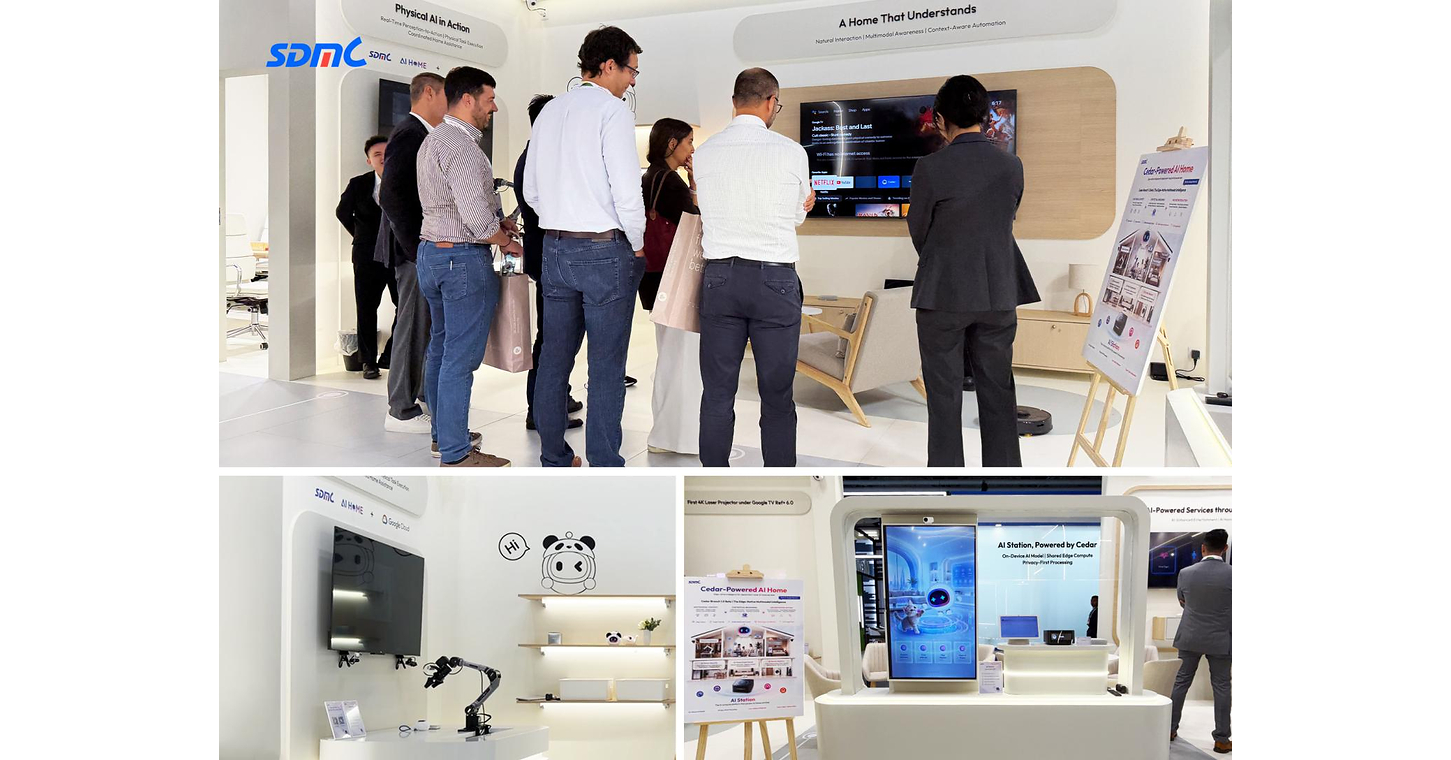
SDMC unveiled a deployable home-AI architecture at IBC 2026, centered on its Cedar multimodal model, Cedar Agent and AI Station shared edge-computing platform. The company is collaborating with Google Cloud through its Physical AI Proactive Acceleration Program, while AI Station uses NVIDIA Jetson T5000 hardware to support shared AI workloads across operators, businesses and premium homes. SDMC aims to enable scalable entertainment, security, network-management and future physical-AI services without requiring dedicated high-performance AI hardware at every endpoint.
Analysis
This is not yet a material earnings event for GOOG or NVDA: the relevant economic question is whether carrier deployments convert into recurring software, inference, and edge-hardware attach rates rather than remaining a trade-show reference design. For GOOG, the upside is strategic distribution of Gemini into operator-managed homes, but the revenue pool will be constrained if local inference reduces cloud-token consumption. For NVDA, shared edge compute can create a new appliance category, although unit volumes are likely low until operators establish a subscriber monetization model.
The more important second-order pressure falls on legacy broadband gateways and set-top-box vendors whose differentiation has been hardware cost and video aggregation. If operators can sell network optimization, security, and home automation as a bundled AI service, cable and telecom providers such as CMCSA, CHTR, and European incumbents may reduce churn and truck-roll expense; conversely, the savings could be competed away through lower broadband pricing. Qualcomm and Broadcom remain better positioned than pure CPE assemblers if AI functionality migrates into mass-market gateway silicon rather than a premium shared-compute hub.
Near term, this is a low-conviction sentiment datapoint, not a catalyst for either mega-cap. The 1-3 month catalyst path is pilot disclosure with a named operator, deployment scale, and commercial terms; without those, the market should assign little value to claimed ecosystem validation. Over 6-18 months, the thesis becomes investable only if operators report measurable reductions in support calls or churn and can price an AI tier above incremental cloud, support, and hardware subsidies.
The consensus risk is assuming that privacy-led edge AI automatically improves economics. Edge architectures shift cost from centralized cloud infrastructure to operator capex, installation complexity, device refresh cycles, and on-premise support; this can make the proposition unattractive for price-sensitive broadband customers. A named multi-country operator contract, disclosed unit commitments, or evidence of sustained AI-service ARPU would falsify the "demo-only" view; repeated pilot extensions without revenue disclosure would reinforce it.
AllMind Terminal
AI-powered research, real-time alerts, and portfolio analytics for institutional investors.
Request TrialMarket Sentiment
Overall Sentiment
moderately positive
Sentiment Score
0.48
Ticker Sentiment
Key Decisions for Investors
- No new directional GOOG or NVDA position on this announcement; treat it as non-material until SDMC or an operator discloses contracted deployments, unit volumes, and recurring service economics. Reassess within the next two reporting cycles rather than chasing any event-driven strength.
- Create a 1-3 month alert on 00901.HK for a named tier-1 operator pilot or purchase order. A position is only actionable after confirmed commercial volume and gross-margin disclosure; absent this data, liquidity and micro-cap execution risk dominate the potential upside.
- Monitor CMCSA and CHTR quarterly disclosures for customer-service expense, broadband churn, and equipment-capex trends. Consider a long CMCSA/short CHTR relative trade only if one operator demonstrates a measurable AI-enabled operating-cost advantage or premium-tier uptake; a broad broadband pricing response would invalidate the spread thesis.
- For semiconductor exposure, prefer NVDA over undifferentiated CPE hardware suppliers only after evidence that shared edge appliances scale beyond premium households. The key falsifier is an operator preference for lower-cost Qualcomm or Broadcom-integrated gateways, which would limit accelerator content per home.
More News
- Crusoe raises $3.9B to build massive data centers and small modular “AI factories”
- Jensen Huang says Nvidia will sell twice as many chips next year
- Warsh says AI’s hyperscalers are part of why your borrowing costs are rising: ‘The competition for capital is real’
- AI coding agents' 0-click RCE flaw could hand attackers keys to the kingdom
- What an Oscar-winning movie can teach us about investing through the AI slowdown debate
- Waymo to bring autonomous ride-hailing to Singapore in 2028