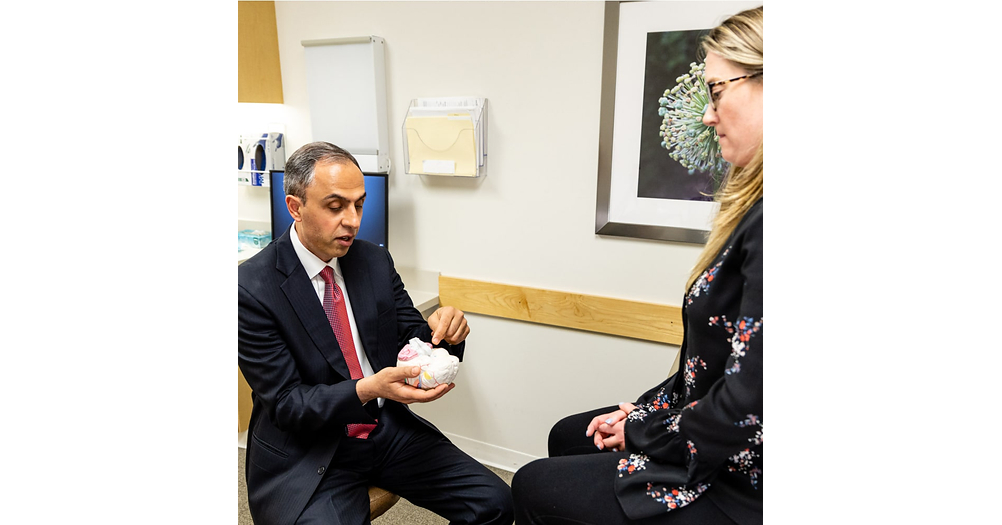
Article highlights that Dr. Aaron Cohen-Gadol has performed 7,500+ complex brain surgeries and pioneered fluorescence-guided glioma resection to better distinguish tumor margins and preserve neurological function. It also describes additional intraoperative technologies including awake brain mapping, real-time mass spectrometry margin assessment, and AI-assisted 3D surgical planning to support maximal safe tumor removal. This is primarily patient/clinical information and is unlikely to move markets.
This is not a revenue event for the named tickers; it is a reputation-and-referral story with almost no direct public-market transmission. The economic value sits with the surgeon’s practice and the host hospitals, which can capture high-acuity referrals, higher case complexity, and more downstream imaging/pathology/ICU utilization, but that is too diffuse to underwrite an immediate equity trade.
The second-order winner set is the medtech stack behind complex neurosurgery: navigation, imaging, fluorescence adjuncts, and planning software. But the addressable spend is tiny relative to the installed base, and adoption is surgeon-dependent, so the market should not extrapolate one high-profile practice into a broad capex cycle without corroborating procurement data or multi-center outcomes. Community hospitals and lower-volume neurosurgeons are the real losers structurally as these cases continue to centralize at super-specialist centers.
The key catalyst is not the PR itself but published evidence: shorter OR time, higher extent-of-resection, fewer deficits, or improved length of stay would matter over 6-18 months and could justify incremental spend by academic centers. Falsifiers are straightforward: if outcomes are indistinguishable from standard techniques, if payors resist out-of-network specialty referrals, or if hospital capex stays flat, the ‘AI + fluorescence’ narrative remains marketing, not monetizable demand.
Contrarian view: the market tends to overprice AI in surgical settings because it confuses workflow augmentation with autonomous decision value. In glioma surgery, operator skill and case volume still dominate the P&L, so the likely alpha is in center-of-excellence density, not in a sudden uplift to software/IP vendors. For the named tickers, there is no clean edge here; any move should be faded unless a subsequent filing, earnings call, or clinical readout confirms actual demand.
AI-powered research, real-time alerts, and portfolio analytics for institutional investors.
Request TrialOverall Sentiment
mildly positive
Sentiment Score
0.15
Ticker Sentiment
