
Canstar Resources Intersects 15.6 Metres of Massive Sulphide Grading 2.3% CuEq at Mary March, Including 9.75 Metres at 3.3% CuEq
Source: feeds.newsfilecorp.com
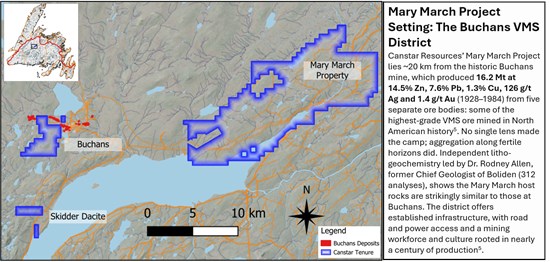
Canstar Resources reported the widest massive sulphide intercept at its Mary March VMS project: 15.6m at 2.3% CuEq (including 9.75m at 3.3% CuEq) in drill hole MM-26-42, with the system described as open along strike and at depth. The company also confirmed additional visually logged sulphide mineralization in other holes and expects remaining assays through September, followed by mid-September BHEM surveys and a fall drill campaign targeted to start in October. Earn-in partner VMS Mining advanced an additional $2.0M ahead of schedule (total funding $4.0M, including $3.5M in 2026), supporting the next phase of drilling.
Analysis
The economic signal here is less about the intercept itself and more about partner behavior: VMSC putting up capital ahead of schedule implies the joint venture is buying optionality on a larger system, which lowers near-term financing risk for ROX/CSRNF and raises the odds of follow-on drilling without punitive dilution. That matters because in junior VMS names, the equity story is usually dictated by the next round of meters, not by a single hole.
The real catalyst stack is over the next 3-8 weeks: assays, BHEM, then rig allocation for an October program. If BHEM outlines off-hole conductors, the market will start pricing a genuine lens cluster rather than isolated massive sulphide pods, which is the difference between a one-day spike and a multi-month rerate. If the conductor picture is weak or the pending assays narrow materially, the move likely fades back to a financing trade.
Contrarianly, the consensus will likely overweight the visible sulphides and underweight the unresolved geometry: true width, continuity, recoveries, and whether the fault-bounded intervals are economic rather than merely geologically exciting. The Glencore royalty conversion is structurally positive but financially small; its main value is cleaning up the cap table and improving future transactionability, not lifting NAV today. On balance, this is a positive de-risking event, but still a high-beta exploration tape with a low information bar to disappoint.
AllMind Terminal
AI-powered research, real-time alerts, and portfolio analytics for institutional investors.
Request TrialMarket Sentiment
Overall Sentiment
moderately positive
Sentiment Score
0.35
Ticker Sentiment
Key Decisions for Investors
- ROX/CSRNF: buy a starter position only on a pullback after the initial news-driven bounce, then add on September assay confirmation if MM-26-41/43/44 show continuity or BHEM identifies a conductive target; thesis breaks if assays come in materially narrower than implied or if the October rig slips.
- ROX/CSRNF: do not chase full size on the headline; treat this as a binary exploration catalyst with a 1-2 month window, where upside is a discovery rerate but downside is a typical junior fade if follow-up data fails to extend mineralization.
- GLNCY: no actionable trade from the 2% NSR conversion; the ownership cleanup is strategically helpful for the project but too small to matter at the corporate level, so avoid forcing a Glencore read-through.
- Watch item: if the market holds ROX/CSRNF above the post-release high into the assay window, that suggests the street is beginning to price a system, not just a hole; if it loses the breakout before assays, fade the move.
- If BHEM is delayed or drill-rig availability pushes the fall campaign out, reduce exposure quickly; for this name, schedule risk is a direct valuation risk because the market will move on the next meters, not on geology narratives.
More News
- Cata-Kor Enters Physical Retail with Target Launch, Bringing Its NAD⁺ Longevity Line to Stores Nationwide
- Musk says Terrafab chip factory could outperform rivals despite challenges
- Nvidia GPUs are everywhere. Here are the ways companies are accessing them
- Stocks saw new highs and big declines: How the volatile AI trade moved last week's market
- Will Warner Bros. kill Skydance — or will David Ellison kill Warner Bros?
- Last-Minute Lawsuit Upends Cable One’s $480 Million Mega Broadband Deal
From AllMind Research
- Anthropic IPO Preview: Valuation, Timing, and What to Watch
- Shein After the IPO: Venue, Valuation, and What Must Be Proved
- What AI Research Tools Should a Small Hedge Fund Buy First?
- 2026 Global Markets Outlook: Asset Allocation After the Great Disconnect
- Fintool Alternatives After the Microsoft Acquisition