
Crisis • Resilience • Evolution -- Building a Tourism Economy for a Shared Future
Source: PR Newswire
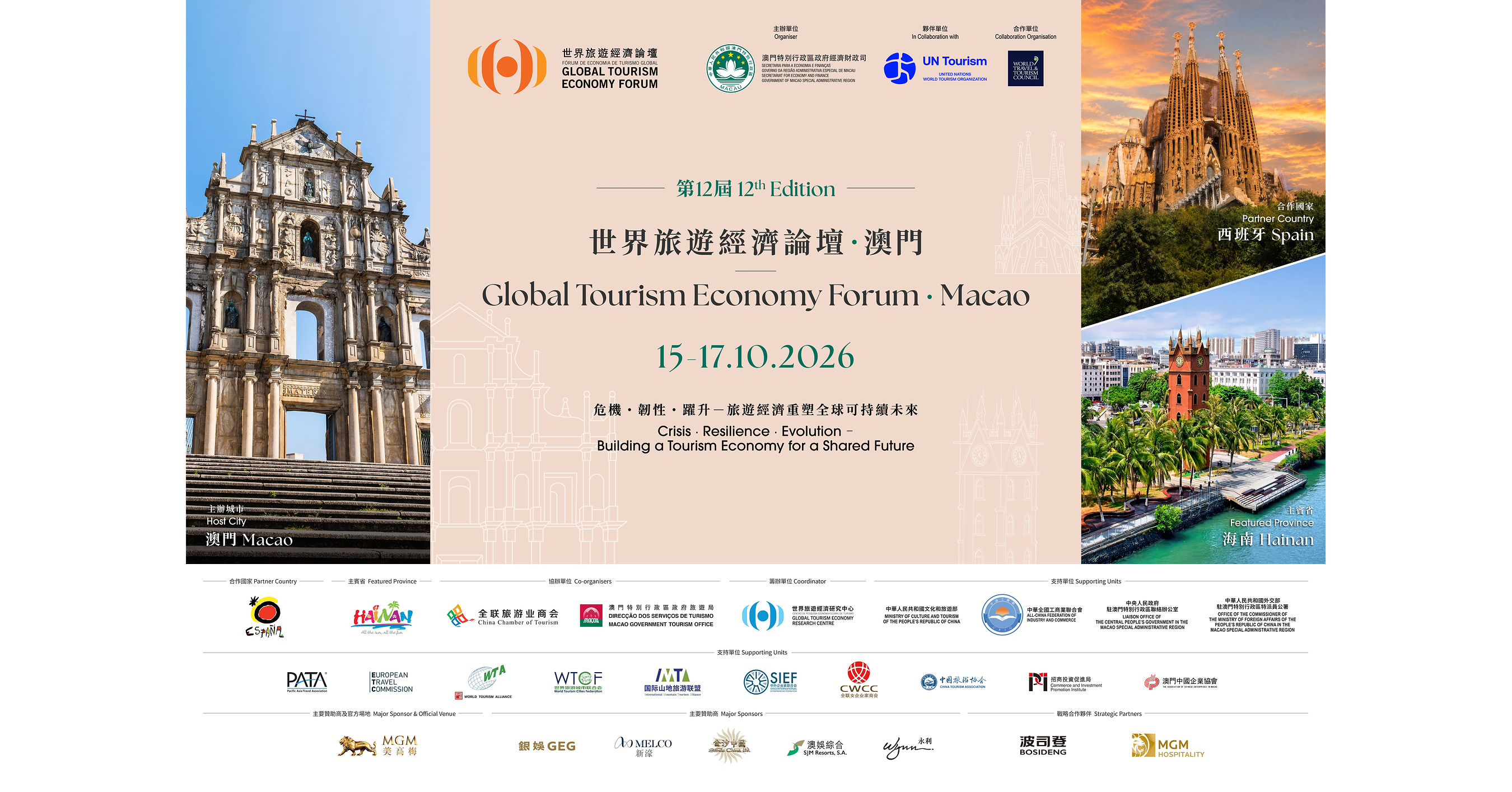
The 12th Global Tourism Economy Forum will be held in Macao on 15-17 October 2026, focused on resilience, technology, sustainable growth and cross-border tourism investment. UN Tourism reported record international arrivals of 1.52 billion in 2025, underscoring continued global tourism recovery. The forum will feature Spain as partner country and Hainan as featured province, promoting AI-enabled tourism, Free Trade Port connectivity, multi-destination travel, MICE activity and Greater Bay Area investment cooperation.
Analysis
This is a low-signal promotional catalyst rather than evidence of incremental bookings, capacity additions, or spending. The investable implication is limited to an October event-driven read-through: Macau operators MGM China (2282 HK), Sands China (1928 HK), Galaxy Entertainment (27 HK), and Melco Resorts (MLCO) could receive modest attention if the forum produces measurable MICE contracts, visa facilitation, or Greater Bay Area transport initiatives. Absent disclosed room-block, convention-revenue, or visitor-flow data, no earnings estimate change is justified.
The more relevant second-order theme is policy coordination between Macau, Hengqin and Hainan. Better multi-destination access could raise weekday premium and corporate visitation, improving non-gaming revenue mix for Macau concessionaires; however, it may also divert leisure days and spending toward Hainan, where duty-free operators and travel platforms capture the transaction. Ctrip/Trip.com (TCOM) is the cleaner liquid proxy for cross-border itinerary volume, while Macau casino equities remain more exposed to China consumer confidence, junket-normalized VIP mix and gaming-policy risk than to conference activity.
Near term, monitor any announcement of visa expansion, direct transport capacity, hotel group commitments, or MICE bookings around the October forum. Over 6-18 months, the structural upside depends on whether policy changes convert into higher overnight stays and midweek occupancy rather than merely redistributing existing Greater Bay Area tourism demand. A weakening China consumption backdrop, tighter outbound controls, or further gaming-revenue regulation would overwhelm this narrative.
Contrarian view: consensus may overvalue the strategic language because national-plan inclusion does not itself create spendable demand or operator pricing power. The likely market effect is negligible unless subsequent data show sustained growth in convention attendance, ADR, and non-gaming revenue versus ordinary leisure traffic.
AllMind Terminal
AI-powered research, real-time alerts, and portfolio analytics for institutional investors.
Request TrialMarket Sentiment
Overall Sentiment
mildly positive
Sentiment Score
0.32
Key Decisions for Investors
- No standalone trade on the announcement. Set an alert for October forum disclosures containing binding MICE contracts, visa-policy implementation dates, or quantified transport capacity; absent these, treat any rally in 1928 HK, 27 HK, 2282 HK, or MLCO as sentiment-driven.
- For existing Macau exposure, favor 27 HK over MLCO on a 6-12 month basis if non-gaming/MICE indicators improve: Galaxy has lower balance-sheet and U.S.-listing risk. Reassess if Macau monthly GGR weakens for two consecutive months or management cuts EBITDA/occupancy commentary.
- Use TCOM as the higher-quality watch-list beneficiary of any verified multi-destination visa or travel-product rollout. Initiate only after management or platform data indicate booking conversion; falsify if China domestic travel take-rates or outbound booking growth decelerate despite policy support.
- If Macau names rally more than 8-10% into the event without measurable booking or policy commitments, consider a tactical short-term relative-value trade: short MLCO versus long TCOM, targeting a 5-8% spread normalization over 1-3 months; stop on confirmed material visa liberalization or above-consensus Macau GGR acceleration.
More News
- South Korea’s exports hit record high on AI boom
- In photos: China's Xi hardens Taiwan warning as country celebrates week-long National Day holiday
- Asian stocks dip, bonds in focus after torrid September
- RAM supply set to worsen, says Micron, as CEO celebrates ‘much higher’ prices
- Tencent leases 100,000 chips from Oracle for $7 bln- FT
- Greer urges G20 to back Trump tariff agenda, takes aim at China
From AllMind Research
- Anthropic IPO Preview: Valuation, Timing, and What to Watch
- Shein After the IPO: Venue, Valuation, and What Must Be Proved
- What AI Research Tools Should a Small Hedge Fund Buy First?
- Augmented Intelligence: AllMind, Elevate Human Judgement With an Accessible, Powerful, Data-Driven Financial AI Toolkit
- AI Research Systems for Hedge Funds: A Pilot Design