
Seasonal Hiring Expected to Rise, With Full-Time Hires in Mind
Source: PR Newswire
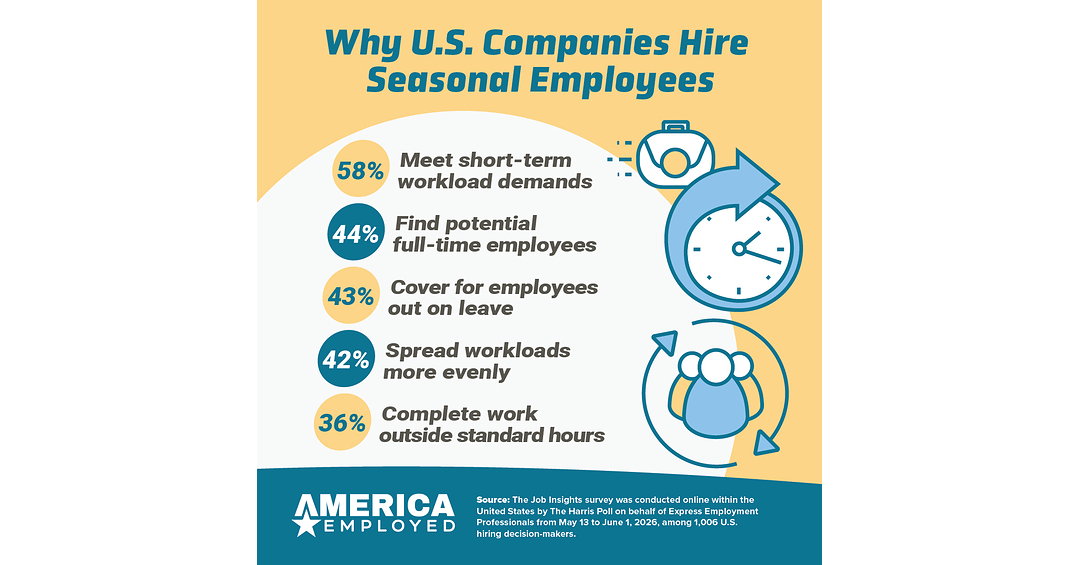
A Harris Poll survey found 38% of U.S. hiring managers plan to hire more seasonal workers than a year earlier, while 15% intend to add seasonal staff in fall 2026 versus 12% in fall 2025. Among hiring managers, 87% see seasonal roles as a way to identify future full-time hires; 45% of service-industry managers expect to increase seasonal hiring. The survey reflects staffing intentions and worker motivations, rather than realized employment growth.
Analysis
The signal is mildly supportive of flexible-labor demand, but it is not evidence of a broad hiring acceleration: these are intentions from a survey commissioned by a staffing franchisor, not observed payrolls or placements. Seasonal hiring can benefit staffing firms such as ManpowerGroup, Robert Half and Adecco if employers source externally; however, the survey does not establish that these roles are agency-filled. Employers’ trial-to-hire approach may also shift recruiting toward seasonal pools while delaying permanent requisitions, limiting the net benefit to recruiters.
The second-order read-through is mixed for retailers and service operators. Flexible staffing can protect service levels through peak demand and absences, but conversion to permanent roles could raise ongoing labor costs if demand proves temporary. The reported cost-saving motivation is relatively uncommon, so this looks more like capacity management and talent screening than a clear labor-cost substitution trend.
Near term, the survey alone is unlikely to move fundamentals. Over 1–3 months, verify actual seasonal job postings, staffing placements, temporary-help payrolls, and wage growth; these will distinguish planned hiring from realized demand. Over 6–18 months, sustained conversion into permanent jobs could support labor-market participation and reduce repeat recruiting friction, but could also expose employers to fixed-cost growth. The contrarian point: high employer interest in using seasonal roles to identify permanent talent may reflect cautious hiring through a trial period, not confidence in durable demand. A decline in temporary-help employment or weaker service-sector hiring would falsify the constructive read.
AllMind Terminal
AI-powered research, real-time alerts, and portfolio analytics for institutional investors.
Request TrialMarket Sentiment
Overall Sentiment
mildly positive
Sentiment Score
0.20
Key Decisions for Investors
- No standalone trade on this survey. Treat it as a watch item, not a forecast: the sponsoring organization has an incentive to highlight staffing demand, and stated intentions may not become hires.
- Track temporary-help employment, seasonal job postings, staffing placements, and hourly wage data into the holiday period. A rise in postings accompanied by realized placements would strengthen the staffing-demand thesis; postings without payroll follow-through would weaken it.
- For staffing names such as ManpowerGroup, Robert Half and Adecco, seek confirmation in reported placement volumes and management commentary before adding exposure; the article does not quantify agency penetration or revenue impact.
- Monitor service-sector and retailer earnings for labor availability, wage pressure, and service-level commentary. If seasonal hiring rises while permanent headcount plans remain subdued, interpret it as cautious capacity management rather than a broad improvement in demand.
More News
- What investors need to know about Alphabet's stock-busting earnings report
- Our next steps for Alphabet stock after earnings disappoint at nearly every turn
- Budget 2026 speech
- Wendy's shares jump 15% as Nelson Peltz's Trian offers $1.4 billion to buy burger chain
- Federal Reserve issues FOMC statement
- GE Vernova shares slip despite a beat-and-raise. What the sellers are getting wrong