
Global Hiring Outlook Strengthens for Q4 as Workforce Transformation Drives Demand for New Skills
Source: PR Newswire
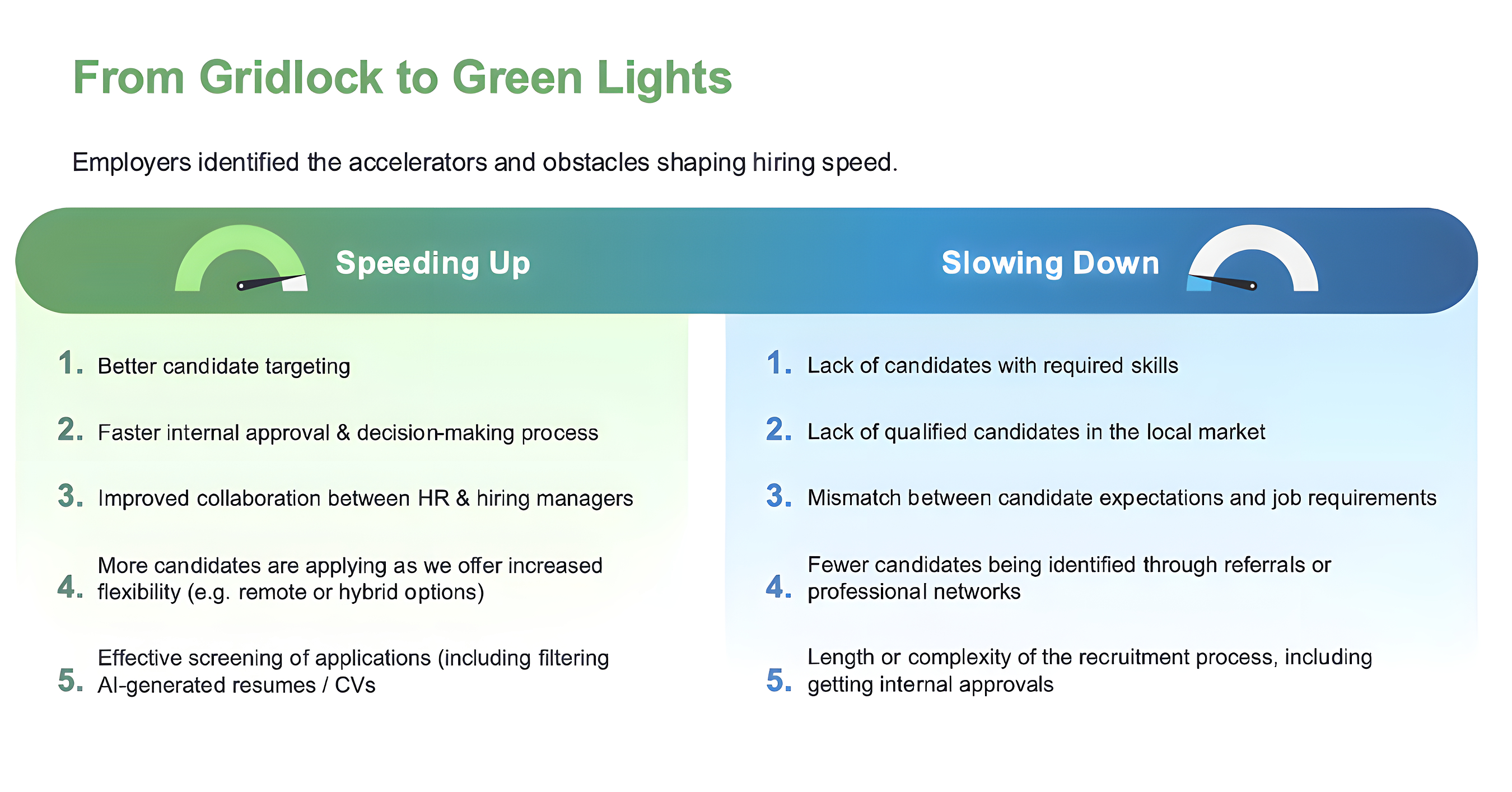
ManpowerGroup's Q4 2026 survey found 43% of global employers plan to increase staffing versus 14% expecting reductions, implying a net employment outlook of 29%, as hiring increasingly reflects changing job requirements and technology-driven skill needs. Among employers adding staff, 62% cited evolving roles and skills, while 45% expect to increase entry-level hiring compared with 20% planning reductions. Hiring intentions were strongest in Construction & Real Estate and Finance & Insurance at 36%, while India led surveyed countries at 54%; AI is reshaping work but has not consistently accelerated recruiting, with 28% reporting faster time-to-hire and 30% reporting slower hiring.
Analysis
The investable signal is less aggregate payroll growth than rising labor-market friction: employers are redesigning jobs while reporting no consistent improvement in recruiting throughput. That supports higher-value staffing, training, and project-based talent solutions, but not necessarily broad volume growth. MAN's Experis and Talent Solutions exposure should outperform its more cyclical general staffing operations if clients shift spend toward scarce technical, finance, and transformation roles; however, this requires favorable mix to offset potentially weak temp-hours demand.
For the next 1-3 months, MAN is a read-through on North American and APAC white-collar demand, while its European exposure remains the earnings vulnerability. Strong construction hiring intentions are incrementally supportive for skilled-trades placement and staffing peers including RHI, but they also imply wage pressure and project labor bottlenecks that can compress margins for homebuilders and construction contractors unless pricing is repriced. The more relevant AI beneficiary is likely HR software—WDAY, PAYC, ADP—only if enterprise clients convert workflow redesign into recurring software deployment; survey intent alone is insufficient evidence.
Consensus may incorrectly frame AI as an immediate staffing disintermediator. In the transition phase, fragmented job definitions, compliance requirements, and new skill taxonomies can increase recruiter and managed-service demand before automation lowers placement intensity. This thesis fails if temporary-help hours, a higher-frequency indicator than stated hiring plans, continue declining, or if MAN's next results show pricing/mix deterioration despite improving client hiring sentiment. Treat the release as a modest directional input, not an earnings revision catalyst until management confirms conversion into orders and gross-margin resilience.
AllMind Terminal
AI-powered research, real-time alerts, and portfolio analytics for institutional investors.
Request TrialMarket Sentiment
Overall Sentiment
mildly positive
Sentiment Score
0.32
Ticker Sentiment
Key Decisions for Investors
- Watch MAN rather than initiate on the survey alone. Upgrade to a tactical 1-3 month long only if management commentary or monthly labor indicators show stabilization in North American temp hours and MAN guides to sequential gross-margin expansion; target 10-15% upside versus a 7-8% stop on renewed volume deterioration.
- Prefer a selective long MAN / short RHI pair over an outright staffing-sector beta trade for 3-6 months if technical and managed-services mix accelerates. MAN has greater global and workforce-solutions exposure; RHI is more exposed to discretionary professional placement. Exit if European client demand weakens further or the relative spread moves 10% against the position.
- Maintain a watchlist long in ADP or WDAY on evidence that workforce redesign is producing incremental implementation bookings, not merely AI recruiting pilots. Confirmation should be raised subscription backlog, services bookings, or guidance; absent that data, do not pay a premium multiple for the narrative.
- For construction-exposed equities, monitor wage inflation and subcontractor availability as a margin-risk overlay. Favor asset-light staffing exposure over contractors until upcoming earnings demonstrate that labor-cost escalation is being passed through; a break in residential activity or construction employment would invalidate the relative thesis.
More News
- What next for France as riots rattle markets? Three questions facing investors ahead of more protests
- Next week brings major risks for the stock market, just as the AI trade keeps faltering
- AI Doubts Spread Cracks in Equities, Credit Markets: Evening Briefing Americas
- Looters hit 3,000 French businesses. Within hours, the haul was trending on Vinted under the riot’s date
- Kinder Morgan, Energy Transfer and Williams could benefit from cheap natural gas
- CrowdStrike CEO's alarming prediction — plus, the sell-off spreads beyond tech