
Korea University Study Reveals How a Blood Biomarker Tracks Response to Lecanemab in Early Alzheimer's Disease
Source: PR Newswire
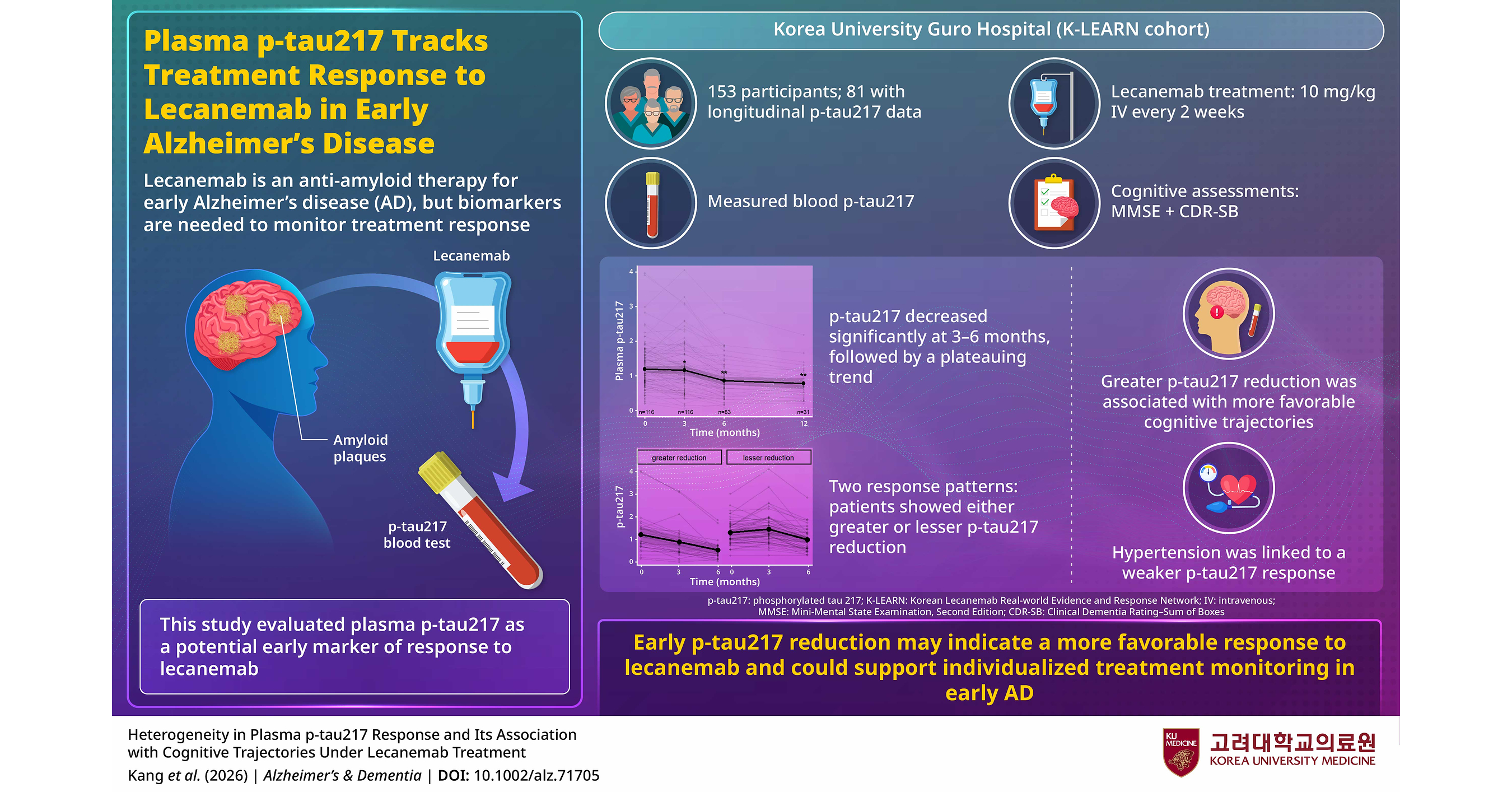
A Korea University prospective real-world study of 153 early Alzheimer’s patients receiving lecanemab found plasma p-tau217 declined significantly beginning at 3 months, with the largest reduction occurring between months 3 and 6. Among 81 patients with complete biomarker data, the 29-patient greater-reduction group had significantly slower CDR-SB worsening than the 52-patient lesser-reduction group (p<0.001) and more favorable MMSE trajectories. Baseline hypertension was associated with a weaker biomarker response, while larger multicenter and longer-term studies are needed before p-tau217 monitoring can be incorporated into routine care.
Analysis
The investable read-through is not near-term drug demand but a potential reduction in the monitoring friction that constrains anti-amyloid adoption. If a blood-based response metric becomes clinically validated and incorporated into treatment pathways, it could lower reliance on scarce PET capacity and support infusion persistence; that is incrementally favorable to Eisai (4523 JP) and Biogen (BIIB), while creating a services opportunity for scaled diagnostic networks such as Quest (DGX), Labcorp (LH), Roche (RHHBY), and H.U. Group/Fujirebio (4544 JP). The revenue effect remains immaterial before prospective validation, assay standardization, guideline inclusion, and payer reimbursement—likely a 12-36 month sequence rather than a 2026 earnings catalyst.
The more consequential second-order issue is patient selection. Vascular comorbidity may identify a population with weaker biological response, which could eventually push prescribers and payers toward tighter eligibility or monitoring requirements; that would reduce the addressable treated population but improve observed real-world effectiveness and persistence. This cuts both ways for BIIB/4523: better outcome evidence could support access, but biomarker-defined nonresponders could cap duration of therapy and net revenue per patient.
Consensus should resist extrapolating a small, single-center observational signal into a commercial inflection. The key competitive risk is that Eli Lilly (LLY) or other anti-amyloid developers could pair their therapies with a more validated, proprietary or broadly reimbursed monitoring pathway, shifting physician preference even if efficacy differences remain modest. Falsification of the diagnostic-enablement thesis would be failure of larger multicenter studies to link early biomarker changes to clinically meaningful outcomes, or continued payer refusal to reimburse serial testing.
AllMind Terminal
AI-powered research, real-time alerts, and portfolio analytics for institutional investors.
Request TrialMarket Sentiment
Overall Sentiment
mildly positive
Sentiment Score
0.38
Key Decisions for Investors
- No immediate directional trade in BIIB, 4523 JP, or LLY: treat this as a 12-36 month diagnostic-adoption watch item, not an earnings revision catalyst.
- Set an alert for prospective, multicenter validation and US guideline/payer language supporting serial plasma p-tau217 testing; confirmation would justify reassessing a long DGX/LH basket versus broad healthcare, as testing volume and network economics are more directly monetizable than drug sales.
- Monitor anti-amyloid quarterly disclosures for discontinuation rates, treated-patient mix, and net revenue per patient. A rising share of vascular-comorbidity exclusions or biomarker-defined nonresponders would be negative for BIIB/4523 revenue durability and positive for LLY only if its own pathway demonstrates superior persistence.
- For biotech exposure, prefer a neutral BIIB versus LLY stance until comparable biomarker-response data are available across agents; the risk/reward does not support assigning a competitive advantage to lecanemab from this evidence alone.
More News
- What investors need to know about Alphabet's stock-busting earnings report
- Microsoft's Big Bets on AI Start to Pay Off
- Google's Gemini 4 Carbon looks like a diamond in the rough
- Microsoft’s strong quarter backs up its stock rebound. Here's our new price target
- Can Southeast Asia pitch itself as an ‘all-in-one’ chip hub?
- As Waymo expands overseas, it remains a niche cash-burning business
From AllMind Research
- AllMind Platform Feature Updates - Fall 2026
- AI Credit Covenant Monitoring: From Clause to Review
- AI-Led Expert Interviews vs. Transcript Libraries
- Weekly Update: Sector Analysis, Improvements on Research Data, and Performance Enhancements
- How to Automate Equity Research Workflows: A Control-First Guide