
Via TRM Releases First Comprehensive Analysis of the Study Abroad Journey, From First Click to Commitment
Source: Newswire
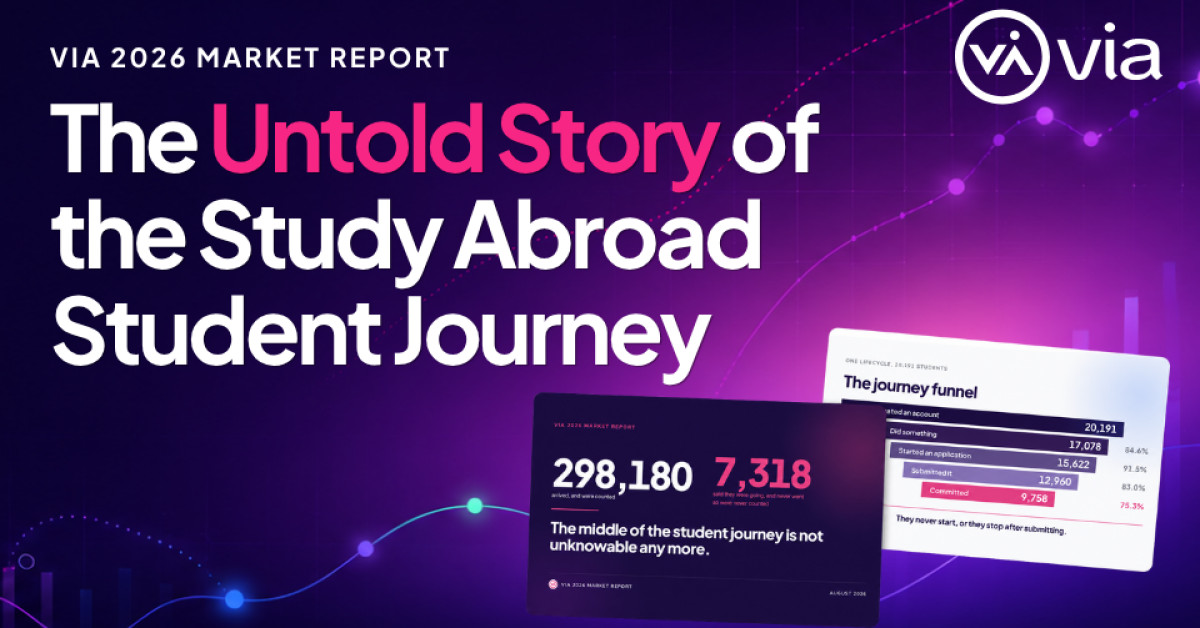
Via TRM released its 2026 study-abroad journey report analyzing 146,324 students and 184,897 applications, finding large in-process losses: 7,318 of 16,128 high-intent students never traveled, 74,407 applications were started but never submitted, and the largest drop appears after campus/provider approval. The study also reports a 42-day wait from approval to commitment (vs. 14 across all programs) and approval-to-review ease that falls from 83.6% to 79.4% thereafter, with conversion varying widely (3.2% to 97.2%) across institutions using the same platform. While the findings highlight operational bottlenecks more than external barriers, it’s primarily baseline research rather than a clear financial catalyst, limiting near-term market impact.
Analysis
This is not a demand shock; it is a workflow-efficiency narrative. The investable read-through is that conversion leakage is likely being redistributed from “lack of interest” to “process latency,” which tends to benefit vendors that can prove measurable funnel improvement, not generic travel or education exposure. For public markets, that means the real winner would be any SaaS vendor selling approval, CRM, and automated follow-up tooling into higher-ed, while point solutions and manual program-management shops face margin pressure as schools try to rationalize staff.
The second-order effect is procurement, not enrollment. If institutions believe a few-point uplift is achievable, they may reallocate spend from broad marketing toward ops software and analytics, but that spend will likely be modest, contract-based, and slow to show up in revenue. The report also creates a measurement problem: if conversion dispersion partly reflects inconsistent logging, vendors will have a hard time proving ROI, which caps multiple expansion even if the category gets more attention.
Near term, there is no obvious day-of-trade catalyst in BABYD or TSTS; the signal is too indirect and the public-market linkage too weak. Over 1-3 months, watch for any budget cycle commentary from ed-tech/workflow SaaS names about pipeline conversion or institution-wide digitization. The contrarian view is that cost is still the dominant constraint, so process optimization may improve metrics at the margin but not re-rate the addressable market; if enrollment growth fails to accelerate despite heavier software adoption, the thesis is falsified.
AllMind Terminal
AI-powered research, real-time alerts, and portfolio analytics for institutional investors.
Request TrialMarket Sentiment
Overall Sentiment
neutral
Sentiment Score
-0.05
Key Decisions for Investors
- No position in BABYD or TSTS on this article; expected fundamental impact is too remote and should fade within days rather than months.
- Use this as a watch item only: if either BABYD or TSTS later discloses meaningful education/higher-ed workflow exposure, reassess after the next 10-Q or earnings call; until then, treat as noise.
- If forced to express the theme, prefer a basket trade in education/workflow SaaS only after proof of budget conversion emerges; without that data, risk/reward is poor and the setup is not investable.
More News
- Pilot killed in attacks by Iran-backed Houthis on Riyadh airport; Saudi-led coalition vows 'firm' response
- Delta Air Lines cuts 2026 forecast on fuel surge, but CEO says demand is still strong
- Is AI the new China Shock?
- Why is T-Mobile stock tumbling today?
- This exchange stock is a buy on renewed options deal, Morgan Stanley says
- India calls JD Vance's comments about immigrants 'deeply offensive'
From AllMind Research
- Anthropic IPO Preview: Valuation, Timing, and What to Watch
- Shein After the IPO: Venue, Valuation, and What Must Be Proved
- What AI Research Tools Should a Small Hedge Fund Buy First?
- Weekly Update: Sector Analysis, Improvements on Research Data, and Performance Enhancements
- Choosing an AI Copilot for Equity Research