
SLAM Uncovers Antimony, Gold and Silver on Its Moose Lake Trenching Program
Source: Newswire
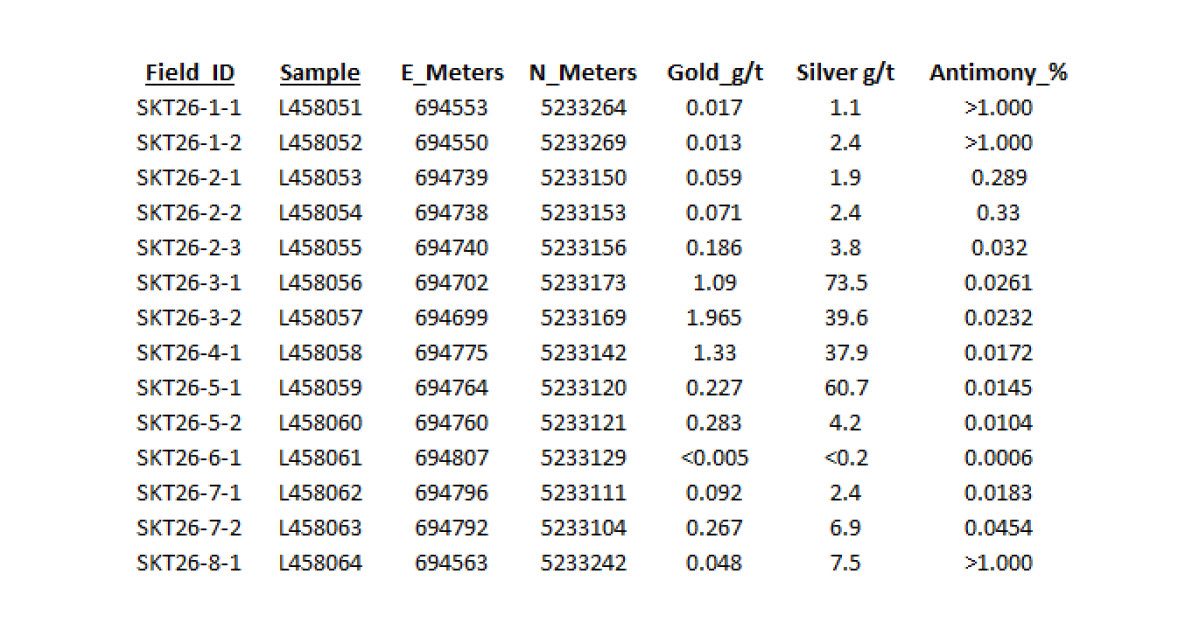
SLAM Exploration reported preliminary trench grab samples at its Skull zone containing up to 1.965 g/t gold, 73.5 g/t silver and antimony assays above the 1% detection limit in three samples, indicating separate gold-silver and antimony mineralization. The silicified breccia zone has been traced across 242 meters, while the adjacent Moose Lake occurrence remains open in all directions. Results are early-stage and several antimony assays remain pending, limiting near-term valuation certainty despite the positive exploration update.
Analysis
This is insufficient to underwrite a resource valuation change: surface grab samples are inherently selective, the antimony assays are censored above the laboratory detection threshold, and neither true width nor continuity has been established. Any near-term move in SXL is therefore likely retail-liquidity driven rather than NAV-driven; the first independently meaningful de-risking event is quantified antimony assays followed by systematic channel sampling and drilling that demonstrates grade-thickness continuity.
The more investable read-through is strategic optionality, not current metal inventory. North American antimony scarcity can attract government, defense-supply-chain, or larger-junior attention, but only after metallurgy, recoveries, permitting path and a drill-defined resource are credible—likely a 6-18 month process. The coexistence of several early-stage projects also creates capital-allocation risk: without a financed, prioritized drill program, positive exploration headlines can be followed by equity issuance and per-share dilution.
Near-term catalysts over 1-3 months are pending assays and results from the separate copper-nickel-cobalt drilling program; a material sulfide intercept there could matter more to institutional liquidity than the antimony showing. The thesis is falsified if follow-up sampling/drilling fails to reproduce mineralization away from isolated surface exposures, if reported antimony grades are low once uncapped, or if cash runway requires discounted financing before a coherent drill campaign. Consensus promotional framing likely overvalues fault-strike length; discontinuous epithermal breccia is common, while economic value depends on continuous, mineable widths and recoverable concentrate quality.
AllMind Terminal
AI-powered research, real-time alerts, and portfolio analytics for institutional investors.
Request TrialMarket Sentiment
Overall Sentiment
mildly positive
Sentiment Score
0.38
Ticker Sentiment
Key Decisions for Investors
- No core position in SXL at this stage; treat it as an event-driven microcap watchlist name until uncapped antimony assays, channel results and drill plans establish grade-thickness. Liquidity and financing risk dominate fundamental upside over the next 90 days.
- If trading SXL, use only a small tactical position after assay release confirms materially higher-than-1% antimony grades and the market holds gains for 2-3 sessions; take profits into promotional volume. Exit on a failed follow-up result or a discounted financing announcement.
- Monitor SXL's next financing terms, cash balance and planned meterage before assigning value to multiple projects. A raise at a meaningful discount to market is a negative catalyst even if exploration news remains favorable.
- For liquid strategic-antimony exposure, prefer diversified critical-minerals vehicles or established producers over SXL until a drill-defined resource exists; the junior's upside is potentially asymmetric, but the probability-weighted outcome remains dominated by geological and dilution uncertainty.
More News
- Wall Street’s Nasdaq hits all-time high as AI frenzy gathers pace
- Oil falls on increased Gulf supply and hopes for US-Iran talks
- Data-Center Bet Makes ESDS One of India’s Best New Listings
- Asia stocks ride tech wave higher, oil stays subdued
- South Korean solar stocks jump as curbs on Chinese sector expected to remain in place
- Bank of America says Brent crude oil could top $150 a barrel if Iran war disruptions persist