
El 64 % de los líderes en ciencias de la vida están tomando medidas para establecer una gobernanza de IA
Source: PR Newswire
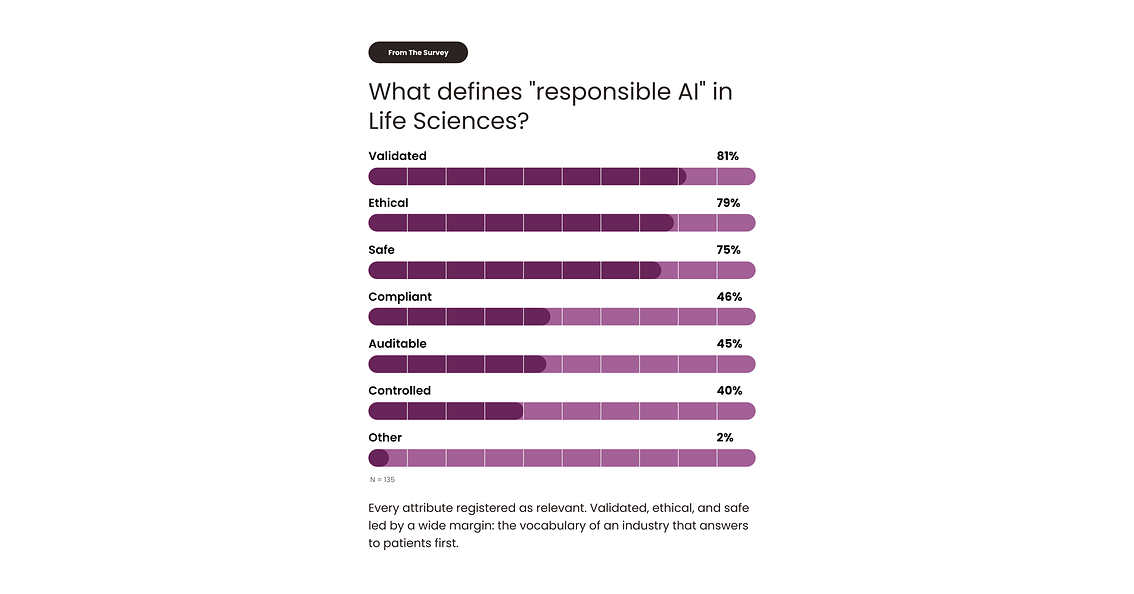
ACTO's 2026 RAIL report finds 64% of surveyed life-sciences leaders have an AI governance process established or in development, but 36% lack defined governance or rely on a single approval point. Trust and oversight remain key constraints: 58% say the sector lacks clear responsible-AI standards, 54% are concerned about AI use in their organizations, and 21% cite regulatory, legal or compliance concerns as the leading internal barrier to scaling. The report introduces a six-component RAIL scoring framework for assessing agentic AI systems; the findings are based on eight roundtables with 80 executives and an online survey of 135 leaders.
Analysis
The investable signal is not broad AI demand but where spend and value accrue: regulated life-sciences firms may prioritize auditability, access controls, validation and human sign-off before scaling autonomous workflows. That favors established systems and vendors able to sit inside compliant workflows, while making near-term productivity claims for multi-agent deployments harder to realize. For Veeva Systems (VEEV), ACTO’s partner relationship is a modest ecosystem positive, not evidence of incremental revenue or customer wins; any benefit depends on ACTO adoption and the depth of integration. The second-order trade-off is that tighter governance can raise switching costs for incumbent platforms, yet add implementation friction and delay customer ROI, tempering AI-related upsell expectations.
Treat the report cautiously: it is a vendor-sponsored survey of 135 executives, not evidence of realized budgets, deployments or outcomes, and RAIL is a proposed rubric rather than an established industry or regulatory standard. The immediate market impact should be limited. Over 1–3 months, watch for concrete procurement criteria, product integrations and customer spending disclosures; over 6–18 months, adoption of common validation standards could separate compliant incumbents from standalone agent vendors. The thesis weakens if customers scale agent workflows without materially increasing governance spend, or if Veeva fails to convert ecosystem positioning into disclosed product adoption. No basis here to infer a VEEV earnings or valuation revision.
AllMind Terminal
AI-powered research, real-time alerts, and portfolio analytics for institutional investors.
Request TrialMarket Sentiment
Overall Sentiment
mixed
Sentiment Score
-0.05
Key Decisions for Investors
- No trade on this report alone. Keep VEEV on watch rather than treating the ACTO partnership reference as a near-term catalyst.
- For VEEV, monitor earnings commentary for measurable AI-related attach rates, integration activity, customer adoption and implementation costs. Upgrade the ecosystem thesis only on evidence of paid deployments or explicit product contribution.
- If considering an AI exposure, prefer a relative-value framework that favors established regulated-workflow platforms over undifferentiated agent vendors; size only after comparing valuation, growth and reported customer evidence, which this report does not provide.
- Falsifiers: Veeva reports no meaningful uptake from AI integrations while implementation burdens rise; alternatively, broad customer evidence shows agent rollouts proceeding without added governance controls, weakening the compliance-platform advantage.
More News
- Biotechs buck a sluggish IPO market, but investors should tread warily
- What investors need to know about Alphabet's stock-busting earnings report
- Our next steps for Alphabet stock after earnings disappoint at nearly every turn
- Budget 2026 speech
- SK Hynix says the memory-chip shortage will last until 2030—and more than half its production is booked for the next two years
- China’s tech darlings are losing their shine. Here’s what’s behind the sell-off