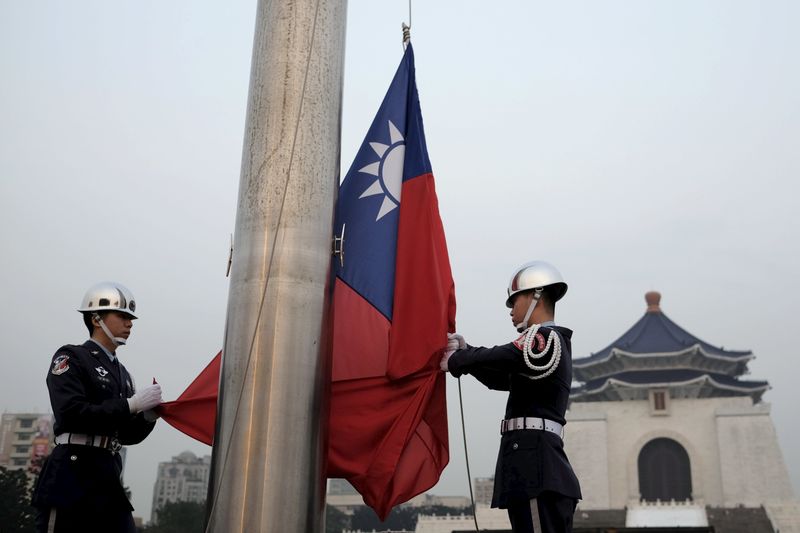
Taiwan was urged to increase defense spending and invest more heavily in drones and other unmanned systems, with U.S. officials saying it should "spend smarter" to strengthen deterrence against China. The article highlights Taiwan's stalled defense budget process, including approval of only about two-thirds of an additional $40 billion military spending request, and uncertainty over a possible new $14 billion U.S. arms package. The backdrop is rising cross-strait tensions, making this a geopolitically sensitive but not immediate market shock.
This is less a headline about Taiwan defense demand in the abstract than a signal that the procurement mix is shifting away from high-cost platforms toward low-cost, high-volume systems. That is structurally positive for primes with drone, autonomy, EW, sensor-fusion, and counter-UAS exposure, but it compresses the value of legacy air/sea platforms if budgets are capped: every dollar redirected into unmanned systems is a dollar not flowing to traditional major programs. The second-order winner is the domestic supply chain around batteries, secure comms, guidance chips, and small-form-factor manufacturing, where unit economics can scale faster than headline defense budgets.
For NOC specifically, the near-term read-through is muted unless management can position into autonomous payloads, ISR, and command-and-control integration rather than pure airframe exposure. The market often misprices geopolitics as a direct revenue catalyst, but the more important driver is budget authorization timing: if the legislature continues to slow incremental spending, the earnings impact slips from months into years. That delay can also create procurement volatility that favors firms with existing production slots and export permissions over those waiting on new program starts.
The contrarian point is that stronger deterrence can reduce immediate escalation risk, which is bearish for some defense beta in the short run if investors were chasing a war-premium trade. The more durable upside comes if this becomes a broader Indo-Pacific rearmament cycle, not if it stays a Taiwan-only headline. Watch for follow-on U.S. arms package approvals and domestic legislative progress; if either stalls, the thematic trade should fade quickly, but if both advance, the winners will be the systems integrators that can deliver low-cost autonomy at scale rather than the largest legacy contractors.
AI-powered research, real-time alerts, and portfolio analytics for institutional investors.
Request TrialOverall Sentiment
mildly negative
Sentiment Score
-0.15
Ticker Sentiment
