
Archwest Capital Completes Third Rated RTL Securitization in Less Than 12 Months, Bringing Total Issuance to $875 Million
Source: PR Newswire
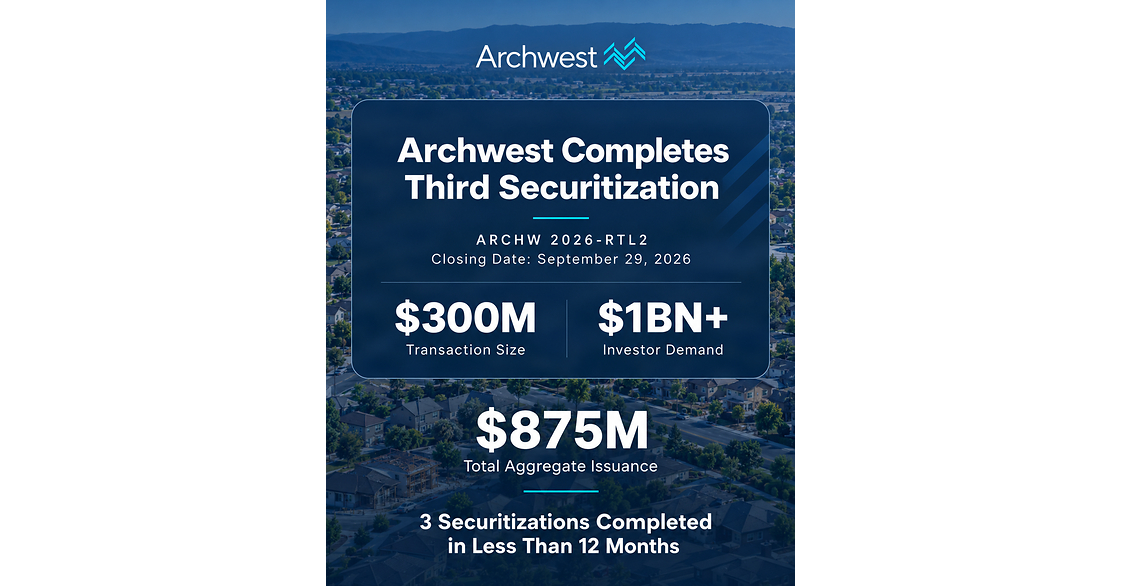
Archwest Capital closed a $300 million rated residential-transition-loan securitization that attracted more than $1 billion of investor interest, marking its third rated RTL deal in under 12 months. Aggregate issuance has reached $875 million, while the deal's two-year revolving structure supports continued loan origination and reinvestment capacity. The initial collateral includes 218 loans totaling approximately $217.3 million plus a $98.5 million accumulation account; the company reported no securitization loan repurchases to date and said its inaugural $300 million transaction has fully revolved.
Analysis
The relevant signal is not the issuance volume but the apparent reopening of repeat institutional demand for short-duration residential-transition-loan ABS. That can lower marginal warehouse and term-funding costs for scaled private lenders, allowing them to compete more aggressively for builder and investor-originated credit; the first beneficiaries are private-originator platforms, while smaller nonbank lenders reliant on bank lines face adverse selection and margin pressure. Public housing equities should not be extrapolated directly: easier fix-and-flip financing may increase renovation supply and resale inventory, which is modestly negative for existing-home scarcity premiums but potentially supportive for transaction-sensitive service providers.
The principal underwriting risk is masked by the revolving structure: collateral performance during a period of rapid principal recycling is less informative than cumulative losses by vintage, loan-to-cost drift, geographic concentration, and extension/default behavior once resale liquidity weakens. A soft housing market or higher-for-longer funding rates could turn rapid prepayments into extensions within 1-3 months, impairing securitization execution and forcing lenders to retain loans on warehouse facilities. Investor interest is not equivalent to an economically attractive funding spread; tranche pricing, credit enhancement, residual retention, and advance rates are the missing variables that determine whether origination growth is value-accretive.
MORN has only indirect exposure through ratings and data activity, so the disclosed transaction is not material enough to alter earnings expectations or justify a standalone position. The more actionable read is a credit-market watch: sustained RTL ABS execution would be a constructive leading indicator for private-credit liquidity over 6-18 months, but it is not yet evidence that public mortgage REIT book values or housing-demand forecasts should be revised higher.
AllMind Terminal
AI-powered research, real-time alerts, and portfolio analytics for institutional investors.
Request TrialMarket Sentiment
Overall Sentiment
moderately positive
Sentiment Score
0.62
Ticker Sentiment
Key Decisions for Investors
- No standalone MORN trade: require evidence of broader ratings-volume acceleration or management guidance before treating private-ABS issuance as earnings-relevant. The transaction is too small relative to MORN's diversified revenue base.
- Create a 1-3 month RTL-ABS monitor: track new-issue spreads, AAA/subordinate tranche placement, overcollateralization, and warehouse-line availability for residential bridge lenders. Tightening spreads with stable credit enhancement would support a broader private-credit-liquidity thesis; wider spreads or higher enhancement would falsify it.
- Do not buy INVH or AMH on this signal alone. Increased investor financing can add competing acquisition demand in the near term, but a rise in renovated resale inventory could cap rent-growth and home-price assumptions over the following 6-18 months.
- For mortgage-credit exposure, keep any long RITM or MFA position conditional on book-value and financing disclosures rather than treating RTL securitization demand as a sector-wide funding proxy. Reduce exposure if repo costs rise, securitized spreads widen materially, or managements report declining loan-sale execution.
More News
- Mattel's CEO departing after a rough year at toy giant as Barbie sales deteriorate: ‘Change is overdue'
- Ten Reasons Investors Are Driving Government Bond Yields Higher
- September Ends on a Grim Market Note: Evening Briefing Americas
- China’s Property Crisis: From Evergrande Collapse to Beijing’s Latest Measures
- RAM supply set to worsen, says Micron, as CEO celebrates ‘much higher’ prices
- Tencent leases 100,000 chips from Oracle for $7 bln- FT