
Every Bed, Every 15 Minutes: ReddiNet Launches HBEDS for Near Real-time Hospital Capacity Across California
Source: PR Newswire
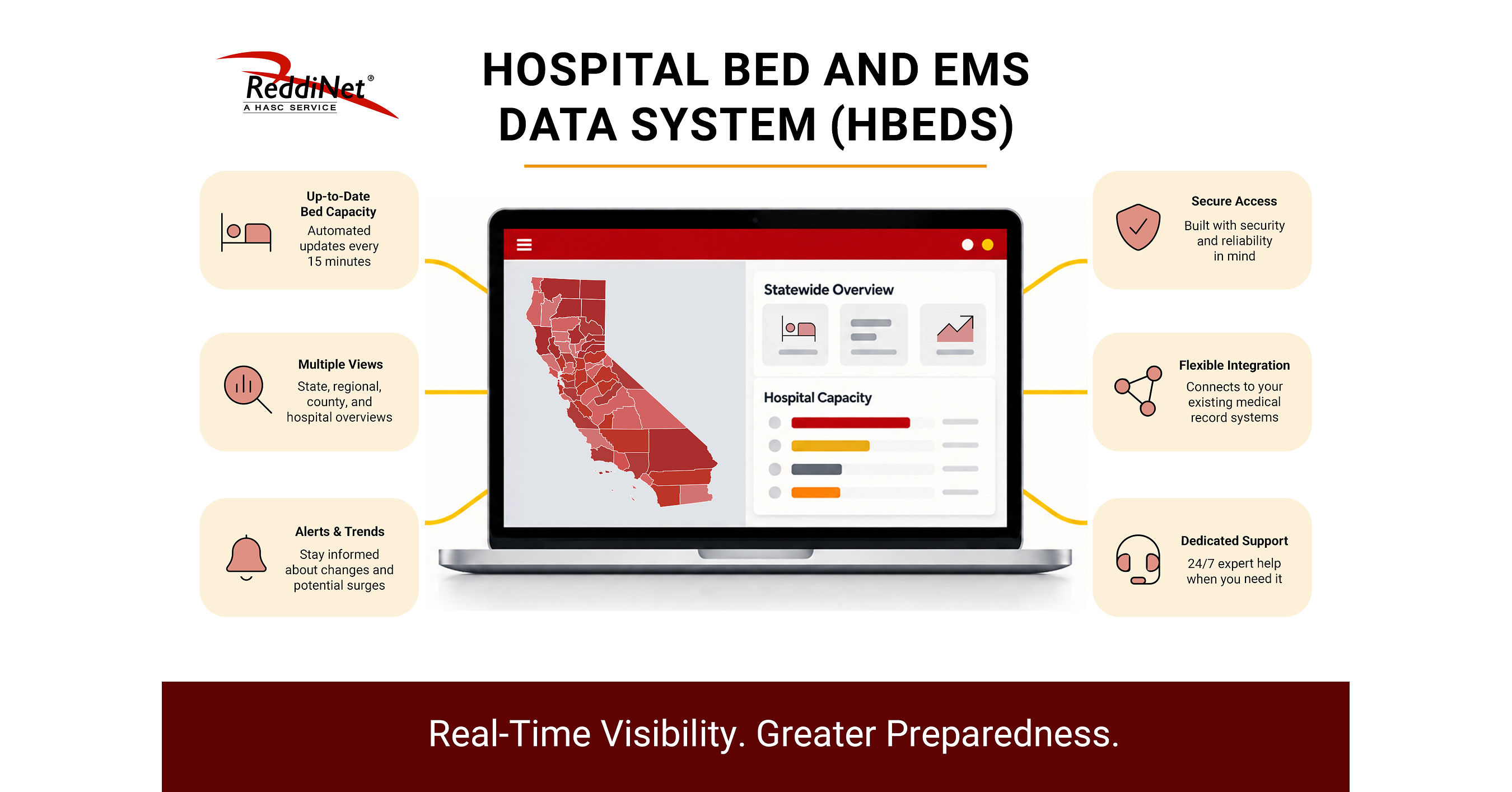
ReddiNet launched HBEDS for California’s Department of Public Health, automating statewide hospital-bed capacity reporting with data refreshed every 15 minutes. The system provides authorized users facility-to-state visibility, meets federal reporting requirements, and is being rolled out across California general acute care hospitals; ReddiNet says it can scale to other states.
Analysis
No clear public-equity read-through: ReddiNet is a service of a nonprofit hospital association, and the article gives no contract economics, pricing, or evidence that the system changes hospital costs or utilization materially. The plausible upside is operational—less staff time spent reporting and better patient routing—but those benefits accrue diffusely to participating hospitals and are not yet quantified. Near term, the launch is unlikely to move broad healthcare or technology earnings; do not treat the announcement as evidence of a scalable commercial software revenue stream.
Over 1–3 months, the signal to watch is execution: hospital onboarding coverage, completeness and reliability of EHR feeds, and whether other states issue funded procurements. Federal reporting compliance may support adoption, but does not by itself establish a proprietary advantage or recurring economics. Over 6–18 months, broader deployment could make capacity data more useful for regional coordination, while also increasing dependence on accurate, secure integrations. Data quality, cybersecurity, and uneven hospital participation are meaningful failure modes.
Contrarian view: the optimistic framing assumes that more timely visibility translates into more available staffed beds. It cannot create clinical staff or physical capacity; during a surge, the binding constraint may remain labor. Any claims of efficiency should be verified against adoption, reporting burden, and operational outcomes. No trade is warranted on this release alone.
AllMind Terminal
AI-powered research, real-time alerts, and portfolio analytics for institutional investors.
Request TrialMarket Sentiment
Overall Sentiment
mildly positive
Sentiment Score
0.25
Key Decisions for Investors
- No immediate position: there is no mapped public issuer or disclosed financial impact to underwrite, and the direct beneficiary appears to be a nonprofit service rather than a listed company.
- Set a 1–3 month watch item for additional state awards and funded contract disclosures; verify contract value, duration, implementation costs, and whether ReddiNet retains the economics before considering any health-IT exposure.
- Track California onboarding coverage, feed completeness, and evidence of reduced reporting workload or improved patient routing. Delayed participation, unreliable data, or a cybersecurity event would weaken the adoption thesis.
- Do not infer incremental hospital earnings from capacity visibility alone. Revisit only if measured outcomes show sustained labor savings or materially improved utilization; visibility cannot resolve staffing-constrained bed supply.
More News
- What Wall Street billionaires are saying about Democrats' midterm sweep
- NextDC shares surge 43% after Goodman, Digital Realty stake purchases
- Voters rebuff data centers in every ballot measure except one during the 2026 midterms
- China Blocks SoftBank Acquisition of ABB Robot Unit, FT Says
- After the midterms, a bigger clash over data centers could be coming
- Softbank’s $5.4 bln takeover of ABB robotics unit blocked by China- FT