
DigiSelf Launches World's Fastest Real-Time AI Avatars, Bringing Conversations Off the Cloud
Source: PR Newswire
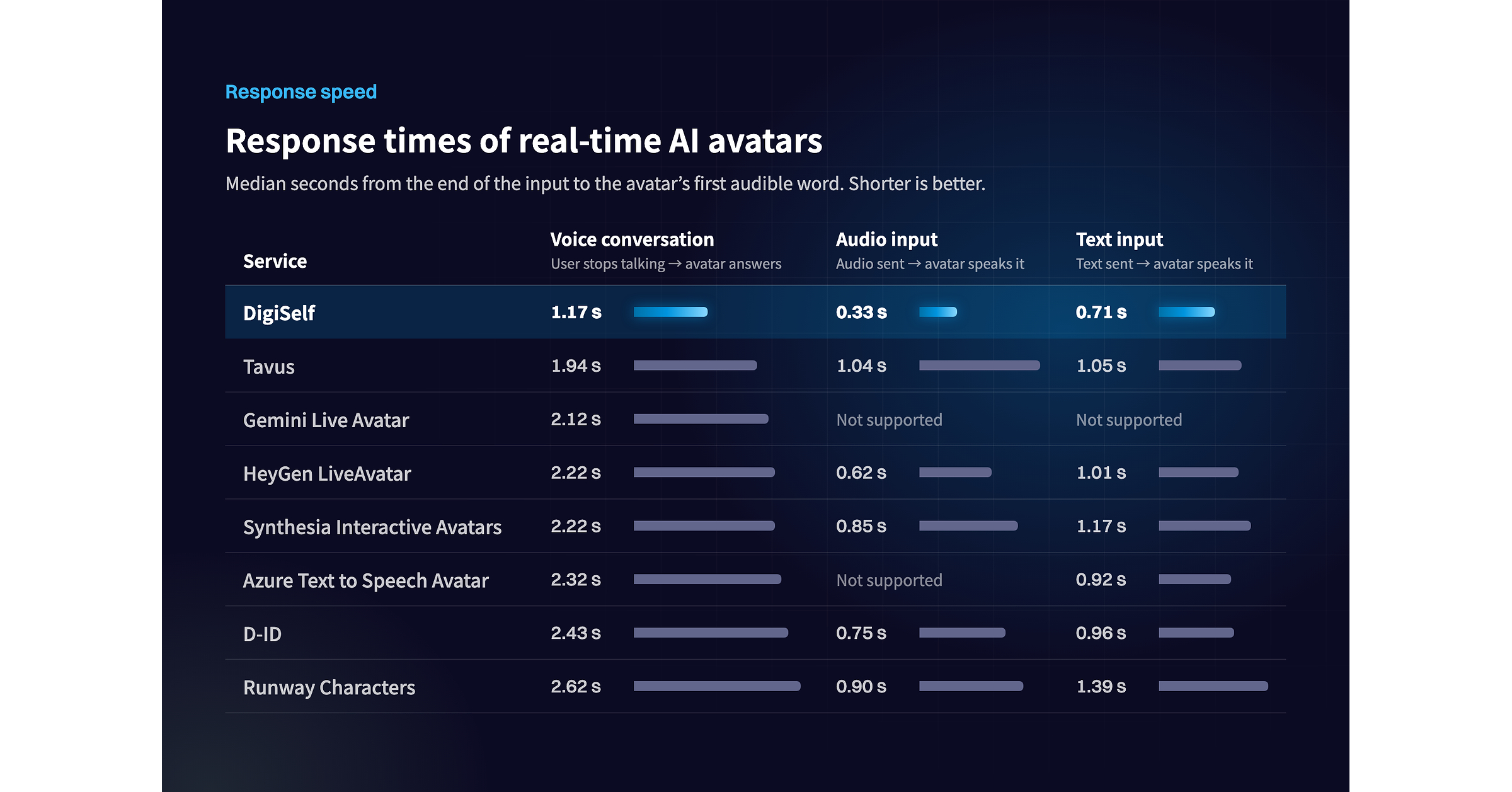
EmbodyMe announced DigiSelf’s global expansion, touting company-run benchmarks showing a 0.33-second median start to speaking incoming audio versus 0.62 seconds for the next-fastest tested competitor, and 1.17 seconds to answer after a user finishes speaking versus 1.94 seconds. Its local offline SDK is reported to start speaking in 0.005 seconds and runs on users’ hardware without sending data to the cloud. The launch adds online and offline options for business and personal uses; pricing starts at $29/month for paid plans, $0.10/minute for API streaming, and a $9,900 one-time license for the offline SDK.
Analysis
The investable signal is not the speed ranking; it is the attempt to package a personalized, low-latency avatar as both a cloud API and an offline enterprise product. Offline execution could ease privacy and data-residency objections in government, healthcare, and regulated customer service, but shifts costs and reliability burdens to customer hardware and makes deployment/support—not raw latency—the commercial bottleneck. The one-time SDK license also trades recurring usage revenue for easier procurement and predictable cost, potentially limiting lifetime value unless renewals, maintenance, or expansion fees are meaningful; verify contract structure and conversion from pilots to paid deployments.
Competitive pressure is most plausible in templated corporate video and avatar interfaces, where Synthesia, HeyGen, and D-ID may face feature convergence. But integrations with Zoom, Google Meet, and Microsoft Teams are distribution channels, not evidence of exclusive access: platform owners could bundle comparable features, compress pricing, or control discovery. The company's benchmarks are self-conducted, and the reported latency advantage does not establish superior output quality, reliability, or unit economics. Its user-download history likewise does not establish enterprise revenue traction.
Near term, this is a product/partner watch item, not a public-equity catalyst: EmbodyMe is privately held and no mapped ticker is supplied. Over 1–3 months, look for named enterprise deployments, repeat contracts, and independent performance comparisons. Over 6–18 months, deepfake consent, impersonation, and provenance requirements could raise compliance costs or constrain use—especially for deceased or public figures—while privacy-sensitive offline deployments could benefit. The contrarian read is that speed may be commoditized; workflow integration, rights management, and trust are likelier to determine durable economics.
AllMind Terminal
AI-powered research, real-time alerts, and portfolio analytics for institutional investors.
Request TrialMarket Sentiment
Overall Sentiment
mildly positive
Sentiment Score
0.35
Key Decisions for Investors
- No direct public-equity trade on this announcement: EmbodyMe is private, and the release provides no independently verified revenue, customer retention, or deployment scale.
- Track Synthesia, HeyGen, and D-ID as competitive watch items rather than short candidates; require evidence of customer displacement or pricing pressure before positioning.
- Treat Zoom, Microsoft, and Google as potential distribution beneficiaries but also as bundling risks to standalone avatar vendors; monitor product integrations and any native feature launches.
- Set a diligence trigger for named enterprise customers, repeat-purchase data, SDK support/renewal terms, and independent latency and quality tests. Failure to show paid conversion would falsify the commercial adoption thesis.
- Monitor consent, likeness-rights, and AI-provenance rules over the next 6–18 months; material restrictions or a prominent misuse incident could overwhelm the privacy advantage of offline processing.
More News
- The U.S. market has never been more focused on one single bet—but AI’s payoff will likely take decades
- Meta put out an ambitious roadmap to Muse monetization after strong quarter and guide
- CoreWeave’s market confidence erodes as bond yields spike and stock sinks
- New Mexico took on Meta alone and won a $25 billion judgment over Facebook’s privacy violations
- Elon Musk Thinks $3.5 Trillion Tesla-SpaceX Mashup Is a Good Idea
- Meta ordered to pay $25 billion in case related to Cambridge Analytica scandal