
LCT Launches New CUSO with One Washington Financial, AKUVO's Jay Mossman and SWBC to Bring Compliance Solutions to Credit Unions
Source: PR Newswire
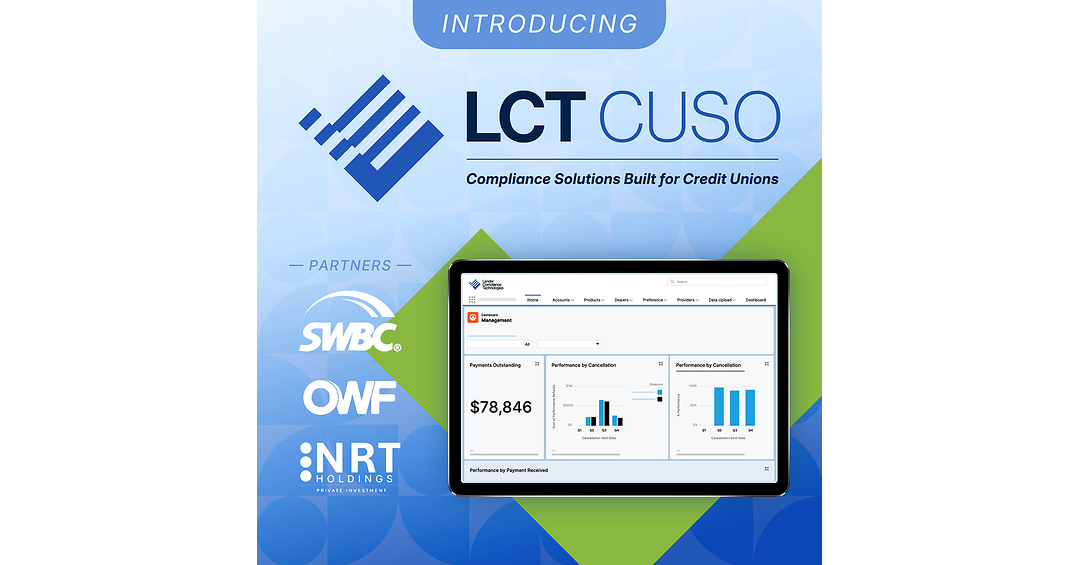
Lender Compliance Technologies launched LCT CUSO with One Washington Financial, AKUVO CEO Jay Mossman and SWBC to expand automated F&I product cancellation and refund compliance services to U.S. credit unions. LCT's cloud-based Refund Control platform processes more than 100,000 cancellations per month, supports nearly 30 credit unions serving over 5 million members, connects to 800+ providers and can reduce workloads by up to 90%. The partnership targets improved refund recoveries, reduced regulatory risk and more streamlined audit-ready workflows, though it is unlikely to have broad public-market impact.
Analysis
This is not presently a public-equity catalyst: LCT, OWF, SWBC and the referenced NRT Holdings vehicle do not create a clearly investable listed exposure from the supplied information. The reported automation and recovery claims are vendor assertions, and the addressable workflow is too narrow to alter earnings for core-banking platforms such as JKHY, QTWO or ALKT absent evidence of broad distribution, contracted recurring revenue, or displacement of incumbent servicing vendors.
The more relevant second-order signal is that credit unions are allocating budget toward auditable loan-servicing workflows before enforcement or member-remediation costs force the spend. Over 6-18 months, that modestly favors configurable digital-banking and compliance infrastructure over labor-intensive servicing/BPO models, but it is unlikely to move sector multiples in the next 1-3 months. A stronger read-through would be rising regulatory actions around unearned-premium refunds, GAP cancellations, or ancillary-product remediation at auto lenders; that would turn this from a niche workflow story into a reserve, conduct-risk and fee-income issue for consumer-finance firms.
Contrarian view: the market may overinterpret any fintech-compliance announcement as incremental software demand. Credit-union procurement cycles are slow, integrations are bespoke, and savings claims frequently shift work from back office to exception management rather than eliminate it. The thesis becomes investable only if adoption demonstrably converts into recurring software revenue and provider-network economics rather than one-time implementation fees.
AllMind Terminal
AI-powered research, real-time alerts, and portfolio analytics for institutional investors.
Request TrialMarket Sentiment
Overall Sentiment
moderately positive
Sentiment Score
0.42
Ticker Sentiment
Key Decisions for Investors
- No directional trade on the stated NRT reference until identity and public-market tradability are independently verified; the article describes NRT Holdings LLC, which should not be assumed to be the listed security represented by the ticker field.
- Maintain neutral exposure to JKHY, QTWO and ALKT over the next 1-3 months; do not extrapolate this announcement into bookings. Upgrade only if upcoming earnings show compliance/loan-servicing ARR acceleration, higher implementation backlog, or credit-union win-rate improvement.
- Create a regulatory alert for CFPB/state enforcement or restitution actions involving GAP, service-contract, or ancillary-product refunds at auto lenders. If such actions broaden, evaluate a defensive pair: long JKHY versus short subprime auto-finance exposure such as CACC, with the thesis invalidated by no measurable rise in remediation reserves or servicing expense over two reporting periods.
- Watch for evidence that large credit-union service organizations standardize a single compliance stack within 6-12 months. A multi-CUSO distribution agreement would be a more meaningful private-market validation than individual customer announcements and could justify revisiting public fintech beneficiaries.
More News
- Here’s the ‘core economic flaw’ in the AI bull case as stock and bond trades unravel, according to a top economist
- 5 big analyst AI moves: ’Uniquely catalyst-rich’ months ahead for SpaceX
- The experience economy keeps defying expectations. Maybe we’ve been looking at it all wrong
- Brookfield to open Qatar office as it expands Middle East operations
- Xencor reports phase 1 data for cancer drug XmAb819
- The U.S. military and NASA have power problems. Nuclear microreactors might solve both