
Tesla Wants to Build 20,000 Optimus Robots a Week. Here's the Supplier That Gets Paid for Every Single One -- and It's Not Nvidia.
Source: fool.com
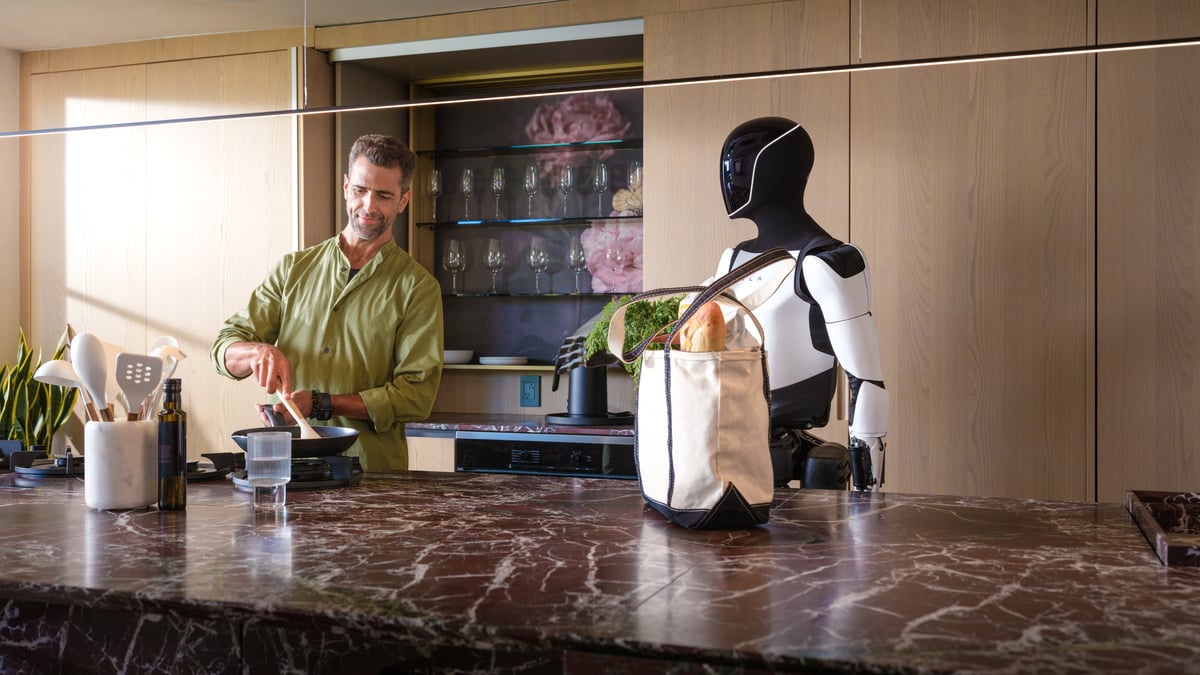
At Tesla’s potential Optimus production of 1 million robots annually, Texas Instruments could generate an estimated $250 million-$500 million in annual analog-chip revenue, based on $250-$500 of TI components per unit. TI supplies motor-control, signal-chain, and power-management components; the article says the opportunity depends on Tesla reaching its production target of 20,000 units per week. TI’s analog revenue rose 27% year over year to $13.2 billion in the first nine months of 2026, while analysts expect 2025-2028 revenue and EPS CAGRs of 18% and 35%; the stock trades at 27 times next year’s earnings and yields nearly 2% forward.
Analysis
The investable point is not Tesla’s unit target; it is whether robot bill-of-materials demand becomes a repeatable, diversified analog revenue stream for Texas Instruments. Even at the stated full-production scenario, the estimated Optimus contribution is incremental rather than a thesis-changing driver of TXN by itself. The path is also unusually execution-sensitive: weekly production targets do not establish sell-through, yield, supplier allocation, or realized content per robot. Treat the quoted component estimate as a teardown-based hypothesis, not contracted revenue.
Near term, the news is unlikely to justify a material TXN re-rating absent purchase commitments or production evidence. Over 1–3 months, track Tesla’s build cadence, supplier qualification, and TXN’s industrial/automotive commentary for evidence that robotics is additive rather than merely an attractive narrative. Over 6–18 months, broader robot adoption could benefit analog suppliers across platforms, but second-source qualification and customer concentration will determine who captures the value. Tesla’s use of its own inference chips weakens the direct Optimus case for NVIDIA; it does not establish that NVIDIA loses broader robotics or data-center demand.
Contrarian read: investors may over-credit TXN for an ambitious end-market forecast while underweighting the risk that robot production ramps slowly or that per-unit content and pricing fall with scale. The more durable TXN thesis remains diversified analog demand, not one Tesla program. Verify TXN’s reported robotics exposure, actual design-win status, and management guidance before assigning earnings value.
AllMind Terminal
AI-powered research, real-time alerts, and portfolio analytics for institutional investors.
Request TrialMarket Sentiment
Overall Sentiment
mildly positive
Sentiment Score
0.38
Ticker Sentiment
Key Decisions for Investors
- Do not trade NVDA short solely on its exclusion from Optimus; the article offers no evidence of lost NVIDIA revenue, and the broader AI compute opportunity is distinct from Tesla’s onboard inference choice.
- For TXN, prefer a watchlist or staged entry on weakness over chasing this catalyst. Reassess only if Tesla demonstrates sustained production and TXN confirms shipments or meaningful customer programs; validate the quoted per-unit content and supply allocation.
- Monitor Tesla production cadence and TXN analog growth/guidance over the next several quarters. A missed robot ramp, lower-than-claimed component content, or weakening TXN industrial/auto commentary would falsify the incremental robotics thesis.
- Treat Tesla’s target as an execution option, not a base-case earnings input. No standalone Optimus-driven position is warranted until build rates, yields, and realized supplier revenue are independently observable.
More News
- Voters rebuff data centers in every ballot measure except one during the 2026 midterms
- After the midterms, a bigger clash over data centers could be coming
- A blue wave sends futures into the green
- Elon Musk’s record election bet backfired. The backlash may reach beyond one billionaire
- We're cutting our Qnity price target but still loved the beat-and-raise quarter
- The post-election rally masks a sharp split in the AI trade. Who stands to win?