
4 Semiconductor Stocks to Buy as Q3 Sales Soar on Robust AI Demand
Source: zacks.com
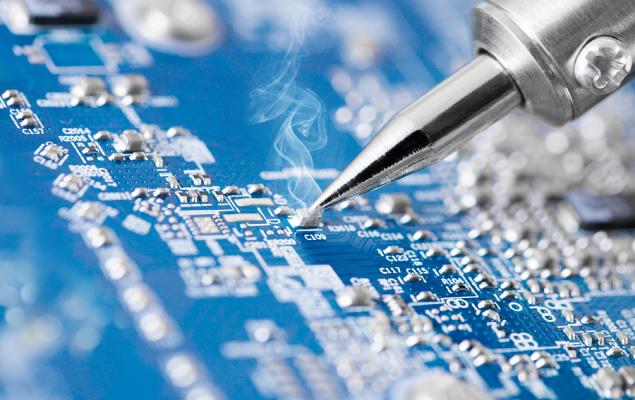
Global semiconductor sales reached a record $517.7 billion in Q3 2026, up 24.1% sequentially; September sales were $172.6 billion, up 146.8% year over year and 7.9% month over month. The article highlights AI infrastructure investment and recommends ADI, TSM, TXN and NVDA, citing expected current-year earnings growth of 66.9%, 3.3%, 63.1% and 95%, respectively. It also notes recent pressure on AI-related shares from valuation and growth-sustainability concerns, despite strong industry sales and improving earnings estimates for the four companies.
Analysis
The headline sales acceleration is not, by itself, evidence of durable end-demand: channel restocking, price/mix, and AI-related shipments can lift aggregate sales while non-AI end markets remain uneven. More importantly, the article’s sales totals and period comparisons appear inconsistent with the usual scale and cadence of SIA reporting; validate the underlying release before changing exposure. Treat the stated EPS growth rates as forecasts, not realized economics, and do not infer cheapness from them without valuation and estimate-quality data.
The exposure split matters. NVIDIA has the most direct upside to sustained accelerator demand, but also the greatest sensitivity to hyperscaler capex digestion, customer concentration, and multiple compression. TSM can benefit from advanced-node utilization across several chip designers, though capacity/capex execution and Taiwan-specific tail risk can dominate a quarter’s demand signal. ADI and TXN are less direct AI proxies: any AI-infrastructure benefit is likely mediated through power, signal-chain, and broader industrial demand, while their recovery case still needs confirmation in order trends and inventory. TXN’s owned-fab model can amplify utilization changes in either direction.
Days: sentiment and positioning can drive a sharp rebound or another de-rating. Over 1–3 months, hyperscaler capex commentary, foundry utilization/pricing, and analog order trends are better catalysts than broad sales aggregates. Over 6–18 months, incremental AI capacity only supports earnings if customer returns justify continued spending; a capex pause would transmit quickly to suppliers and then broader semiconductor sentiment. The contrarian risk is that investors extrapolate a cyclical/AI-led shipment surge as synchronized demand across the whole industry.
AllMind Terminal
AI-powered research, real-time alerts, and portfolio analytics for institutional investors.
Request TrialMarket Sentiment
Overall Sentiment
moderately positive
Sentiment Score
0.45
Ticker Sentiment
Key Decisions for Investors
- Do not add broad semiconductor beta on this article alone. First reconcile the cited SIA figures against the original release; if they do not reconcile, disregard the sales-growth signal.
- Watchlist, not an immediate recommendation: consider a small, defined-risk NVDA call spread only after a valuation-led pullback and confirmation in the next major customer capex/guidance cycle. Exit or avoid if hyperscalers cut infrastructure budgets, NVDA order visibility weakens, or the stock resumes underperforming semiconductors on positive guidance.
- For a less concentrated AI exposure, evaluate TSM against a semiconductor benchmark after checking current valuation, advanced-node utilization, capex, and Taiwan risk. A relative-value position is not justified from the article alone; falsify the foundry-upside thesis if utilization/pricing weaken or capex rises without corresponding demand visibility.
- Keep ADI and TXN as analog-cycle monitors rather than AI substitutes. Require improving bookings/order trends and inventory normalization before adding; renewed customer destocking or weaker industrial/automotive demand would invalidate the recovery case.
More News
- Voters rebuff data centers in every ballot measure except one during the 2026 midterms
- After the midterms, a bigger clash over data centers could be coming
- A blue wave sends futures into the green
- We're cutting our Qnity price target but still loved the beat-and-raise quarter
- The post-election rally masks a sharp split in the AI trade. Who stands to win?
- US markets rise as Democrats sweep midterm elections