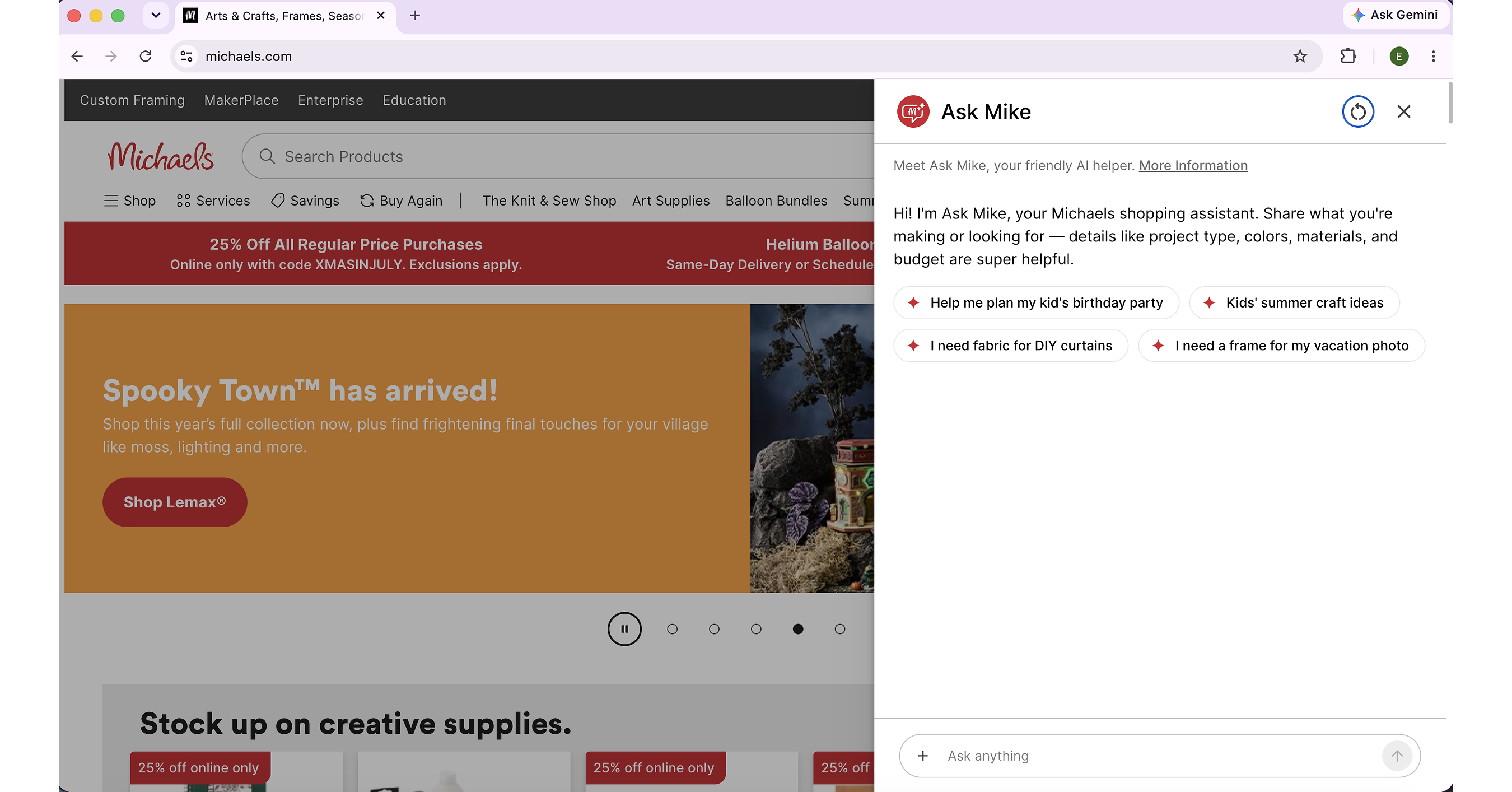
Michaels launched Ask Mike, a new Gemini Enterprise-powered AI shopping assistant now live on Michaels.com to improve product discovery from inspiration to purchase. Since its May release, it has generated nearly 75,000 conversations, with 60%+ of interactions focused on product discovery across the online assortment, signaling engagement traction. The retailer plans further upgrades, including AI-driven product overviews and contextual prompts on product detail pages.
This is more of a merchandising efficiency story than a near-term revenue inflection, so the equity impact should be modest unless the tool materially lifts online conversion or basket size over the next 1-2 quarters. The real economic lever for Michaels is not traffic; it is better monetization of high-intent, long-tail SKUs where search friction typically kills checkout. If the assistant reduces abandonment even modestly, the company can get a disproportionate benefit in gross profit dollars because fixed digital overhead is already largely absorbed.
For Google, the read-through is mainly strategic validation of Gemini Enterprise as a retail workflow product, not a direct earnings driver. The second-order benefit is sales velocity: one visible retailer demo can help Google Cloud compete for similar mid-market consumer names that need better discovery, personalization, and on-site conversion tooling. The offset is that high-engagement inference use cases can look great in demos while quietly pressuring cloud economics if utilization scales faster than realized margin lift for the customer.
The biggest loser is not a named public peer but any retailer that still relies on brittle keyword search and shallow merchandising rules; the threat is cumulative, because AI-assisted discovery can widen the gap in conversion efficiency between strong and weak operators. The catalyst path is months, not days: we need to see whether this shows up in online conversion, AOV, and digital mix in the next earnings cycle. The thesis is falsified if engagement stays high but conversion and repeat purchase do not move, or if AI/hosting costs rise enough to offset the gains.
Consensus is probably overrating the immediacy of the win and underestimating the cost side. In retail, AI search often increases browsing satisfaction before it improves P&L, and the first real beneficiaries are usually the platform vendors and consultants, not the retailer. The more important contrarian angle is that this is a proof-of-concept for retail AI adoption broadly, which should help Google Cloud’s pipeline more than it helps Michaels’ near-term valuation.
AI-powered research, real-time alerts, and portfolio analytics for institutional investors.
Request TrialOverall Sentiment
mildly positive
Sentiment Score
0.35
Ticker Sentiment
