
Fifth Third Q3 Earnings Beat Estimates on NII & Fee Income Growth
Source: zacks.com
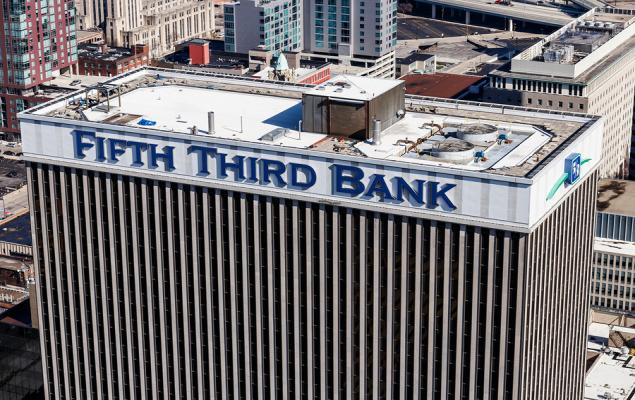
Fifth Third’s Q3 2026 adjusted EPS was $1.13 versus the $1.09 estimate, while revenue of $3.28 billion rose 42% year over year but missed the $3.34 billion consensus. NII increased 49% to $2.28 billion, supported by Comerica, and fee income rose 29%; expenses also surged 62% to $2.05 billion, while CET1 fell to 10.02% from 10.57%. For Q4, the bank expects NII to rise 2.5–3.5% sequentially and adjusted expenses to decline 2–3%; it expects the full $850 million annualized Comerica expense run rate to be realized in Q4 2026.
Analysis
The headline EPS beat is less informative than the earnings mix: acquisition-driven balance-sheet expansion is lifting NII, while the revenue miss and elevated expense base leave organic operating leverage unproven. The key near-term setup is whether merger savings convert into actual sequential expense relief without sacrificing client retention or fee momentum. If they do, the market can begin underwriting a cleaner post-integration earnings run rate; if not, the current NII growth may be capital- and cost-intensive rather than accretive.
The counterweight is diminishing capital flexibility. Lower CET1 alongside a smaller allowance relative to loans makes the combination of continued loan growth and credit normalization more consequential: a turn in commercial borrower performance could force higher provisioning just as integration costs remain sticky. Falling charge-offs are encouraging but backward-looking; rising nonperforming balances warrant monitoring rather than extrapolating the improvement.
Over days, the beat and Q4 outlook may support sentiment. Over 1–3 months, expense realization and deposit pricing are the decisive catalysts. Over 6–18 months, the question is whether acquired scale yields durable returns above the cost of integration and capital. PNC and M&T are useful operating comparators, but the supplied data do not establish a valuation-based pair trade. Contrarian read: investors may be treating headline NII growth as organic momentum and underweighting revenue shortfall, capital consumption, and execution risk.
AllMind Terminal
AI-powered research, real-time alerts, and portfolio analytics for institutional investors.
Request TrialMarket Sentiment
Overall Sentiment
mildly positive
Sentiment Score
0.25
Ticker Sentiment
Key Decisions for Investors
- Do not chase the EPS beat. Consider a small, staged FITB long only after price action settles and the next update confirms sequential expense reduction alongside stable fee income; the upside case is synergy-led operating leverage, while failure to lower adjusted costs or a material CET1 decline falsifies it.
- For the next 1–3 months, track realized merger savings versus the stated run-rate, deposit costs, and average loan growth. Treat guidance as a company target, not verified savings; absent evidence of conversion into lower expenses, keep exposure neutral rather than paying for the projected earnings step-up.
- Monitor nonperforming loans, net charge-offs, allowance coverage, and CET1 together. A renewed rise in charge-offs or provisions, especially with weaker capital, is a reason to reduce or avoid FITB exposure; improving NPLs and stable capital would strengthen the post-integration thesis.
- No compelling peer pair is established from this information alone. Reassess FITB versus PNC and M&T after comparing valuation, organic NII trends, expense efficiency, and capital returns on consistent reporting bases.
More News
- These Analysts Cut Their Forecasts On M&T Bank Following Upbeat Q3 Results
- Fifth Third Bancorp raises quarterly profit as Comerica integration advances
- Fifth Third Bancorp: 3 Key Takeaways for Long-Term Investors
- Fifth Third: Solid Q3 Should Calm Margin Fears (Upgrade)
- BlackRock, GIC among investors chasing Indian telecom major Jio's IPO as anchor bids top $26 billion
- Nscale, Anthropic Eye $45 Billion Cloud Deal as AI Trade Rebounds