
ConocoPhillips: The Oil Price Play I Want, But With Added Risk
Source: seekingalpha.com
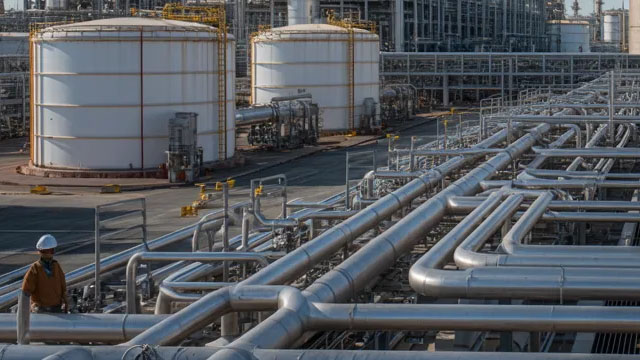
ConocoPhillips is rated Buy, with potential oil-price upside viewed as outweighing geopolitical risks tied to operations in Qatar, Libya, Iraq and Syria. Q2 execution included record Permian output, $4.2B of free cash flow and $3B returned to shareholders, although total production declined 4% year over year. The investment case depends on U.S. Lower 48 production strength and supportive oil prices despite elevated international exposure.
Analysis
COP's valuation case is less about headline production growth than about whether management can convert its diversified asset base into lower-decline, lower-capital-intensity barrels after recent portfolio expansion. The market is likely assigning a geopolitical discount to international volumes while giving limited credit to the embedded LNG-linked optionality in Qatar; that discount can narrow if cash-return guidance holds through a softer commodity tape. Relative to EOG and FANG, COP offers greater oil-beta diversification but less pure-play Permian torque, making it the better vehicle for a sustained crude upside scenario rather than a short-cycle U.S. shale rebound.
Near term, oil-price direction will dominate: a $5/bbl change in realized oil pricing should have a materially larger effect on annual free cash flow than modest quarterly volume variance. Over the next 1-3 months, the key catalyst is evidence that Lower 48 growth offsets operational or political interruptions abroad without requiring higher capital spending; a capex increase to protect production would undermine the FCF and buyback multiple. The principal tail risk is not simply a supply disruption—higher crude could initially help COP, but an extended disruption could impair entitlement volumes, working capital, and the reliability premium investors expect from a large-cap producer.
Contrarian view: geopolitical concerns may already be over-discounted if the affected international assets remain cash-generative and the company preserves its return framework. Conversely, consensus Buy ratings can prove fragile if crude weakens: COP's broad international footprint does not insulate it from a global demand-led oil selloff, and a reduction in repurchase pace would likely cause sharper multiple compression than peers with visibly growing domestic production. The thesis is falsified by downward revision to full-year production or FCF guidance, a material interruption in Libya/Iraq/Qatar-linked cash flows, or WTI sustaining below roughly $65/bbl.
AllMind Terminal
AI-powered research, real-time alerts, and portfolio analytics for institutional investors.
Request TrialMarket Sentiment
Overall Sentiment
mildly positive
Sentiment Score
0.32
Ticker Sentiment
Key Decisions for Investors
- Initiate a 3-6 month long COP position only on WTI stabilization above $70/bbl or following confirmation that full-year production and capital-return guidance remain intact; target 10-15% upside from oil-price leverage and discount normalization, with a 6-8% stop if WTI breaks $65 or guidance is cut.
- Express relative value as long COP / short XOP for 3-6 months if management demonstrates capital discipline: COP's scale, buyback capacity and LNG/international optionality should outperform smaller E&Ps if crude remains range-bound, while the hedge reduces outright oil-beta risk.
- Do not add on geopolitical-spike strength alone. If crude rallies above $85 primarily on disruption risk, monetize part of the long or buy 3-month COP put spreads; elevated oil may be offset by an increased probability of direct asset or cash-flow interruption.
- Monitor the next earnings release for three decision variables: Lower 48 exit-rate growth, capex versus plan, and repurchase pace. A production miss without offsetting capex restraint is a signal to rotate from COP into EOG or FANG, which provide cleaner domestic growth exposure.
More News
- Iran vows 'painful' retaliation as Trump piles on pressure ahead of UN General Assembly meeting
- Chinese biopharma stocks jump as U.S. weighs keeping door open to drug deals
- Oil falls as crude flows remain 'surprisingly strong'
- Trump & Xi to Meet Amidst Friction on Wars, Tech, Trade
- US Diesel Tops $6.50 a Gallon as Wars Worsen Global Fuels Crunch
- Here are the 3 big things we're watching in the stock market this week
From AllMind Research
- Anthropic IPO Preview: Valuation, Timing, and What to Watch
- Shein After the IPO: Venue, Valuation, and What Must Be Proved
- What AI Research Tools Should a Small Hedge Fund Buy First?
- 2026 Global Markets Outlook: Asset Allocation After the Great Disconnect
- Fintool Alternatives After the Microsoft Acquisition