
PolicyMe: Family Well-Being Leads Life Insurance Priorities for Canadians
Source: PR Newswire
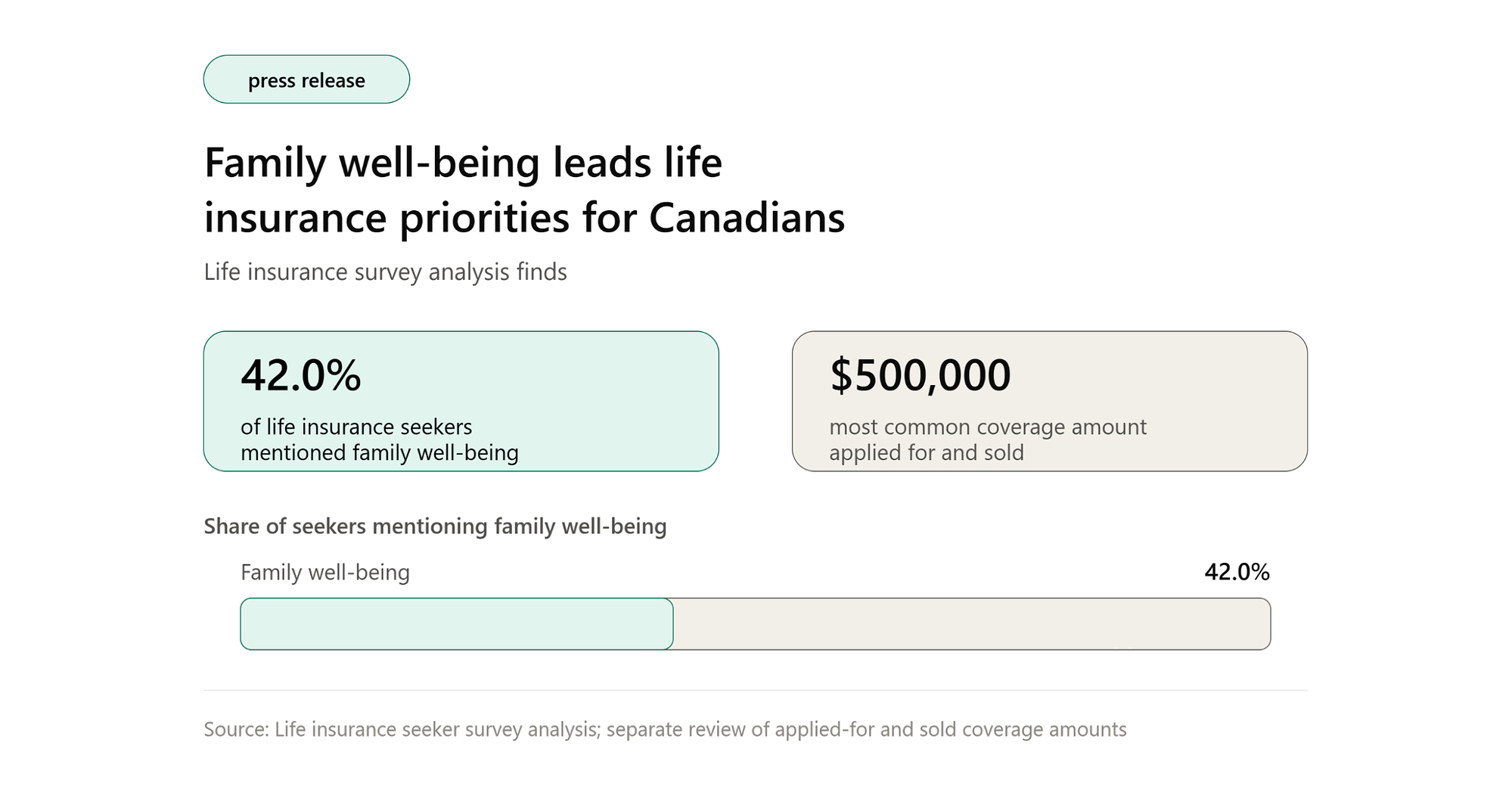
PolicyMe's analysis of more than 6,500 Canadian customer interactions found family well-being was cited in 42.0% of life-insurance discussions, versus 19.7% for mortgage obligations and 17.4% for end-of-life expenses. Across more than 48,000 interactions, $500,000 was the most common coverage amount applied for and sold, followed by $1 million and $250,000. The findings broadly align with industry data showing average insured-household protection of $509,000 in 2024, within a Canadian market covering 23 million people and roughly $6 trillion of life insurance.
Analysis
This is not a demand inflection signal for listed insurers; it is a marketing dataset from a digital distributor with self-selected, younger applicants. The investable read is narrower: household protection demand is increasingly tied to income continuity rather than a discrete mortgage payoff, favoring flexible term products and direct-to-consumer distribution over bank-sold creditor insurance. That creates modest long-run pressure on bank insurance fee pools and on insurers with expensive captive distribution, but underwriting economics—not lead volume—will determine value creation.
For Canadian life carriers, rising household leverage can expand policy demand while simultaneously worsening anti-selection: financially stretched applicants are more likely to seek larger coverage, and deteriorating mortality, lapse, or claims experience can offset premium growth. The key 1-3 month datapoints are Canadian mortgage renewals, unemployment, and consumer delinquencies; weaker household cash flow may lift quote activity but reduce bind rates and accelerate policy lapses. A sustained rate decline would be more constructive for sales conversion and insurer investment portfolios, although lower reinvestment yields eventually dilute earnings.
The non-obvious structural beneficiary is digital distribution/software rather than the risk carrier, but PolicyMe is private and the release provides no CAC, conversion, retention, carrier commission, or loss-ratio data. There is therefore no clean public-equity expression from this item alone. Consensus may overread coverage-selection anecdotes as proof of underinsurance; the economically relevant question is whether incremental policies are new protection or replacement of existing coverage at lower commission cost.
AllMind Terminal
AI-powered research, real-time alerts, and portfolio analytics for institutional investors.
Request TrialMarket Sentiment
Overall Sentiment
neutral
Sentiment Score
0.10
Key Decisions for Investors
- No standalone trade on this release; maintain neutral exposure to Canadian life insurers until quarterly disclosures show new-business strain, lapse rates, and mortality claims improving simultaneously.
- Monitor MFC and SLF at next earnings for Canadian individual-insurance sales growth versus distribution expense and policy lapse experience. Consider a tactical long only if sales growth exceeds expense growth and management confirms no adverse selection; falsifier: reserve strengthening or higher lapse assumptions.
- Use FCX? No suitable liquid Canadian digital-life-distribution proxy is identified in the supplied data; place an alert for a listed fintech/insurtech partnership or carrier-distribution agreement rather than forcing a proxy trade.
- For bank exposure, watch CM, RY, TD and BNS insurance-fee disclosures over 6-18 months. A measurable migration from creditor insurance toward independent term coverage would be a modest relative negative for bank fee income, but the revenue pool is too small for a near-term directional short without evidence of accelerated attrition.
More News
- What investors need to know about Alphabet's stock-busting earnings report
- Our next steps for Alphabet stock after earnings disappoint at nearly every turn
- Budget 2026 speech
- Wendy's shares jump 15% as Nelson Peltz's Trian offers $1.4 billion to buy burger chain
- Fortinet’s stock is taking a dive after earnings. Here’s why.
- RBC Capital cuts Sprouts Farmers Market stock rating on margin concerns