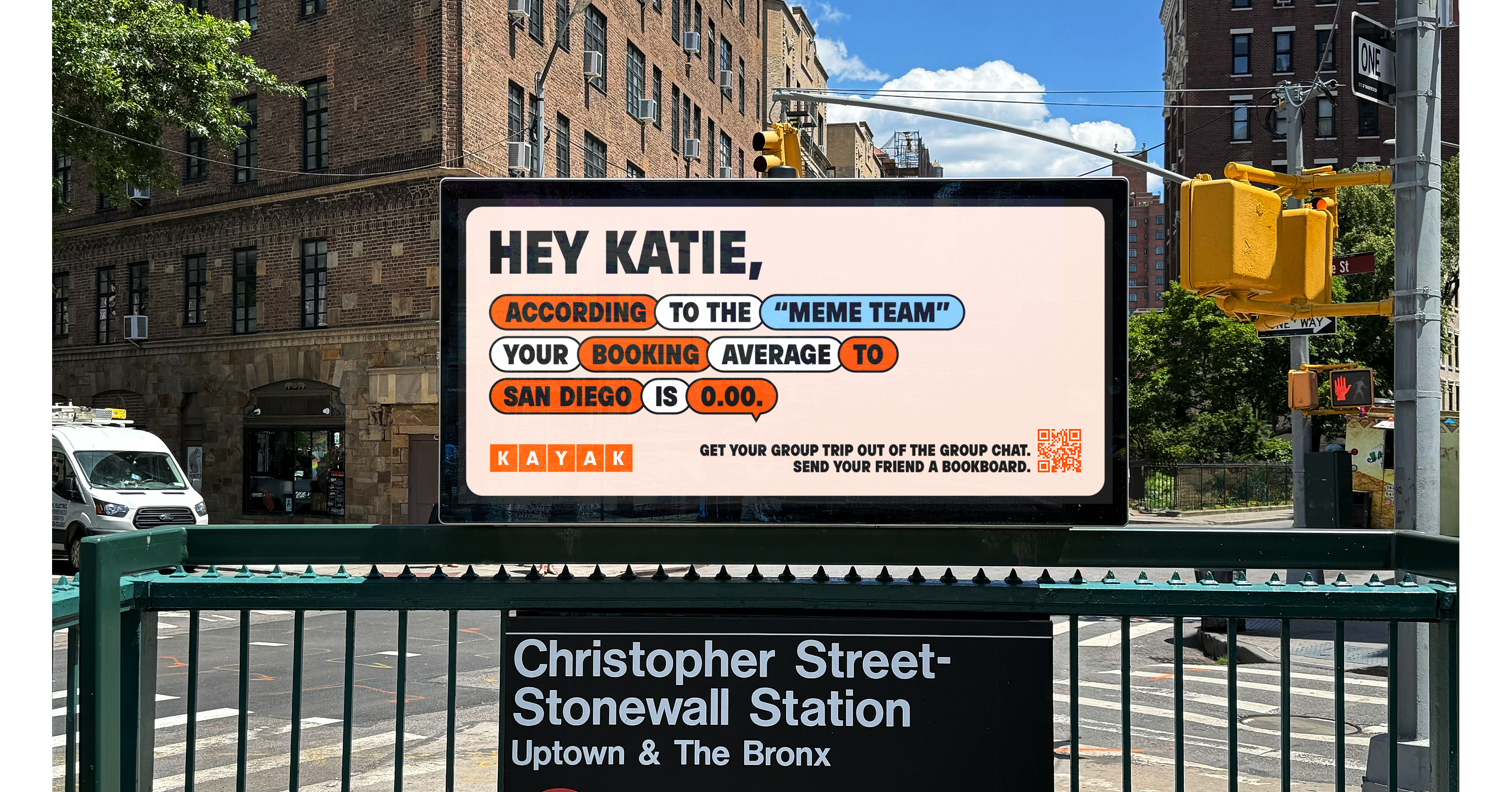
KAYAK is launching “BookBoards” (digital billboards in New York, Chicago, and Los Angeles) to convert group-trip plans that are stuck in chat—84% of travelers report group trips get delayed this way, typically for 1–3 months. The campaign coincides with AI-powered group planning tools (Ask AI on KAYAK) and highlights 2026 group destinations with per-person flight prices around $306–$404 and hotel rates generally $188–$394. Separately, KAYAK notes domestic airfare is up 23% YoY and hotel rates up 3% YoY, positioning group travel as a cost-stretching strategy.
This is mostly a funnel-improvement story, not a demand inflection story. For BKNG, the economic lever is conversion efficiency: if the AI planning layer meaningfully reduces abandonment in higher-AOV group itineraries, it can improve booking mix toward larger rooms and longer stays, but the revenue delta is likely small versus Booking.com’s core lodging engine. The first-order market reaction should be muted; the only material upside is if management later shows higher app engagement or lower customer acquisition cost from these tools.
The second-order beneficiaries are probably the inventory providers most suited to groups: ABNB and hotel chains with family-size rooms or suite-heavy portfolios. Group travelers are more price-sensitive, so any incremental demand could skew toward value inventory, which is a headwind for premium urban hotels and a tailwind for larger-format rentals and midscale leisure destinations. On the flip side, more search activity may not translate into more monetization for metasearch peers if AI short-circuits the browser-based comparison loop and shifts users into a booking path controlled by BKNG.
The contrarian view is that this is mostly marketing theater. Billboard stunts and chat-style prompts can raise branded traffic, but they do not solve the real constraint: coordinating commitment and payment across multiple people, which is a behavioral problem with weak elasticity. Over 1-3 months, watch for any lift in app usage, conversion, or take rate; absent that, the thesis fades. The main falsifier for a BKNG-long is if AI features increase query volume without improving booking conversion, which would just raise traffic costs and compress margins.
AI-powered research, real-time alerts, and portfolio analytics for institutional investors.
Request TrialOverall Sentiment
mildly positive
Sentiment Score
0.12
Ticker Sentiment
