
Metafoodx Introduces Real-Time Food Quality and Waste Tracking for Chefs and Dining Teams
Source: PR Newswire
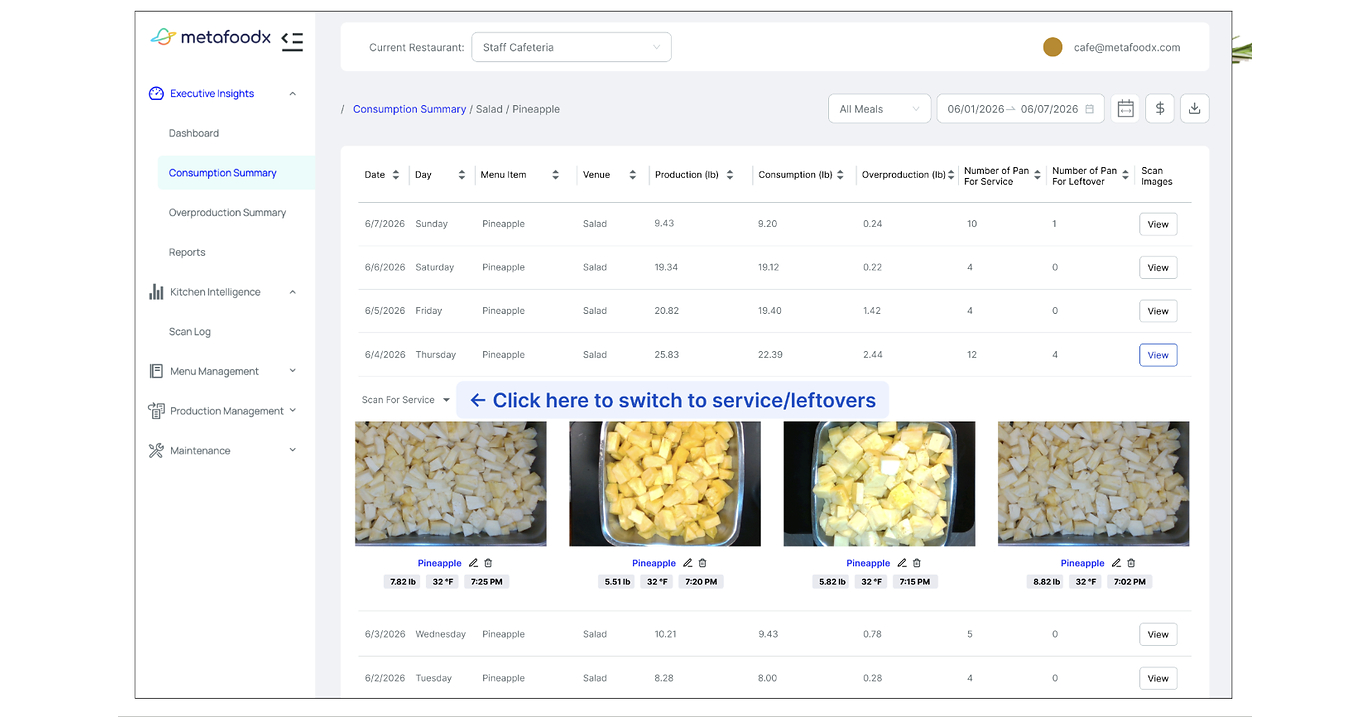
Metafoodx introduced four platform updates, including real-time Freshness Alerts, automated weekly AI reporting, scan-image menu metrics, and empty-pan baseline-weight checks. The AI kitchen-intelligence tools are intended to improve food-quality monitoring and provide more reliable waste data for foodservice operators, where retail and foodservice account for roughly 40% of U.S. food waste by weight, according to ReFED. The release is a positive product enhancement but is unlikely to have broad public-market impact.
Analysis
This is not independently investable news, but it reinforces a broader procurement-software theme: foodservice operators facing wage inflation and tighter sustainability reporting will increasingly favor workflow tools that convert waste reduction into auditable unit economics. The economic value accrues less to standalone point solutions unless they demonstrate low installation friction and measurable payback, and more to scaled distributors, facilities-management providers, and enterprise software platforms that can bundle data capture into existing contracts.
Near term, the principal read-through is modestly positive for foodservice outsourcing and hospitality operators with large, repetitive institutional meal volumes—Compass Group (CPG.L), Sodexo (SW.PA), Aramark (ARMK), and Marriott (MAR)—because lower overproduction and spoilage can offset food-cost inflation without overt menu price increases. For ARMK, the relevant catalyst is evidence that technology-enabled waste programs improve operating margins or retention in education and healthcare contracts over the next 1-3 quarters; a vendor press release alone does not establish either adoption scale or savings realization.
The non-obvious risk is that improved measurement initially exposes more waste rather than reducing it, creating a short-term drag through tighter production controls, training costs, and discarded inventory. Over 6-18 months, credible waste data can become a competitive requirement in university and corporate-dining RFPs, favoring incumbents with digital operating infrastructure while raising switching costs; however, camera/scan hardware and fragmented kitchen workflows remain barriers to rapid penetration.
AllMind Terminal
AI-powered research, real-time alerts, and portfolio analytics for institutional investors.
Request TrialMarket Sentiment
Overall Sentiment
mildly positive
Sentiment Score
0.35
Key Decisions for Investors
- No standalone trade on Metafoodx; treat this as an adoption watch item until customer count, contract value, retention, and independently verified food-cost savings are disclosed.
- Maintain ARMK on a 1-3 quarter watchlist for margin upside: initiate only if management quantifies technology-driven food-cost savings or raises operating-margin guidance; invalidate if organic revenue growth requires incremental pricing while margins remain flat.
- Relative-value screen: prefer long CPG.L or SW.PA versus short ARMK only if European operators demonstrate superior food-cost margin conversion in upcoming results; this is a data-dependent alert, not an active recommendation.
- Monitor university and corporate-dining RFP language over the next 6-18 months for mandatory waste-reporting requirements. A material increase would support higher renewal rates and modest multiple expansion for CPG.L, SW.PA, and ARMK; absence of procurement adoption falsifies the structural thesis.
More News
- China's AI leaders keep quiet despite U.S. 'publicity' on tech risks
- U.S. stock futures drift higher with Fed rate hike in focus
- AWS says it can't restore service to Bahrain, UAE facilities 6 months after Iran strikes
- Chinese investors rush into US stocks as Beijing opens wider path overseas
- Factbox-How AI leaders and world governments react to ’AI doom’ fears
- Is Amazon Stock a Buy After Its Best Quarter in Years?