
Bolt Graphics Achieves Silicon Bring-up of Zeus Test Chip, Opens Taipei Office
Source: PR Newswire
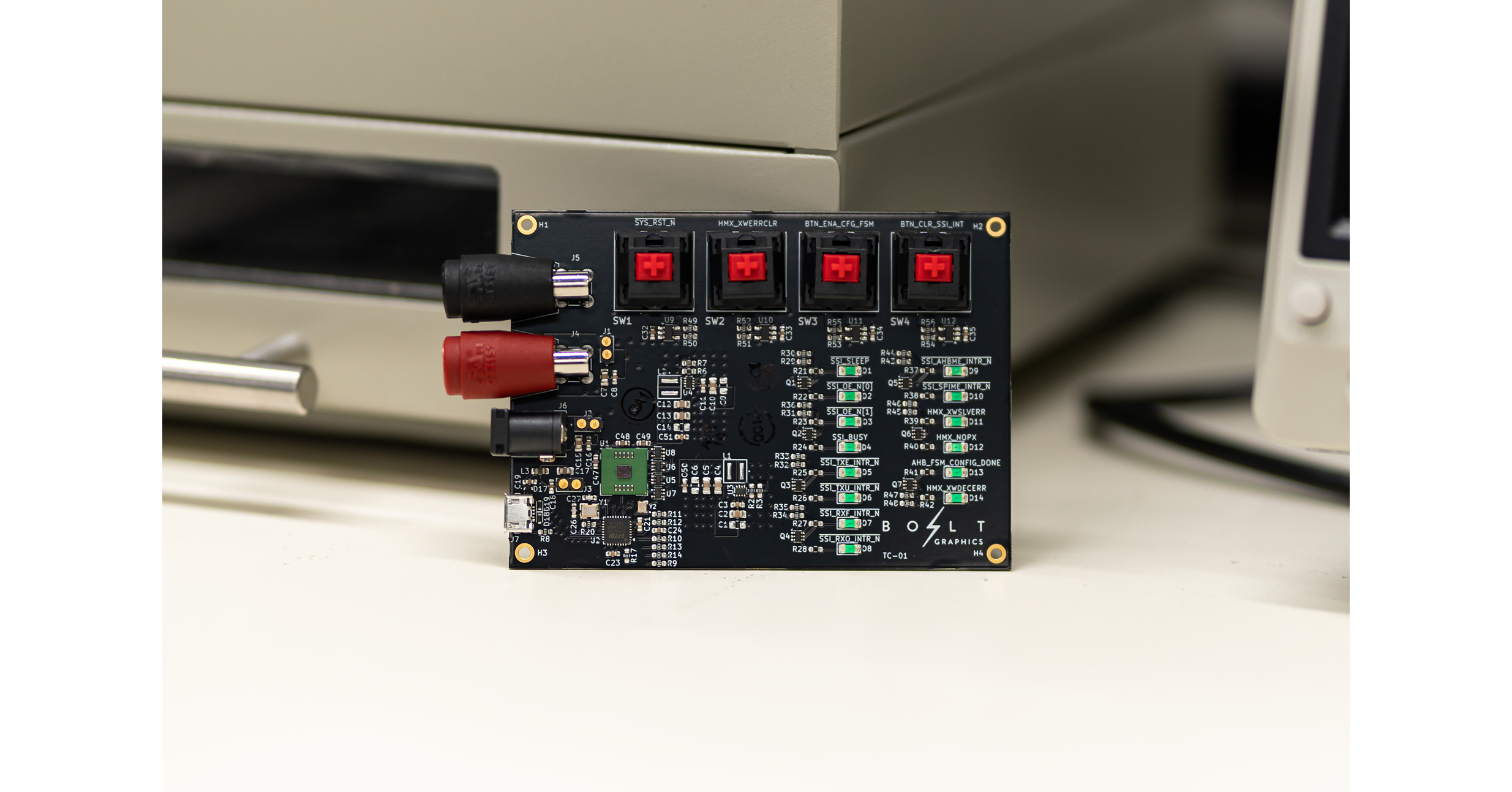
Bolt Graphics brought up its 12nm Zeus test chip in 24 hours with no functional issues across tests from -40°C to 85°C. The 6-square-millimeter chip drew 1.4 watts versus 35 watts for the FPGA prototyping platform, exceeding the company's internal performance and efficiency estimates. Bolt opened a Taipei office to coordinate manufacturing and plans developer access in Q1 2027, early-access GPU availability in late 2027, and volume production in 2028.
Analysis
The investable read-through is limited: this is an early technical milestone, not evidence of commercial demand or a material foundry revenue stream. Bolt Graphics is unlisted, and the announcement does not establish wafer volumes, yield, customer commitments, or production economics. For TSMC, the potential N5P workload is too unquantified to support a change in earnings expectations; the Taipei presence is operationally useful to Bolt but does not itself secure capacity. The key execution gap is between a functioning test chip and a production GPU with competitive performance, software support, reliable yields, and repeat customers.
Over the next 1–3 months, developer access and independently reproducible workload benchmarks matter more than the company’s internal performance claims. A failure to show useful performance on full workloads—or delays in the software and developer ecosystem—would weaken the 2027–28 commercialization case. Over 6–18 months, successful deployment could validate specialized accelerators for electromagnetic simulation and adjacent engineering workloads, adding niche competition for established GPU platforms such as Nvidia and AMD. It would not, by itself, imply broad displacement in general-purpose compute.
Contrarian view: the headline’s silicon bring-up may sound like product validation, but the tested 12nm device and the planned N5P commercial product are distinct steps; neither proves production readiness or customer economics. No immediate trade is warranted on this evidence.
AllMind Terminal
AI-powered research, real-time alerts, and portfolio analytics for institutional investors.
Request TrialMarket Sentiment
Overall Sentiment
moderately positive
Sentiment Score
0.45
Key Decisions for Investors
- Do not trade TSMC on this announcement alone. Treat any eventual Bolt wafer demand as an unquantified, likely immaterial catalyst until volumes, production timing, and a commercial commitment are disclosed.
- Add Bolt to a watchlist rather than initiate exposure: verify Q1 2027 developer access, independent benchmark results on target workloads, software portability, customer participation, and whether the N5P production design reaches tape-out on schedule.
- Reassess the competitive risk to Nvidia and AMD only if external users demonstrate sustained workload-level advantages and Bolt converts early access into paid deployments; a test-chip efficiency comparison against an FPGA is not a like-for-like commercial GPU comparison.
- Falsifiers for the commercialization thesis are delayed developer access or production milestones, weak independent benchmarks, lack of named customer deployments, or evidence that software adaptation and system-level costs erase the claimed acceleration.
More News
- Applied Materials’ $5 billion AI lab aims to cut chip development time in half—and restore Silicon Valley’s edge
- Why this little known Chinese chipmaker has caused a global stock rout
- The AI trade is cracking. Here's how to profit
- Taiwan agrees to buy 30% of gas from Alaska LNG project, Trump says
- South Korean carmaker Hyundai plans 'strategic' investment of $15.5 billion in India by 2032
- Wells Fargo CFO on Earnings, Deals, Consumer Strength