
TerraMaster Launches 725 Series Xeon Rackmount NAS to Deliver Enterprise Unified Storage for the AI Era
Source: PR Newswire
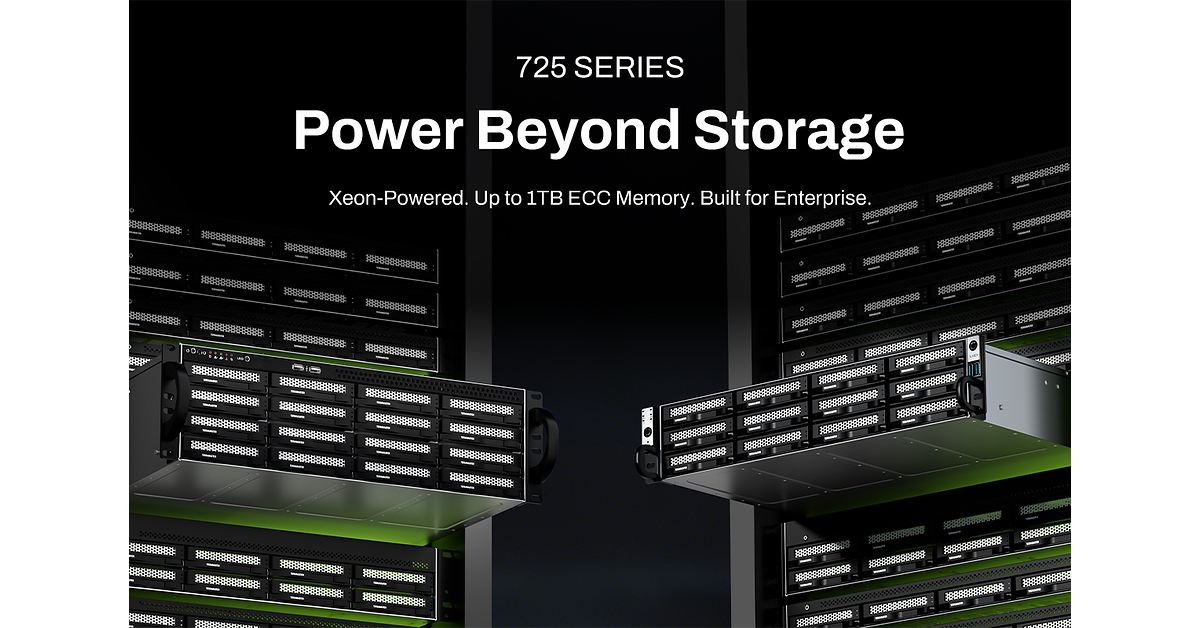
TerraMaster launched its 725 Series enterprise rackmount NAS lineup on September 22, 2026, spanning four Xeon-based models with 8 to 16 drive bays and 4-core or 8-core Intel Xeon D processors. The U12-725 offers four 10GbE SFP+ ports, PCIe 4.0 NVMe support, laboratory-tested sequential read/write speeds of up to 6,250/3,480 MB/s, and up to 945,063 4K random-read IOPS. The systems run TerraMaster's TOS 7 AI-native operating system and target unified enterprise storage for AI datasets, virtualization, media production, backup, and surveillance workloads.
Analysis
This is not a material Intel demand catalyst in isolation: Xeon D is an embedded/edge platform with lower ASP and volume than mainstream server CPUs, and a single NAS vendor launch is unlikely to alter near-term estimates. The more relevant signal is architectural: AI-adjacent storage is moving toward lower-cost, on-premise inference/training-data deployments rather than all-flash enterprise arrays or cloud-only workflows. That trend creates a modest unit opportunity for Xeon D, 10/25GbE NICs and SSDs, but it is more likely to pressure incumbent NAS vendors on price and channel margins than expand total storage spend immediately.
The product's claimed throughput is configuration-dependent and does not establish sustained enterprise performance, software reliability, or channel adoption. In the next 1-3 months, reseller availability, street pricing versus Synology/Asustor/QNAP and evidence of enterprise-grade support contracts matter more than launch specifications. Over 6-18 months, the limiting factor for local AI storage is likely GPU utilization and networking bottlenecks; customers may choose NVIDIA-certified AI infrastructure or cloud object storage if integration and data-governance tooling remain immature.
Contrarian view: the market tends to equate every "AI-ready" storage launch with incremental semiconductor demand. Budget NAS appliances can instead cannibalize higher-margin storage systems and attach relatively little compute content per deployed dollar. For Intel, a broader edge-storage refresh could be strategically useful only if it converts into recurring design wins across OEMs; this announcement alone is not a basis to change earnings expectations or valuation.
AllMind Terminal
AI-powered research, real-time alerts, and portfolio analytics for institutional investors.
Request TrialMarket Sentiment
Overall Sentiment
mildly positive
Sentiment Score
0.35
Ticker Sentiment
Key Decisions for Investors
- No standalone INTC trade on this launch; the expected revenue contribution is immaterial relative to Intel's data-center and edge revenue base. Reassess only if multiple NAS/OEM design wins indicate Xeon D unit momentum in the next two earnings cycles.
- Maintain a watchlist pair: long INTC / short WDC or STX only if channel data show a sustained SMB/edge-storage refresh with rising enterprise-HDD shipments; the thesis fails if cloud-capex demand absorbs storage budgets or HDD pricing weakens despite unit growth.
- For storage-equipment exposure, monitor NET and ANET rather than treating low-cost NAS deployment as a direct beneficiary: network upgrades become investable only if 25/100GbE attach rates, rather than advertised 10GbE ports, rise in enterprise edge deployments over 6-18 months.
More News
- Meta's quick success with Muse puts consumers back in the driver's seat of the AI trade
- Trump to speak at UN; Alibaba’s new AI chip - what’s moving markets
- No new stock highs, no problem: Options traders bet they're coming in these names
- Cognex to Acquire RealSense, Expanding Machine Vision Leadership into High-Growth Robotic Perception Market
- Singapore’s Nexstrom wants to bring 2D semiconductors to chip fabs
- Wall Street’s Nasdaq hits all-time high as AI frenzy gathers pace