
Nordic intègre l'IA en périphérie sur les appareils Wi-Fi alimentés par batterie, atteignant ainsi une consommation en veille vingt fois moindre grâce à la nouvelle série nRF71
Source: PR Newswire
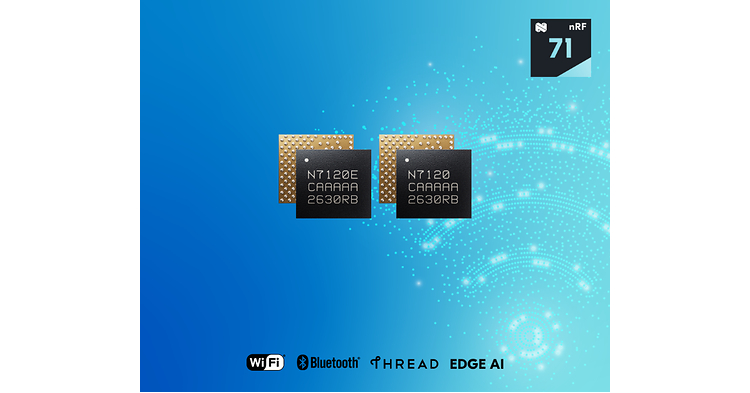
Nordic Semiconductor launched its nRF71 system-on-chip series, combining Wi-Fi, Bluetooth LE, Thread and edge-AI capabilities for connected devices. The company says standby power is up to 20 times lower than its existing nRF70 Wi-Fi products, while the Axon NPU runs machine-learning models 10–17 times faster than an Arm Cortex-M33 at 256 MHz. The nRF7120 supports dual-band Wi-Fi 6; the nRF7120E adds tri-band Wi-Fi 6E and the Axon NPU. Samples are available to a small group of customers.
Analysis
The investment case is a design-win option, not yet an earnings event. If customers can remove a separate Wi-Fi, Bluetooth/Thread and inference component, Nordic could gain content per device and strengthen software-toolchain lock-in; the offset is that integration may shift value away from external MCU/NPU and module suppliers. Nordic’s existing low-power portfolio also faces some self-cannibalization, so the relevant test is incremental platform revenue and gross profit—not unit shipments alone.
Near term (days): the announcement may support sentiment, but a small, selected sample program does not establish production readiness or customer demand. Over 1–3 months, Electronica demonstrations and disclosed customer/design-win evidence are the key catalysts. Over 6–18 months, qualification, certification, production ramp and real-world battery life determine whether this opens new Wi-Fi-on-battery categories or remains a compelling specification sheet. Potential competitors include Silicon Labs, Espressif and Qualcomm, alongside standalone connectivity and edge-inference vendors; the degree of substitution depends on price, availability and developer migration costs.
Contrarian point: the headline power and inference comparisons are vendor claims under unspecified test conditions. Always-on Wi-Fi, radio coexistence, workload, memory and thermal constraints could erode system-level savings. The absence of disclosed pricing, shipment timing, customer commitments and revenue contribution argues against extrapolating this launch into near-term estimates. Thesis weakens if qualification slips, customers retain discrete components, or subsequent guidance fails to show incremental growth without margin dilution.
AllMind Terminal
AI-powered research, real-time alerts, and portfolio analytics for institutional investors.
Request TrialMarket Sentiment
Overall Sentiment
mildly positive
Sentiment Score
0.35
Ticker Sentiment
Key Decisions for Investors
- Treat NOD as a watchlist catalyst rather than chase the launch. Reassess after evidence of named or otherwise verifiable design wins, production timing, pricing and expected contribution to revenue or gross profit.
- For a constructive medium-term view, consider building NOD exposure only on confirmed qualification and customer adoption; size it as an execution-sensitive position, since current evidence is samples for a limited customer group rather than volume demand.
- Track system-level battery-life results, Wi-Fi coexistence/certification, and whether customers can eliminate external components. These data distinguish genuine bill-of-materials and power benefits from benchmark claims.
- Falsification triggers: qualification or availability delays, customer designs continuing to use discrete radios/accelerators, or management guidance showing no incremental growth or margin benefit as the product ramps. No standalone options trade is justified without timing, valuation and volatility data.
More News
- What Wall Street billionaires are saying about Democrats' midterm sweep
- NextDC shares surge 43% after Goodman, Digital Realty stake purchases
- A blue wave sends futures into the green
- Asian chip stocks slide as disappointing Qualcomm, Arm earnings weigh
- Oil and data centre stocks sink after US midterms
- China Blocks SoftBank Acquisition of ABB Robot Unit, FT Says