
Could SpaceX be worth $12 trillion one day? Citi says Starship gets it a step closer.
Source: marketwatch.com
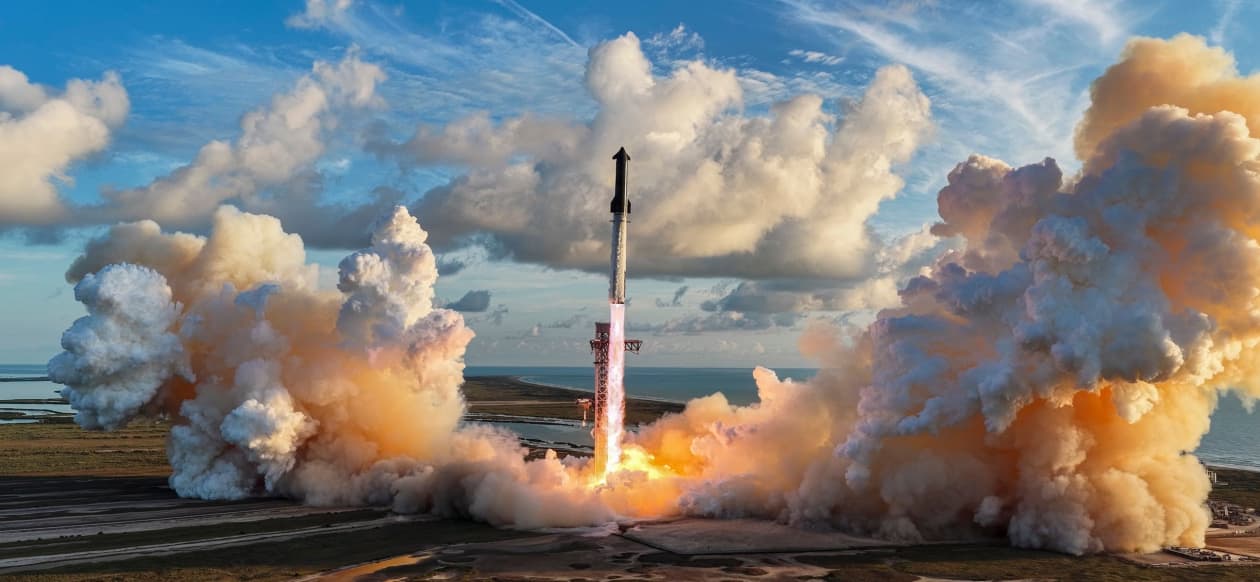
Citi said SpaceX's successful 14th Starship flight is a step toward a long-run share value of $900 or more, implying an approximately $12.2 trillion valuation. The target is more than six times SpaceX's current roughly $2 trillion market capitalization and exceeds twice Nvidia's current size. The launch strengthens the technical case for Starship, though the valuation remains a highly long-term analyst scenario.
Analysis
The relevant read-through is not a near-term mark for a private asset, but a potential reduction in the cost and cadence constraints governing the space economy. If reusable heavy-lift economics become commercially repeatable over the next 12-24 months, the largest value transfer is from legacy launch and satellite operators toward applications that can deploy denser constellations: direct-to-device connectivity, Earth observation, defense sensing, and in-space data infrastructure. That is structurally negative for launch pricing, but can expand the addressable market for satellite-enabled services.
The valuation framing is not investable without evidence that launch success converts into contracted payload volume, reflight reliability, insurance-rate reductions, and positive incremental margins. A single technical milestone should not change Citi's earnings power or NVDA's fundamentals; C's exposure is reputational/research-distribution rather than economically material. The non-obvious risk is that increasingly capable launch capacity commoditizes orbital access faster than downstream satellite demand develops, impairing returns for capital-intensive constellation operators.
Public-market second-order pressure is most acute for IRDM, where lower-cost, higher-capacity LEO alternatives could erode premium satellite-connectivity pricing over a 6-18 month horizon. RKLB has more defensible near-term exposure through space systems and dedicated small-launch missions, but its launch multiple becomes vulnerable if heavy-lift rideshare economics compress dedicated-launch demand. The contrarian view is that the market may over-credit technology progress before regulatory approvals, ground-network buildout, spectrum rights, and customer adoption determine monetization; this is a watch catalyst, not a reason to chase adjacent equities today.
AllMind Terminal
AI-powered research, real-time alerts, and portfolio analytics for institutional investors.
Request TrialMarket Sentiment
Overall Sentiment
moderately positive
Sentiment Score
0.42
Ticker Sentiment
Key Decisions for Investors
- No directional position in SPCX based on this research note: it is not a broadly tradable public common equity, and a credible valuation framework requires disclosed launch cadence, reflight cost, backlog conversion, and satellite-service unit economics.
- Establish a 6-12 month watchlist short in IRDM versus long RKLB only if IRDM underperforms its next two revenue-growth or service-ARPU expectations while Starlink/direct-to-cell deployment cadence accelerates. Thesis risk: IRDM's government and specialized connectivity mix proves materially stickier than consumer LEO alternatives; exit if IRDM reaffirms growth and margin guidance while RKLB space-systems backlog weakens.
- Avoid treating NVDA as a sympathy long. Add only if space-network deployments create identifiable incremental demand in a reported data-center, edge-compute, or sovereign-defense order pipeline; absent that evidence, the linkage is narrative rather than earnings-relevant.
- For AMZN, monitor Kuiper deployment milestones and launch-procurement disclosures over the next 1-3 months. Improved competing launch economics could raise competitive intensity and cap long-run satellite broadband returns, but AMZN's consolidated earnings sensitivity is too small for a standalone short catalyst.
More News
- Trump's meeting with tech leaders leaves AI safety more unsettled than ever
- “We’re not going to shoot ourselves in the foot” over Hugging Face, says OpenAI’s chief research officer
- AI's coming roadblock in regulation: Antitrust hawks
- Moderna has been on a tear since mid-August. Citi now sees it plunging 60%
- Palo Alto Networks’ Nikesh Arora is building a defense against the dark side of AI
- Why is Moderna stock down 4% today?