
Novo Falls 5% in a Week: How Should Investors Approach the Stock Now?
Source: zacks.com
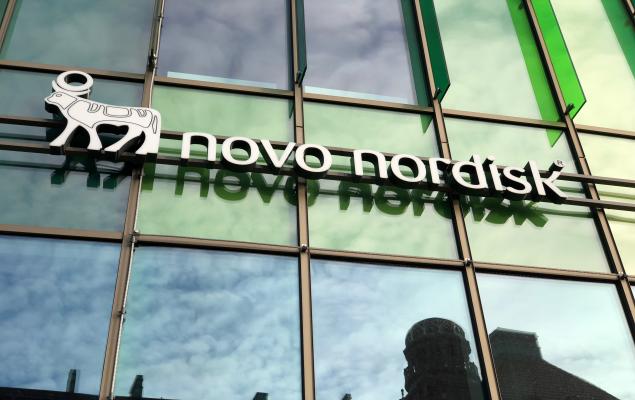
Novo Nordisk shares fell about 5% in the past week and are down 18% year to date, versus 10.9% industry growth, as Morgan Stanley downgraded the stock to Underweight while retaining its $40 price target. Semaglutide products—Wegovy, Ozempic and Rybelsus—represented roughly 75.5% of adjusted first-half 2026 sales, leaving Novo exposed to Eli Lilly's expanding GLP-1 competition, pricing pressure and patent expirations in the early 2030s. Novo's forward P/E of 12.17x is below the industry's 18.02x and its 28.99x five-year average, while 2026 EPS estimates rose to $3.53 from $3.41; however, investors need clearer evidence of market-share stabilization and pipeline execution from CagriSema, zenagamtide and broader rare-disease/liver-care initiatives.
Analysis
The relevant valuation question is not the distant loss of exclusivity; it is whether U.S. net pricing and formulary access reset the earnings power of the incumbent GLP-1 franchise over the next 2-4 quarters. NVO's lower multiple can be justified if volume growth is being purchased through rebates, because incremental patients then carry materially less operating leverage than the market's historical model assumes. LLY is the cleaner relative beneficiary: superior commercial momentum can translate into payer leverage, while NVO must defend share and absorb the greater risk of unfavorable contracting.
The market may be over-discounting NVO's non-obesity optionality, but these assets should not command much value until revenue conversion is visible. A favorable CagriSema decision could create a tradable relief rally in the next several months; it does not by itself solve the key issue of differentiated efficacy, tolerability, capacity, and net price versus LLY. Conversely, adverse regulatory or trial-readout outcomes for VKTX and GPCR would strengthen the incumbents' pricing umbrella, while credible oral efficacy/safety data from either would pressure terminal GLP-1 margins before commercial launch.
Contrarianly, a 12x forward multiple alongside upward near-term estimates suggests much of the headline pessimism is already reflected. The asymmetric catalyst is evidence that NVO's U.S. prescription share, gross-to-net deductions, and supply availability have stabilized simultaneously; that would force a rerating because consensus is framing the business as structurally impaired. Falsify a tactical long if the next earnings release shows renewed share loss plus lower gross margin or reduced 2027 guidance; the same combination supports further multiple compression despite the optically cheap P/E.
AllMind Terminal
AI-powered research, real-time alerts, and portfolio analytics for institutional investors.
Request TrialMarket Sentiment
Overall Sentiment
moderately negative
Sentiment Score
-0.42
Ticker Sentiment
Key Decisions for Investors
- Maintain a 3-6 month pair trade: long LLY / short NVO, sized beta-neutral. The thesis is relative payer and pricing power rather than absolute GLP-1 demand; cover the NVO short if U.S. share data stabilize for two consecutive monthly reads or if NVO lifts 2027 guidance.
- Do not add outright NVO ahead of the next quarterly disclosure without U.S. new-to-brand share, gross-to-net trend, and CagriSema label details. Set an alert to initiate a tactical long only after those metrics stabilize; target a 15-25% rerating toward a mid-teens earnings multiple, with a stop on a guidance cut or gross-margin miss.
- Use VKTX and GPCR only as event-driven satellite exposure, not core substitutes for LLY/NVO: late-stage oral/injectable differentiation can create large upside, but both remain binary clinical and execution vehicles. Reduce exposure before pivotal efficacy, discontinuation-rate, and liver-safety disclosures if implied volatility does not adequately compensate.
- Monitor managed-care commentary from UNH, CVS, CI, and ELV over the next 1-3 months. Any indication of broader anti-obesity coverage with competitive bidding is negative for NVO and LLY margins, but disproportionately favors scale leaders over pipeline-only biotechs.
More News
- This AI-picked stock jumps 18% on Amazon’s $8 billion power deal
- Crusoe raises $3.9B to build massive data centers and small modular “AI factories”
- Jensen Huang says Nvidia will sell twice as many chips next year
- Generac shares surge on big Amazon deal. Wall Street thinks the generator stock has more to go
- Warsh spooks investors, OpenAI's 'concerning' incidents, Boeing's production problems and more in Morning Squawk
- Waymo to bring autonomous ride-hailing to Singapore in 2028