
Bitmine Immersion Technologies (BMNR) annonce que ses avoirs en ETH (Ethereum) s'élèvent à 5,96 millions de jetons, et que le total de ses avoirs en cryptomonnaies et en liquidités atteint 15,8 milliards de dollars
Source: PR Newswire
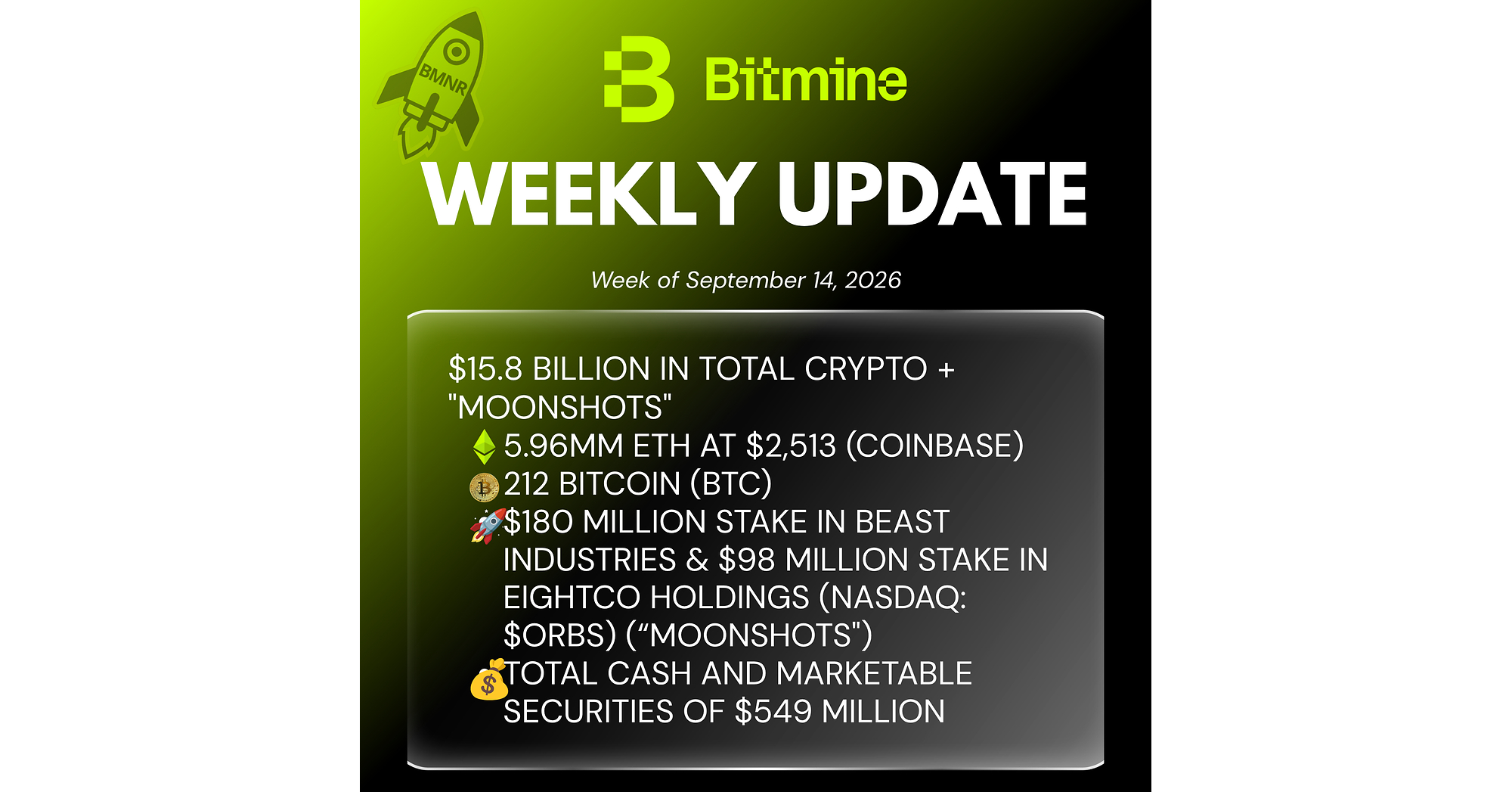
Bitmine reported a $15.8B portfolio as of September 13, including 5.96M ETH valued at $14.97B, equal to 4.9% of Ethereum's total supply, after purchasing 27,180 ETH during the prior week. The company has staked 5.07M ETH, or 85% of holdings, and estimates current annualized staking revenue of $334M at a 2.62% annualized seven-day yield, rising to $392M if fully staked. Management expects ETH strength to continue, citing ETH's Q3 outperformance versus the S&P 500 by 5,866bps, prospective CLARITY Act legislation, institutional adoption, Wall Street tokenization and agentic-AI blockchain use.
Analysis
BMNR has evolved into a highly levered, quasi-closed-end ETH vehicle: its equity sensitivity is not just to spot ETH, but to the premium/discount investors assign to a concentrated, externally financed treasury strategy. The staking yield can support operating costs, but it does not offset a material ETH drawdown; a 20% decline in ETH would erase several years of the indicated staking income on the treasury mark. The more consequential near-term issue is whether continued accumulation requires dilutive equity issuance, especially if BMNR’s trading premium to NAV compresses.
The concentration creates a non-obvious Ethereum market-structure risk. A single holder controlling nearly 5% of supply, with most assets staked, reduces apparent liquid float and can amplify upside during persistent buying; conversely, validator exits or a financing-driven sale would create a disproportionately visible supply event. This is modestly constructive for ETH over the next 1-3 months if institutional allocations broaden, but it raises BMNR-specific governance, custody, slashing, and liquidity risk over 6-18 months. Coinbase (COIN) benefits from higher ETH turnover and institutional custody demand, while MSTR is a cleaner relative hedge against a broad digital-asset treasury de-rating because its BTC exposure has deeper spot and derivative liquidity.
Consensus is likely over-crediting the projected staking revenue as recurring infrastructure earnings. At current scale, the equity remains principally a marked-to-market ETH position; validator revenue should be valued closer to volatile token-denominated carry than software-like cash flow until third-party MAVAN assets, fees, retention, and unit economics are disclosed. Regulatory progress is a catalyst for the sector multiple, but a favorable legislative headline alone does not validate the asserted tokenization or agentic-AI demand path.
Near term, the legislative vote and September conference can sustain retail/institutional attention, but these are event catalysts rather than earnings catalysts. Falsify the constructive ETH/BMNR view if ETH/BTC reverses below its recent breakout range, BMNR begins trading at or below transparent NAV, or quarterly disclosures show material dilution, lower staking yield, or no measurable third-party staking adoption.
AllMind Terminal
AI-powered research, real-time alerts, and portfolio analytics for institutional investors.
Request TrialMarket Sentiment
Overall Sentiment
moderately positive
Sentiment Score
0.62
Ticker Sentiment
Key Decisions for Investors
- Do not chase BMNR outright after a press-release-driven move; establish only on a discount-to-transparent-NAV entry, using BTC/ETH holdings, cash, and publicly marked investments less debt and preferred claims. Target a 15-25% NAV discount; exit if the discount widens beyond 35% or equity issuance accelerates.
- For a 1-3 month ETH-relative-upside view, prefer long ETH exposure or ETH-linked liquid instruments paired with short MSTR in equal crypto-beta terms. The trade isolates ETH/BTC strength while avoiding BMNR’s financing and valuation-premium risk; stop if ETH/BTC loses the post-breakout low.
- For BMNR-specific exposure, use a small long BMNR / short ETH hedge only after confirming the stock trades at a meaningful NAV discount and that new share issuance is paused. This captures potential discount closure and staking carry while reducing spot-ETH beta; reassess at the next 10-Q for share count, debt/preferred terms, and independently auditable staking revenue.
- Treat ORBS as an event-driven watch item, not a fundamental read-through on AI. Require disclosed ownership terms, liquidity restrictions, and independently verifiable valuation of its indirect AI exposure before taking a position; absent disclosure, any spike should be considered a candidate tactical short rather than a core long.
- Add COIN only if ETH volumes, custody assets, and institutional transaction revenue show acceleration in the next monthly/quarterly disclosures. COIN is the higher-quality expression of a sustained activity cycle; the thesis fails if ETH appreciation occurs without corresponding volume and custody growth.
More News
- US Senate crypto bill collapses in blow to industry
- Wall St futures slip as rising oil, Treasury yields compound AI anxiety
- Crypto stocks fall as Senate blocks landmark digital asset bill
- Strategy (MSTR) stock falls 5% as Clarity Act stalls
- AI coding agent startup Factory triples valuation to $5 billion in latest funding round
- Factory raises $200 million, valuation triples to $5 billion