
AnonRouter Takes on OpenRouter With a Private, Open-Source Alternative That Can't See Your Prompts
Source: PR Newswire
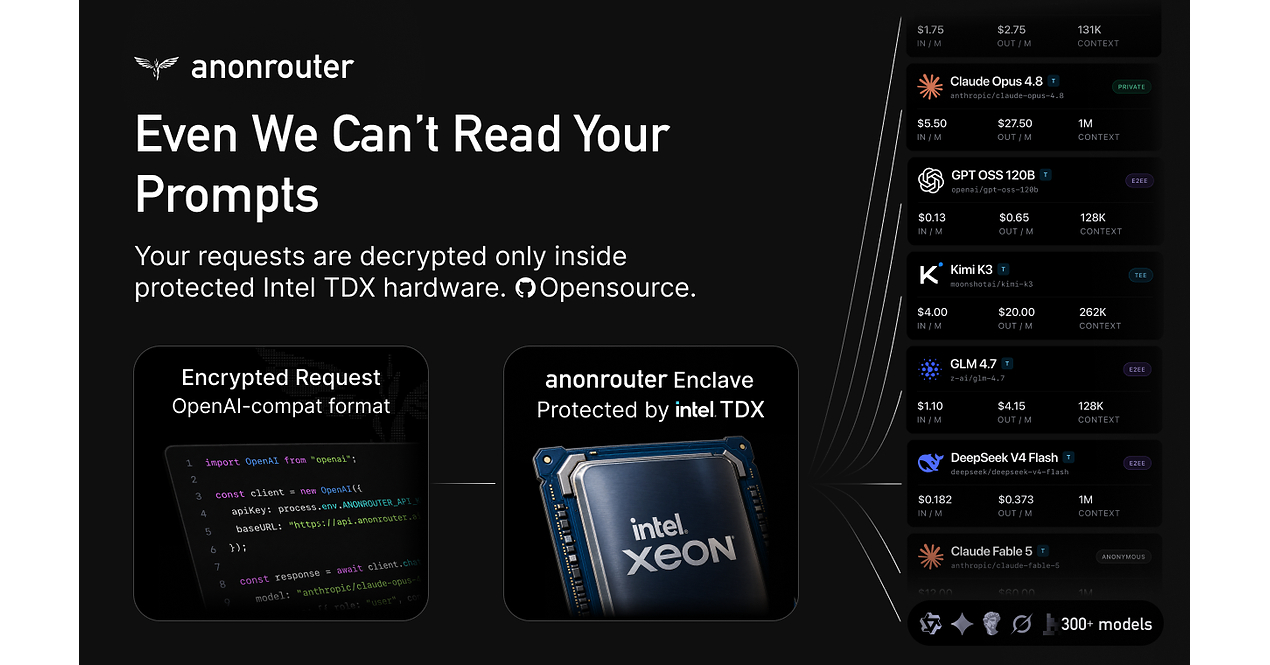
AnonRouter launched an AI routing service offering access to more than 300 models through one API, with the company saying protected hardware, open-source code and hardware attestation keep prompts private even from AnonRouter. The service supports several AI functions and offers four privacy levels; users can switch an existing application with one configuration change. Its launch comes after Stripe agreed to acquire OpenRouter, drawing attention to companies that route requests between AI applications and model providers.
Analysis
The strategic prize is control of the routing layer, not privacy branding by itself. Verifiable isolation could reduce enterprise objections to sending sensitive workloads through an intermediary and make model choice more interchangeable, weakening any router whose differentiation rests on a proprietary interface or routing data. But privacy is only as strong as the weakest boundary: the model provider still processes the request, and attestation does not establish provider retention practices, prevent endpoint leakage, or eliminate implementation and hardware vulnerabilities. The launch therefore supports a category thesis, not yet a company-level earnings thesis.
Near term (days), the announcement is unlikely to change public-company cash flows: AnonRouter has no supplied public-market identity, and there is no disclosed usage, pricing, or customer evidence. Over 1–3 months, watch for independently reproducible security audits, enterprise deployments, latency/reliability comparisons, and evidence developers actually migrate. Over 6–18 months, confidential-computing infrastructure and cloud security capabilities could gain strategic value if privacy becomes a procurement requirement; conversely, model providers or larger gateways could bundle comparable controls and compress standalone router economics. The contrarian risk is that buyers ultimately prioritize uptime, model quality, and cost over prompt confidentiality, while the strongest privacy claim cannot cover the downstream provider.
AllMind Terminal
AI-powered research, real-time alerts, and portfolio analytics for institutional investors.
Request TrialMarket Sentiment
Overall Sentiment
mildly positive
Sentiment Score
0.20
Key Decisions for Investors
- No direct position on this launch: the issuer is not publicly mapped and the release supplies no adoption, revenue, or unit-economics data. Treat it as a watch item for the AI routing/security theme, not a validated investable catalyst.
- Over the next 1–3 months, verify independent code and attestation review, named customer deployments, service performance, and whether providers retain or train on routed inputs. Upgrade the thesis only if evidence shows repeat usage and enterprise willingness to pay; a security audit alone is not commercial validation.
- Monitor public cloud and cybersecurity names for evidence that confidential-computing controls are becoming a differentiated product or procurement requirement; do not buy a broad proxy solely on this announcement. A stronger signal would be disclosed customer adoption or product revenue contribution, while weak uptake or bundled competing controls would argue against the theme.
- Falsifiers: a material attestation or isolation failure, poor latency or availability versus ordinary routers, enterprise rejection because downstream model providers remain in the data path, or rapid bundling of equivalent controls by larger platforms. Any of these would undermine the proposed routing-layer advantage.
More News
- US stock market hits all-time high as investors bet big on AI
- Singapore's Temasek warns of the ‘biggest risk’ facing markets right now
- A 32% beat, a +6% jump: the IT solutions name our models picked in July
- Paramount's hard-fought takeover of Warner Bros. Discovery closes Tuesday. Here's how we got here
- Nvidia Is on the Verge of a $6 Trillion Market Value
- Controversial $110 billion mega-merger of Paramount and Warner Bros. finally closes