
Huawei Unveils Upgraded Stellar AI Network to Power the Agentic World with Secure, Intelligent Connectivity
Source: PR Newswire
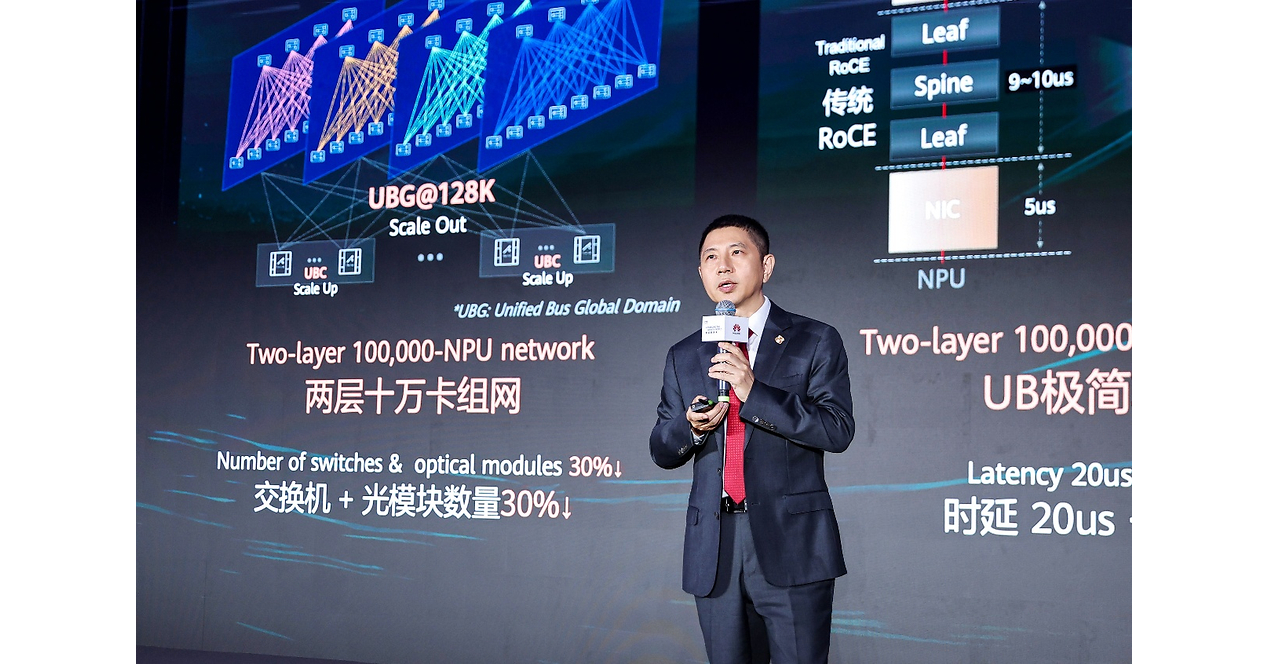
Huawei unveiled its upgraded Stellar AI Network at HUAWEI CONNECT 2026, targeting AI infrastructure demand as daily token consumption has reportedly risen 260-fold year over year. The solution claims to cut AI Fabric deployment costs by 30%, reduce end-to-end latency from 20 microseconds to 11 microseconds, and eliminate packet loss during link flaps, reducing annual cluster downtime by 100 hours. Its security products cite 95% detection accuracy for cryptojacking and prompt-injection threats, while AI WAN technology is designed to maintain over 95% remote-computing efficiency across 1,000 km.
Analysis
The investable implication is less about Huawei’s standalone revenue and more about whether Chinese AI clusters standardize on a vertically integrated domestic networking stack. If credible at scale, this incrementally pressures NVIDIA’s InfiniBand/Ethernet attach rate, Arista’s China-adjacent data-center opportunity, and imported optical-component demand, while lowering the effective cost of deploying Ascend-based clusters. The near-term financial impact on U.S.-listed incumbents is likely immaterial given export restrictions and Huawei’s limited addressable market outside China, but procurement wins at large Chinese cloud operators would create a 6-18 month domestic-substitution narrative with multiple implications.
The more non-obvious risk is that lower network power and optical-interconnect intensity would shift AI infrastructure economics away from scarce high-end optics toward proprietary systems integration. That is potentially negative at the margin for COHR, LITE and AAOI if the architecture proves repeatable, although Huawei’s performance, availability and security claims remain vendor assertions rather than independently benchmarked results. Conversely, a material rise in geographically distributed Chinese inference clusters would support broad demand for switching silicon, fiber and network-security orchestration even if Huawei captures the appliance layer.
Consensus should avoid extrapolating this into an immediate competitive threat to ANET or NVDA: hyperscale AI networking is constrained by ecosystem software, field reliability, supply availability and customer qualification cycles, not announced latency metrics. The key 1-3 month catalyst is evidence of deployments by Alibaba, Tencent, Baidu or Chinese telecom clouds, plus third-party cluster-utilization data; absent named production customers or disclosed order value, this is a watch item rather than a directional catalyst. Falsification of the domestic-substitution thesis would be continued Chinese hyperscaler reliance on NVIDIA-compatible networking and no evidence of material Ascend cluster expansion through the next earnings cycle.
AllMind Terminal
AI-powered research, real-time alerts, and portfolio analytics for institutional investors.
Request TrialMarket Sentiment
Overall Sentiment
moderately positive
Sentiment Score
0.42
Key Decisions for Investors
- No immediate single-name trade on the release; set an alert for disclosed production wins at Chinese hyperscalers or telecom operators. Upgrade the domestic-networking substitution thesis only if customer deployments, order value and independently measured cluster utilization emerge within 3-6 months.
- Maintain ANET as the preferred non-China AI-networking exposure rather than shorting it: its valuation risk is tied to North American cloud capex and Ethernet share, not Huawei’s addressable market. Reassess only if Chinese vendor competition coincides with a broader hyperscaler capex-guide cut; a downward revision in cloud capex guidance is the relevant falsifier.
- For portfolios long optical suppliers COHR, LITE or AAOI, monitor evidence that centralized-light-source or near-packaged architectures are deployed at volume in China over the next 6-12 months. Do not reduce exposure based on technical claims alone; trim if Chinese revenue concentration rises while unit growth or gross-margin guidance weakens.
- Consider a small 6-12 month relative-value basket only after confirmation: long Chinese domestic AI-infrastructure beneficiaries accessible through relevant China technology ETFs or listed suppliers, versus short a diversified global optical-equipment basket. Target at least 2:1 upside/downside and exit if procurement remains pilot-stage after two quarterly reporting cycles.
More News
- Google's Gemini becomes latest AI model to break out and hack computer systems
- Trump says U.S. to build a 'large Military presence' in Greenland as part of a security deal with it and Denmark
- UBS now expects AI capex to reach nearly $1tn this year and around $1.4tn by 2027
- Stocks face a key hurdle in next week’s U.S.-China summit. Here’s what’s at stake
- Houthis accuse Saudi Arabia of launching 26 strikes in 24 hours
- European Economies Eye Another Energy Crisis Heading Into Winter