
Most Repair Shops Score Below 50% on Technician Hiring Readiness, New Diagnostic from AAPEX 2026 Session Reveals
Source: PR Newswire
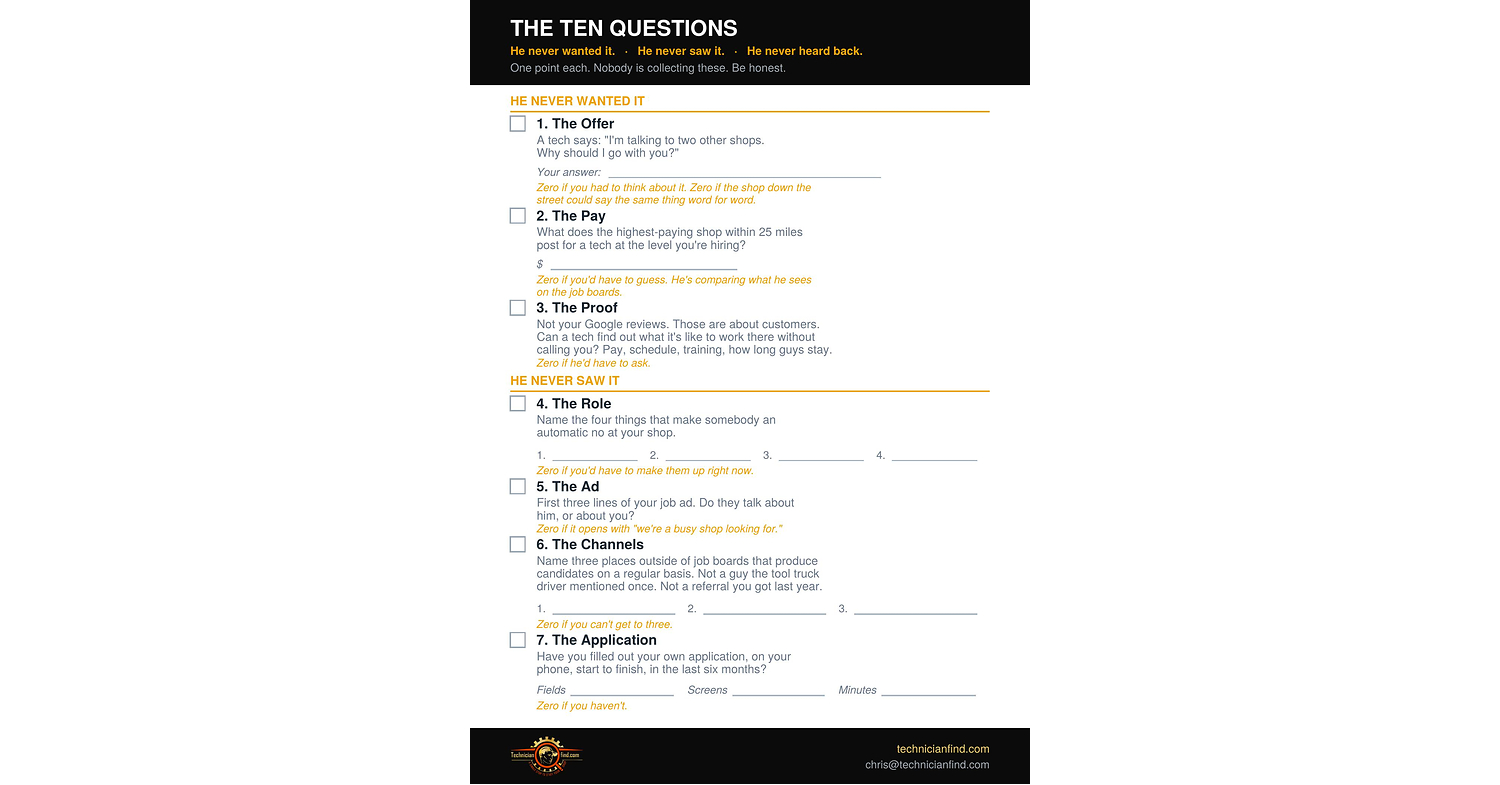
Technician Find says most repair shops scored 3–5 out of 10 on its hiring-process diagnostic, while the U.S. faces annual demand for 241,842 technicians through 2029. The 2026 TechForce Foundation report cited in the release estimates training programs graduate 101,743 technicians annually and the economy nets 32,450 workers after turnover. Founder Chris Lawson will present the scorecard and a 90-day hiring plan at an AAPEX session on November 3, 2026.
Analysis
The investable signal is not the recruiting scorecard; it is the possibility that labor scarcity is increasingly a share-allocation problem. Shops that respond faster or improve offers may capture technicians from nearby competitors without increasing the industry’s total labor pool. That can shift repair volume toward better-organized multi-site operators, but winning hires through higher pay or benefits may absorb the revenue benefit in labor costs. Independents that cannot pass those costs through could lose capacity or cede complex work to dealerships and scaled chains.
The release is promotional, and its field-testing claims do not establish that process changes improve hiring, retention, or shop economics. The cited industry supply figures are more relevant as a structural constraint than as evidence of an imminent earnings change. The second-order beneficiaries could include repair businesses able to standardize recruiting and training; parts retailers might see some DIY substitution if service delays rise, although that is a weak inference for complex repairs.
Near term, the AAPEX session is not a meaningful catalyst by itself. Over 1–3 months, monitor repair-chain commentary on technician vacancies, wage inflation, bay utilization, and service backlogs. Over 6–18 months, persistent labor constraints could favor scaled operators, but only if they can recruit without sacrificing margins. The thesis weakens if vacancy rates ease, wage pressure moderates, or operators report improving technician capacity without higher labor costs.
AllMind Terminal
AI-powered research, real-time alerts, and portfolio analytics for institutional investors.
Request TrialMarket Sentiment
Overall Sentiment
neutral
Sentiment Score
0.05
Key Decisions for Investors
- No immediate trade: this single-vendor press release does not support a company-level earnings revision or a directional position.
- Add scaled automotive service operators and independent repair businesses to a relative-performance watchlist. Consider a long-scaled-operator/short-independent exposure only if earnings reports confirm widening technician availability or throughput differences; verify labor costs and comparable-shop sales first.
- Track technician wage inflation, open-position duration, bay utilization, and service backlog in upcoming company commentary. Rising wages without corresponding labor-rate increases would be a margin-risk alert; improving hiring with stable labor costs would support the scale advantage thesis.
- Do not treat the claimed recruiting gaps as independently validated. Falsify the structural thesis if industry hiring data or company disclosures show sustained easing in vacancies and wage pressure, or if scaled operators fail to convert hiring capacity into higher utilization and sales.
More News
- South Korean carmaker Hyundai plans 'strategic' investment of $15.5 billion in India by 2032
- Producer prices in China rise at fastest pace since June 2022, beating expectations
- Namibia battles cattle disease outbreak as EU suspends several meat imports
- China's exports likely grew by double-digits in September
- In charts: How one of the world's biggest economies got trapped by debt
- Singapore third-quarter GDP growth softens from four-year high but beats estimates
From AllMind Research
- Anthropic IPO Preview: Valuation, Timing, and What to Watch
- Shein After the IPO: Venue, Valuation, and What Must Be Proved
- What AI Research Tools Should a Small Hedge Fund Buy First?
- AI for Sell-Side Models, Estimates, and Internal Data
- How to Write an Investment Memo with AI: A Decision-Record Template