
CATL stellt TECTRANS II auf der IAA Transportation 2026 vor, um die weltweite Elektrifizierung von Nutzfahrzeugen voranzutreiben
Source: PR Newswire
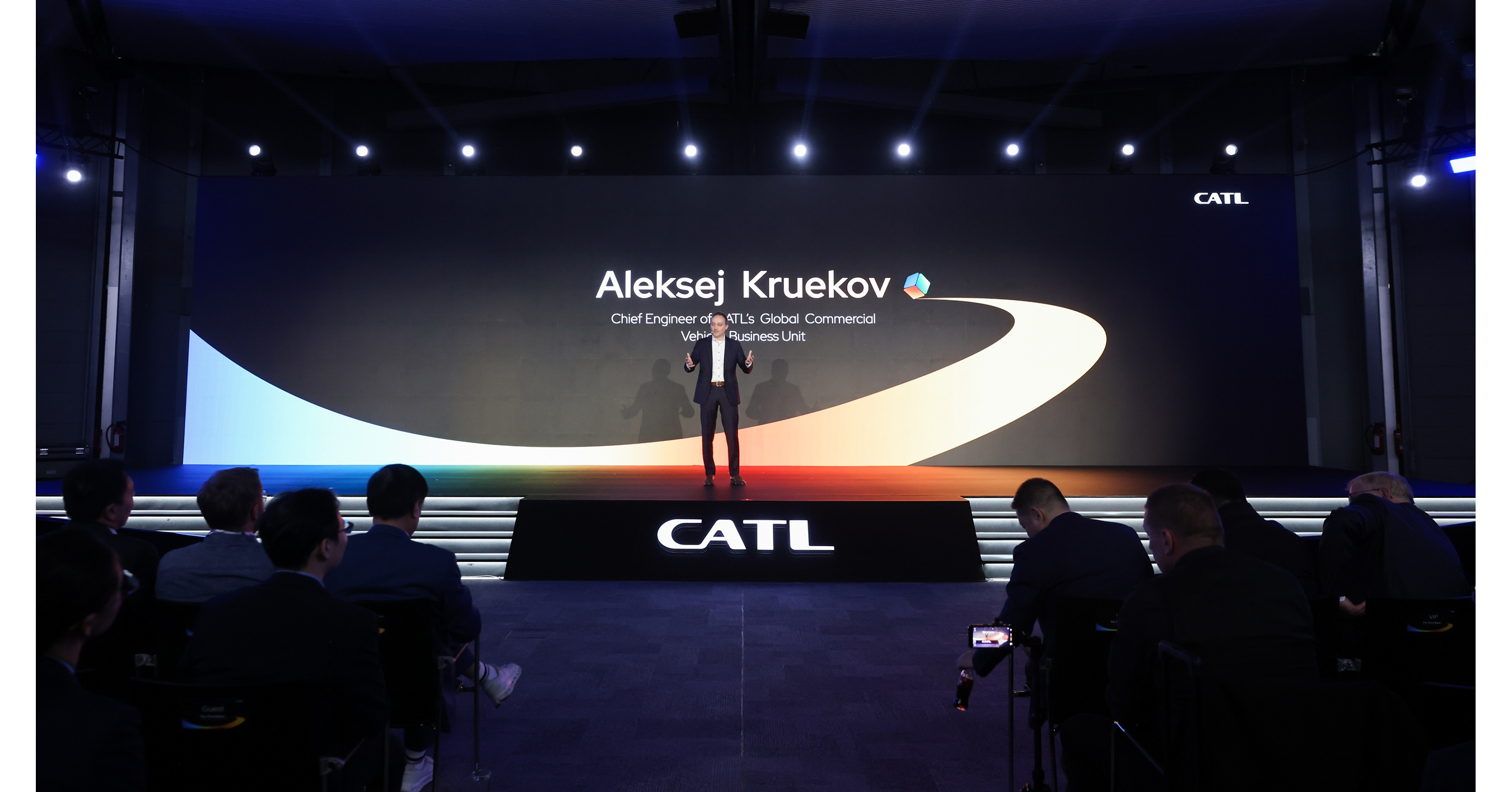
CATL introduced its TECTRANS II modular commercial-vehicle battery platform, offering up to 1,000 km range, 170 Wh/kg energy density, 25-minute charging to 80% via megawatt charging, and a 96% round-trip efficiency. CATL says the platform can cut OEM vehicle-development cycles by 50% and R&D costs by 60%-70%, while its heavy-truck battery is designed for 12 years or 1.5 million km with 70% capacity retention. The company also signed an MoU with DHL Group to develop green freight corridors across Europe and launch purpose-built EV pilot projects with OEM partners.
Analysis
The economic signal is less about near-term DHL earnings than about battery-platform standardization shifting value capture toward CATL (3750 HK) and away from European truck OEMs' proprietary EV engineering. If a common pack/interface meaningfully lowers vehicle-development cost and enables later battery upgrades, Daimler Truck (DTG.DE), Volvo (VOLV-B.ST) and Traton (8TRA.DE) may accelerate model launches but face greater supplier concentration and less differentiation in the powertrain stack. Component suppliers tied to bespoke battery housings, integration and thermal systems face a negative mix shift; charging, depot-energy and fleet-management providers gain only when corridor pilots convert into firm vehicle and infrastructure orders.
DHL Group (DHL.DE) has limited direct revenue sensitivity because the announced framework is not an order commitment; its upside is potentially lower total cost of ownership and higher network utilization on fixed routes, which would emerge over 12-36 months rather than in the next quarter. The nearer 1-3 month catalyst is disclosure of named OEMs, vehicle volumes, residual-value guarantees, charging commitments and pilot economics; absent these, the release should not alter consensus estimates. The key contrarian risk is that interoperability makes the technology credible precisely when European scrutiny of Chinese battery supply chains rises: local-content rules, tariffs, cybersecurity requirements or customer reluctance to concentrate procurement could delay adoption and force OEMs toward Northvolt-alternative/local sourcing despite inferior near-term economics.
AllMind Terminal
AI-powered research, real-time alerts, and portfolio analytics for institutional investors.
Request TrialMarket Sentiment
Overall Sentiment
moderately positive
Sentiment Score
0.48
Ticker Sentiment
Key Decisions for Investors
- No standalone directional position in DHL.DE on this announcement. Establish an alert for binding vehicle-volume commitments or disclosed corridor capex; consider a long only if management quantifies route-level cost savings or raises medium-term margin/FCF guidance. Falsifier: pilots remain pre-commercial or require material DHL-funded infrastructure.
- Monitor long CATL (3750 HK) versus short a European truck OEM basket (DTG.DE/8TRA.DE) over 6-12 months, but initiate only after at least one OEM adopts the platform commercially. The thesis is supplier value capture from standardization; stop if European localization rules or OEM sourcing disclosures restrict CATL content.
- Prefer Volvo (VOLV-B.ST) over Daimler Truck (DTG.DE) as a 6-18 month relative-value expression if fleet electrification accelerates: Volvo's broader charging/ecosystem exposure should monetize deployment beyond vehicle sales. Reassess if electric-truck order intake fails to improve or price competition compresses vehicle gross margin.
- Treat European depot-charging and grid-equipment names as a second-order watchlist rather than a trade until route locations and megawatt-charger procurement are identified. The relevant catalyst is signed infrastructure contracts, not vehicle technology specifications.
More News
- China's AI leaders keep quiet despite U.S. 'publicity' on tech risks
- Exclusive-Malaysia talks to rival airlines as it monitors AirAsia’s financial health, sources say
- MBS and Saudi Arabia Face Crisis With Key Oil Pipeline Shut for Weeks
- AWS says it can't restore service to Bahrain, UAE facilities 6 months after Iran strikes
- Chinese investors rush into US stocks as Beijing opens wider path overseas
- Factbox-How AI leaders and world governments react to ’AI doom’ fears
From AllMind Research
- Anthropic IPO Preview: Valuation, Timing, and What to Watch
- Shein After the IPO: Venue, Valuation, and What Must Be Proved
- What AI Research Tools Should a Small Hedge Fund Buy First?
- Can Hedge Funds Use ChatGPT? A Control Framework
- Palantir (PLTR) Q4 2025 Earnings: 70% Revenue Growth, Then an 11% Single-Day Crash