
AI boom risks widening divide between rich and poor nations as major study from Ayre Think Tank reveals $360 billion divide
Source: PR Newswire
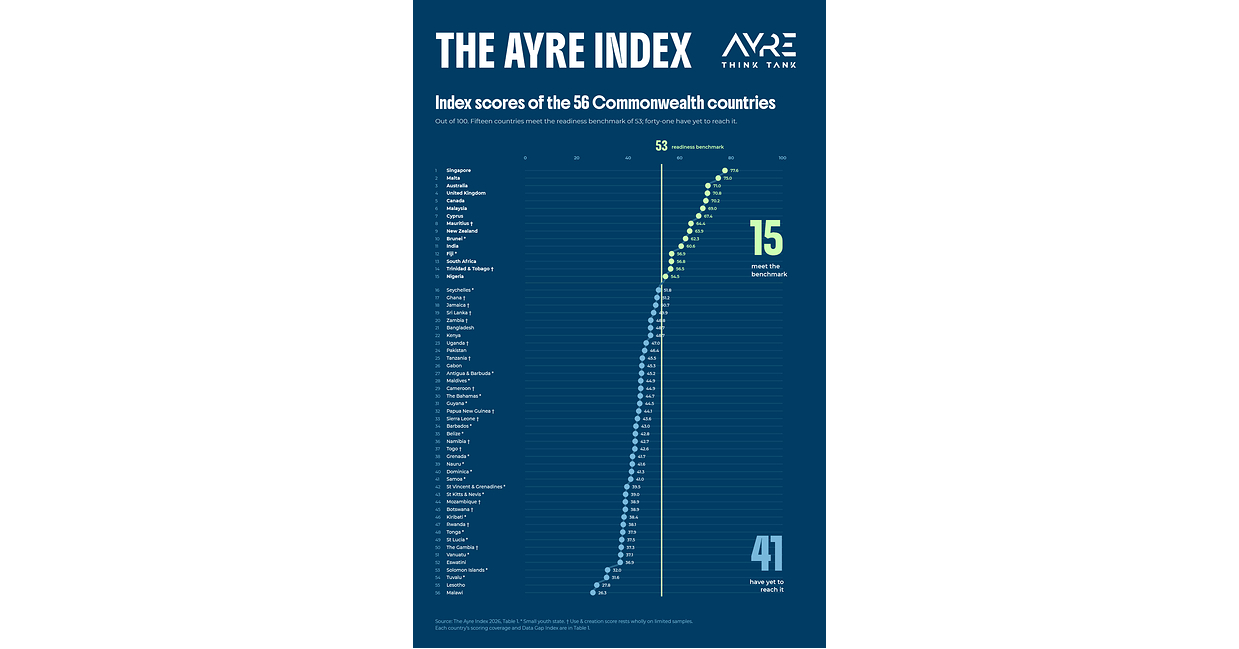
The Ayre Index estimates a $360 billion difference in potential 10-year economic gains between 15 Commonwealth countries meeting its youth AI-readiness benchmark ($389.2 billion combined) and 41 countries that do not ($29.2 billion). It warns that connectivity alone is insufficient: skills, affordable internet and employment opportunities will shape whether AI narrows or widens economic divides. Only three of the Commonwealth’s 21 African members met the benchmark, and South Africa’s youth unemployment was 46.3% despite qualifying.
Analysis
The investment takeaway is a constraint on the speed and breadth of AI monetization, not evidence that the global AI opportunity is smaller. In lower-readiness markets, unreliable power, affordability and skills can keep usage—and therefore paid software demand—well below network-coverage or enthusiasm metrics. That makes near-term revenue assumptions for consumer internet and AI applications in emerging markets especially vulnerable to extrapolation. Connectivity and power providers may benefit over time, but only if investment translates into affordable, reliable service and actual usage; coverage alone is not a sufficient demand signal.
The headline GDP gap is not an equity earnings estimate. It spans a decade, depends on a study scenario, and does not establish which companies capture value. Limited comparable data on AI capability further weakens country rankings as a basis for tactical country allocation. Near term, there is no clear catalyst for repricing listed companies from this study alone. Over 1–3 months, monitor company disclosures for paid-seat adoption, ARPU and capex returns in emerging markets. Over 6–18 months, power reliability, affordability and job-creation pathways will determine whether adoption broadens or value remains concentrated in better-prepared economies. The contrarian risk is treating adoption constraints as permanent: falling compute costs and locally relevant tools could accelerate uptake, but this requires evidence in usage and paid conversion.
AllMind Terminal
AI-powered research, real-time alerts, and portfolio analytics for institutional investors.
Request TrialMarket Sentiment
Overall Sentiment
mixed
Sentiment Score
-0.15
Key Decisions for Investors
- Do not pay an AI-adoption premium for emerging-market exposure based on coverage, survey enthusiasm or GDP scenarios alone. Require evidence of paid usage, retention and improving ARPU before upgrading revenue assumptions.
- For the next 1–3 months, favor AI exposure whose economics are supported by disclosed enterprise demand over consumer-AI growth assumptions in lower-readiness markets; avoid a broad country short based on this index.
- Treat power, affordable connectivity and skills providers as a watchlist rather than an immediate buy: verify utilization, collections and capex returns before underwriting the long-term adoption spillover.
- Falsify the cautious adoption thesis if company filings show sustained paid-seat and ARPU growth across less-ready markets; strengthen it if usage fails to convert to paid customers or providers cut expansion plans. The study supplies no company-level adoption or valuation data, so there is no standalone trade signal.
More News
- Magnificent 7 loses $1 trillion. The most eye-popping stats from Thursday's tech stock plunge
- Tech stocks are suffering their biggest selloff since Covid, as investors see premature end to AI datacenter boom
- Wall Street’s best post-midterm rally in 44 years lasted just one day—then $3 trillion vanished as chip stocks plunged over AI fears
- How Wall Street's postelection rally got obliterated — and what's next
- Elon Musk's Tesla and SpaceX lose over $420 billion in combined market cap after midterms
- AI stocks plunge after election, driving down US markets