
Enterprise AI Bottlenecks Stem From Workload Misalignment, Says Info-Tech Research Group
Source: PR Newswire
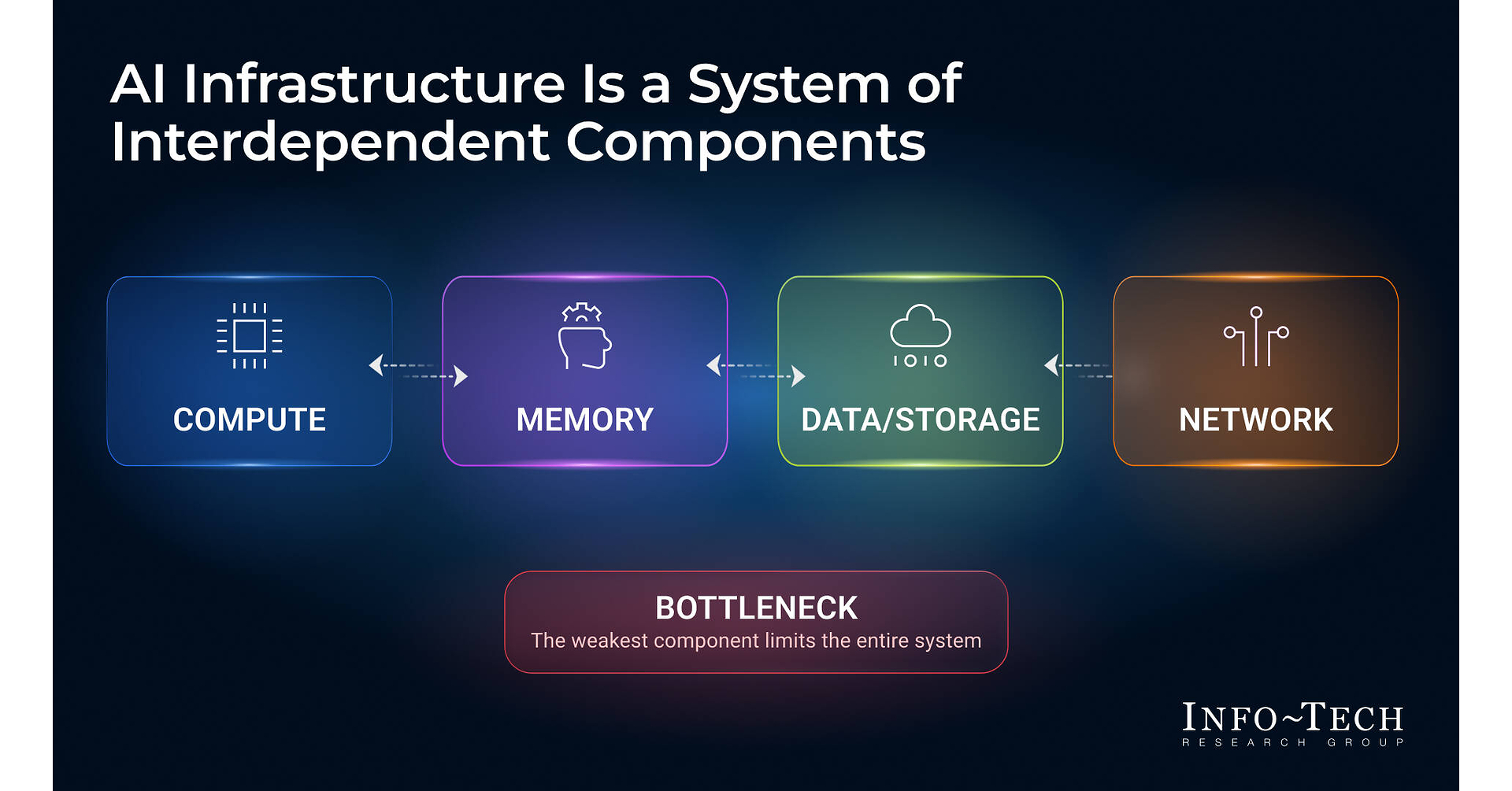
Info-Tech Research Group released its Define Your Target AI Infrastructure blueprint to help organizations align infrastructure architecture and sourcing with AI workload requirements. The framework covers five planning phases and includes an assessment workbook with seven reference architecture patterns, cost analysis, and deployment scenario simulation; the article reports no financial results or market reaction.
Analysis
This is a weak commercial signal, not evidence of a near-term change in enterprise capex: a consulting blueprint does not establish customer adoption, procurement shifts, or measurable infrastructure savings. The investable mechanism is a possible mix change. Workload-level optimization could reduce wasteful accelerator purchases while increasing the value of less visible bottlenecks—high-speed networking, memory, storage, power, and cooling. That creates a potential relative headwind to a simple “more AI means more GPUs” thesis and a relative tailwind to suppliers such as Arista Networks, Broadcom, Vertiv, and Eaton if deployments expose those constraints. The effect is conditional; the release provides no adoption or spending data.
Over 1–3 months, watch enterprise IT budget commentary and vendor disclosures for evidence that projects are shifting from capacity acquisition toward utilization, networking, or facility upgrades. Over 6–18 months, improved cost per unit of AI output could either temper hardware demand or, through lower inference costs, expand usage enough to sustain it. The latter is the key second-order offset. A contrarian read is that workload optimization is not necessarily bearish for infrastructure: removing bottlenecks may unlock deployments previously uneconomic, but the benefit may accrue to a broader systems stack rather than only accelerators. Reassess if customer capex plans weaken alongside utilization gains, or if hyperscaler and enterprise disclosures show continued accelerator-led growth without corresponding bottleneck spending.
AllMind Terminal
AI-powered research, real-time alerts, and portfolio analytics for institutional investors.
Request TrialMarket Sentiment
Overall Sentiment
neutral
Sentiment Score
0.10
Key Decisions for Investors
- No trade on this announcement alone; it is advisory content without disclosed uptake, financial impact, or a company-specific catalyst.
- Set an alert for earnings and budget commentary from enterprise IT buyers and infrastructure vendors: look for utilization improvements alongside changes in spend mix across accelerators, networking, storage, and data-center power/cooling.
- If multiple disclosures confirm bottleneck-led spending, consider a relative-value tilt toward networking and power/cooling suppliers versus a broad, undifferentiated accelerator-infrastructure basket; avoid initiating before confirming order trends and valuation support.
- Falsify the efficiency-led demand-mix thesis if reported AI infrastructure spending remains accelerator-dominated and networking/facility investment does not accelerate; the broader AI buildout thesis weakens if utilization improves but customer capex and deployment plans contract.
More News
- World Bank warns of AI concentration risks as it lifts East Asia and Pacific growth outlook to 4.5%
- Samsung, SK Hynix shares drop as Q3 earnings loom
- DeepSeek set to raise at least $12 bln in Tencent, CATL-led round- Bloomberg
- CH Robinson to Buy RXO for $5.8B in Bet on AI Model
- Security researcher claims to they found KVM guest-host escape flaw
- Brazil Election: Bolsonaro Pushes Lula to Brink as Markets Set to Rally
From AllMind Research
- Anthropic IPO Preview: Valuation, Timing, and What to Watch
- Shein After the IPO: Venue, Valuation, and What Must Be Proved
- What AI Research Tools Should a Small Hedge Fund Buy First?
- How to Evaluate Consensus Estimates Platforms With AI
- Weekly Update: Adding Live MBO Level 3 Data - Liquidity Heatmap, OFI Charts, and More