
A Reliable, High-Performance Alternative to Legacy Autopilots: Upbeat Launches Bluemag Pi with Onboard AI
Source: PR Newswire
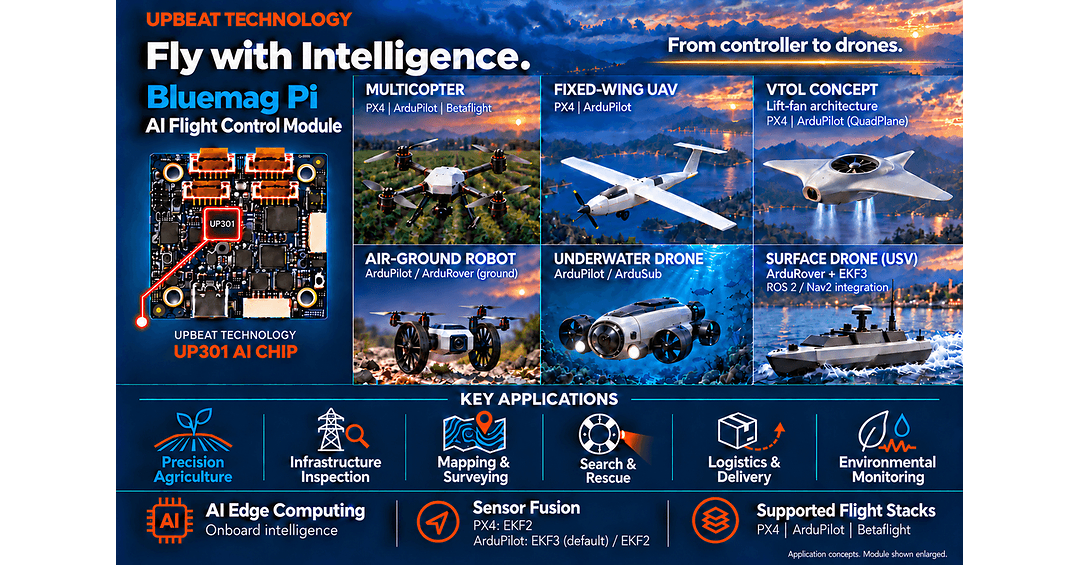
Upbeat Technology launched Bluemag Pi, an AI-enabled flight controller for fixed-wing aircraft, multirotor drones, and unmanned surface vessels, available for purchase now. Its UP301 chip uses separate RISC-V cores for flight-critical control and AI or system tasks, alongside redundant sensors and compatibility with PX4, ArduPilot, and Betaflight. The article cites a global drone market valued at approximately $96.4 billion in 2026 and projected to reach $182.4 billion by 2033, but reports no sales figures or market reaction for Upbeat.
Analysis
The investment signal is product validation, not yet revenue evidence. If onboard inference can replace a separate companion computer without compromising flight-control reliability, OEMs could reduce bill of materials, power draw, and integration work—most relevant in endurance-sensitive platforms. That could pressure standalone companion-compute suppliers at the margin, while creating a differentiation challenge for established flight-controller vendors. But compatibility with PX4/ArduPilot lowers software friction; it does not establish drop-in hardware compatibility or trigger rapid switching from proven designs.
The key technical distinction to verify is whether core separation and redundant sensors translate into measured fault containment and predictable behavior under real workloads. Redundant components alone are not evidence of certification or system-level safety. No pricing, independent benchmarks, customer volumes, or production design wins are disclosed, so market-size estimates should not be translated into an addressable-revenue forecast for Upbeat.
Days: the Oct. 13–16 demonstration may generate visibility, but is unlikely to establish commercial traction. Over 1–3 months, look for named OEM design wins, shipment cadence, pricing, and third-party power/latency/reliability data. Over 6–18 months, successful qualification could shift procurement toward integrated AI flight-control boards; slow certification, thermal/power limits, or incumbent ecosystem advantages could stall adoption. No public-equity exposure is identified in the supplied company mapping, so this is a watch item rather than a trade.
AllMind Terminal
AI-powered research, real-time alerts, and portfolio analytics for institutional investors.
Request TrialMarket Sentiment
Overall Sentiment
mildly positive
Sentiment Score
0.20
Key Decisions for Investors
- Do not trade the launch headline alone; no listed issuer, revenue contribution, or independently verified customer commitment is established in the supplied data.
- Track the CEATEC demonstration for independently verifiable inference latency, power consumption, fault-handling results, and comparisons against a flight controller plus companion computer.
- Treat confirmed production design wins and repeat orders—not developer-board availability or compatibility claims—as the 1–3 month commercial catalyst.
- Falsify the integration thesis if workload testing shows the AI task degrades flight-control timing, or if OEMs continue to require a separate companion computer after qualification.
More News
- Tanker hit by multiple projectiles off north coast of Qatar, UKMTO says
- Asia shares subdued, bonds swamped by AI debt wave
- Elon Musk blames Indian 'oligarchs' for stalling Starlink launch
- Anthropic will be 'most ridiculous IPO' of year, analyst says
- Megacaps Are Back Driving the US Stock Rally in Hot-Running Economy
- Yemeni government forces claim 1,860 Houthis ‘neutralised’