
Parks Associates: 39% of US Internet Households Watch Live Events or Sports Through On-Demand Streaming Services
Source: PR Newswire
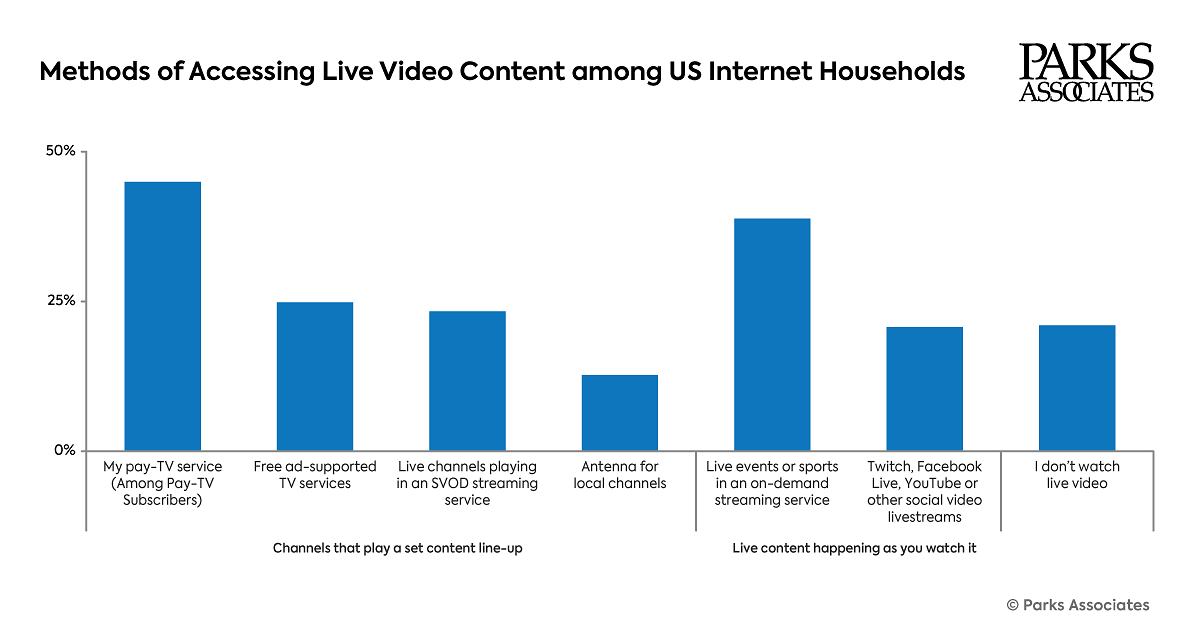
Parks Associates found 39% of US internet households watch live events or sports through an on-demand streaming service, while 25% use FAST services and 21% report not watching live video. Separately, 45% of pay-TV subscribers use pay TV to access live video, and 48% of respondents watch live sports. The research describes a widening mix of ways to access live programming and competition among providers to make content easier to find and access.
Analysis
This is evidence of a distribution and discovery problem, not proof that live programming is becoming more profitable. The survey’s usage measures have different denominators and do not establish viewing frequency, willingness to pay, ad yield, or subscriber conversion. Treating them as market-share data would overstate the signal.
The second-order risk for Comcast and Charter is that live content may no longer be sufficient to defend traditional bundles if customers can find it elsewhere; however, fragmented rights can also make a consolidated bundle more valuable. For Netflix, Amazon, Disney, and other streaming platforms, sports and news can support engagement, but bidding up rights without improving retention or ad monetization could dilute returns. FAST operators such as Tubi and Roku’s channel offering may gain viewing and ad inventory, though audience reach alone does not establish pricing power.
The contrarian point: easier discovery could reduce friction, but fragmented access may increase consumer frustration and churn rather than expand total paid demand. The study does not quantify either outcome. ADEA and IDCC are identified as event sponsors, not as demonstrated beneficiaries; this release provides no basis to revise either company’s earnings outlook.
Near term, there is no clear catalyst or trade from the survey alone. Over 1–3 months, monitor platform and distributor commentary on sports-rights costs, churn, ad monetization, and discovery tools. Over 6–18 months, the key question is whether aggregation and navigation improve economics enough to offset rights costs. The thesis weakens if streaming platforms report better retention and ad yields without rising content-cost pressure; it also weakens for pay-TV bears if bundle churn stabilizes and distributors retain attractive sports packages.
AllMind Terminal
AI-powered research, real-time alerts, and portfolio analytics for institutional investors.
Request TrialMarket Sentiment
Overall Sentiment
neutral
Sentiment Score
0.00
Key Decisions for Investors
- No directional position on this survey alone: self-reported viewing does not establish incremental revenue, margins, or subscriber growth.
- Watch earnings commentary from Comcast, Charter, Netflix, Amazon, Disney, Roku, and Fox for measurable changes in sports-rights expense, churn/retention, ad load and yield, and live-content engagement. Treat positive usage claims without monetization evidence as non-confirmatory.
- Consider a relative-value screen—not an immediate trade—between distributors exposed to bundle erosion (Comcast or Charter) and streaming/FAST platforms (Netflix, Roku, Fox). Enter only if subsequent results show a durable divergence in churn or content-cost economics; invalidate on stabilizing pay-TV churn or worsening streaming rights-cost commentary.
- Do not infer a catalyst for ADEA or IDCC from their sponsorship of the conference. Reassess only if company disclosures independently connect their products or licensing revenue to live-streaming demand.
More News
- Meta put out an ambitious roadmap to Muse monetization after strong quarter and guide
- New Mexico took on Meta alone and won a $25 billion judgment over Facebook’s privacy violations
- Critical web security flaws spark global alarm as Google, OpenAI and Amazon respond
- Futures orbit around SpaceX as Tesla merger talk cheers investors
- Elon Musk Thinks $3.5 Trillion Tesla-SpaceX Mashup Is a Good Idea
- World leaders warn against security flaw found in PHP computer programming
From AllMind Research
- Anthropic IPO Preview: Valuation, Timing, and What to Watch
- Shein After the IPO: Venue, Valuation, and What Must Be Proved
- What AI Research Tools Should a Small Hedge Fund Buy First?
- How to Evaluate AI Report Writers for Financial Analysis
- Weekly Update: Sector Analysis, Improvements on Research Data, and Performance Enhancements